Inside a Cell
A town needs walls with gates, a library of plans, power stations and factories. A single cell, far too small to see, has parts that do all of these jobs. What is inside one, and what does each part do?
Myth or fact? A cell is just a tiny bag of liquid.
The edge: the cell membrane
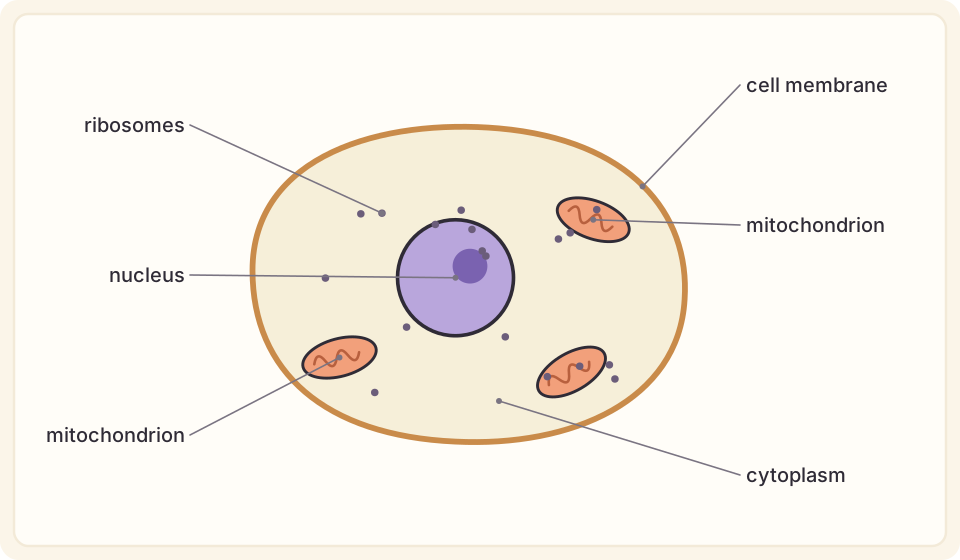
Every cell is wrapped in a thin, soft skin called the cell membrane. It keeps the inside of the cell in and the outside out, but it is not a solid wall: it lets water, oxygen and food in, and waste out, and it controls what else may pass.1
The inside: cytoplasm
Inside the membrane is the cytoplasm: a jelly-like liquid, mostly water, and all the parts floating in it.1 Many of the cell's chemical jobs happen here.
The control centre: the nucleus
Most cells of plants and animals have a nucleus, a round part with its own skin around it. The nucleus holds the cell's DNA: the instructions for building and running the cell, and for making new cells.1 (DNA has a lesson of its own: DNA: The Instructions.)
Show the answer
Myth. A cell is full of parts, each with a job, all packed into a busy jelly. Even the liquid is not plain water: it is full of the chemicals the cell is using and making.
The energy releasers: mitochondria
A cell needs energy for everything it does. The mitochondria (one is a mitochondrion) are small bean-shaped parts that release the energy stored in food, so the rest of the cell can use it. Scientists often call them the cell's "powerhouses".1 Cells that work hard, like muscle cells, have many of them. How they do it is the subject of How Cells Release Energy.
The builders: ribosomes
Ribosomes are tiny grains, the smallest parts on the drawing. They build proteins: the molecules that do most of the work in a cell and build much of it, following the instructions from the nucleus.1
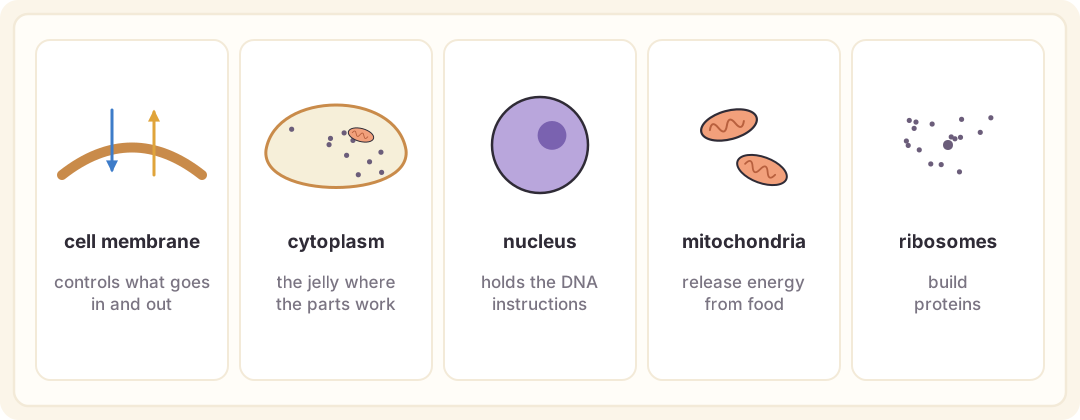
A cell has more parts than these five (biology at later levels meets them), but these are enough to understand how a cell stays alive.
Try it yourself
Make a model cell in a clear plastic food bag: the bag is the membrane, clear jelly or thick hair gel is the cytoplasm, a plum or an apricot is the nucleus, a few beans are mitochondria, and a pinch of sprinkles or sesame seeds are ribosomes. Then try to name each part's job without looking.
Words to know
- cell membrane - the thin skin around a cell that controls what goes in and out
- cytoplasm - the jelly inside a cell, with its parts floating in it
- nucleus - the part of a cell that holds its DNA instructions
- mitochondria - small parts that release energy from food for the cell
- ribosome - a tiny grain in a cell that builds proteins
Big idea
A cell is a tiny busy town, with an edge that guards it, instructions in its nucleus, and parts that release energy and build what it needs.