DNA: The Instructions
A cake recipe is a set of instructions: what to mix, in what order. A living thing needs instructions too, far more of them, for building a body and keeping it working. Where are they kept, and what are they written in?
A twisted ladder
The instructions are kept in a molecule called DNA. In plants and animals, it is found inside the nucleus, the cell's control centre.
DNA looks like a ladder twisted into a spiral. Scientists call this shape a double helix: two long strands wound around each other. The rungs of the ladder are made of chemicals called bases. There are only four kinds, known by their first letters: A (adenine), T (thymine), C (cytosine) and G (guanine).1
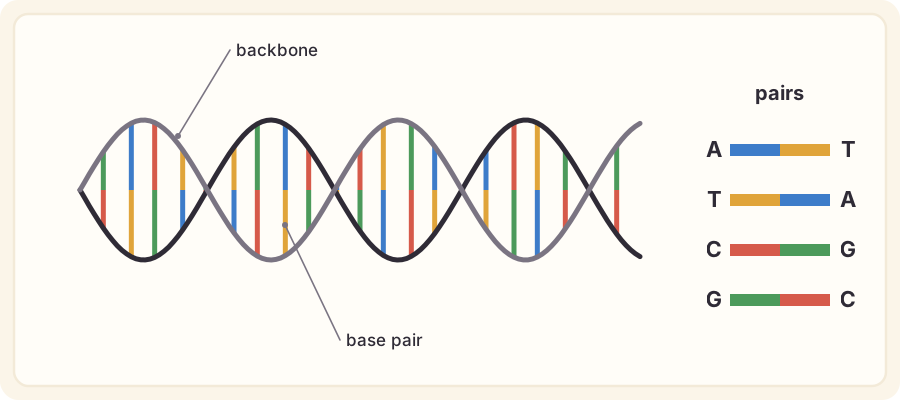
Each rung is two bases joined together, called a base pair. They always pair the same way: A with T, and C with G. So if you know one side of the ladder, you know the other side too. This is what lets a cell make exact copies of its DNA.1
A very long message
The order of the bases along DNA is the message. Just as the letters of the alphabet can spell any word, A, T, C and G, in different orders, spell out the instructions for a mushroom, an oak tree or a person.
One full set of human DNA holds about 3 billion base pairs.2 Written out at one letter a second, it would take you about 95 years just to read one side of it. And almost every cell of your body carries two full sets: one from each parent.3
How the shape was found
In the early 1950s, several scientists raced to find the shape of DNA. At King's College London, Rosalind Franklin and her student Raymond Gosling shone X-rays through DNA fibres. In May 1952, after about 100 hours of exposure, they made a famous picture now called Photo 51. Its X-shaped pattern is the sign of a helix.4
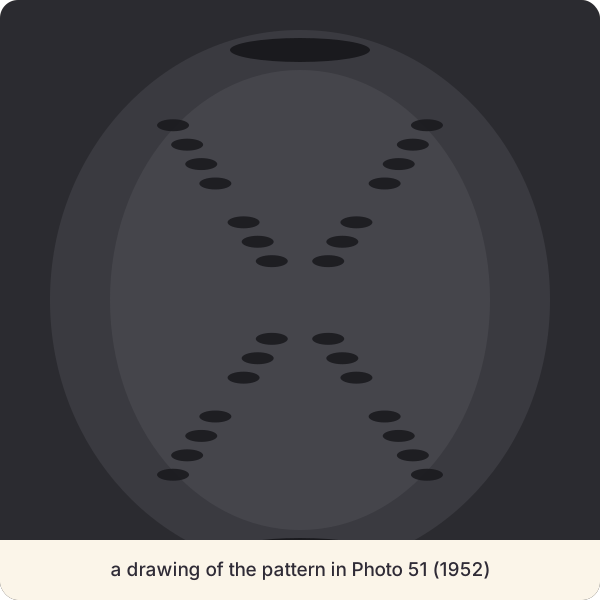
In January 1953, Maurice Wilkins, who also worked at King's, showed Photo 51 to James Watson without Franklin's knowledge. Watson and Francis Crick, in Cambridge, also used an unpublished report containing her measurements. With this evidence they built their model of the double helix, published in April 1953, in the same issue of the journal Nature as a paper by Franklin and Gosling.45
Watson, Crick and Wilkins won the Nobel Prize in 1962. Franklin had died in 1958, at 37, and the prize is not given after death.4
Try it yourself
Write one strand of DNA using any ten letters from A, T, C and G, such as A T T C G A C G T A. Now write the matching strand underneath, using the pairing rule (A with T, C with G). You have just done, by hand, what a cell does every time it copies its DNA.
Words to know
- DNA - the molecule that carries the instructions for building and running a living thing
- double helix - the shape of DNA: two strands twisted around each other like a spiral ladder
- base - one of the four chemical "letters" of DNA: A, T, C and G
- base pair - two bases joined across the ladder: A with T, or C with G
Big idea
DNA is a twisted ladder of four letters, and the order of those letters is the instruction book for life.
Sources
-
National Human Genome Research Institute, Deoxyribonucleic Acid (DNA) (Talking Glossary of Genomic and Genetic Terms). ↩ ↩2
-
National Human Genome Research Institute, Base Pair (Talking Glossary of Genomic and Genetic Terms). ↩
-
MedlinePlus Genetics, US National Library of Medicine, How many chromosomes do people have?. ↩
-
PBS NOVA, Secret of Photo 51 (about the documentary, 2003). ↩ ↩2 ↩3
-
James Watson and Francis Crick, Molecular Structure of Nucleic Acids (Nature, 25 April 1953). ↩