What Is a Cell?
Cut your finger, and a week later the cut has closed with new skin. Where did the new skin come from? From cells: tiny living units that made copies of themselves. You are built from them, and so is every other living thing.
Myth or fact? Your body has about as many cells as there are people on Earth.
The smallest living thing
A cell is the smallest unit of life: the smallest thing that can stay alive on its own, take in food, grow and make more of itself. Parts of a cell can't do that by themselves; a whole cell can.
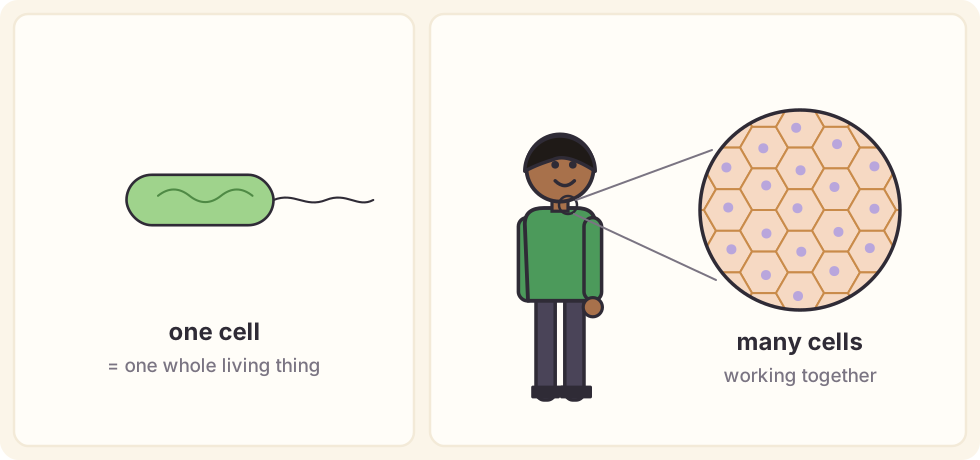
Some living things are just one cell. A bacterium is one cell, and so is the yeast that makes bread rise. Scientists call them unicellular (one-celled). A plant, a cat or a person is made of a huge number of cells working together: multicellular (many-celled).1
How many?
A careful count in 2016 found that a typical adult is made of about 30 trillion cells (30 million million). About 84 out of every 100 of them are red blood cells, the small cells that carry oxygen in your blood.2
Show the answer
Myth. There are about 8 billion people on Earth,3 so your body has thousands of times more cells than there are people. If every person on Earth had their own cell from you, you would still have almost all of yours left over.
How small?
Most cells are measured in micrometres. A micrometre is a thousandth of a millimetre: a thousand of them side by side make one millimetre, the smallest mark on a ruler.
- Bacteria are about 0.1 to 5 micrometres across.4
- Most cells of plants and animals are about 10 to 100 micrometres.4
- A red blood cell is about 8 micrometres.5
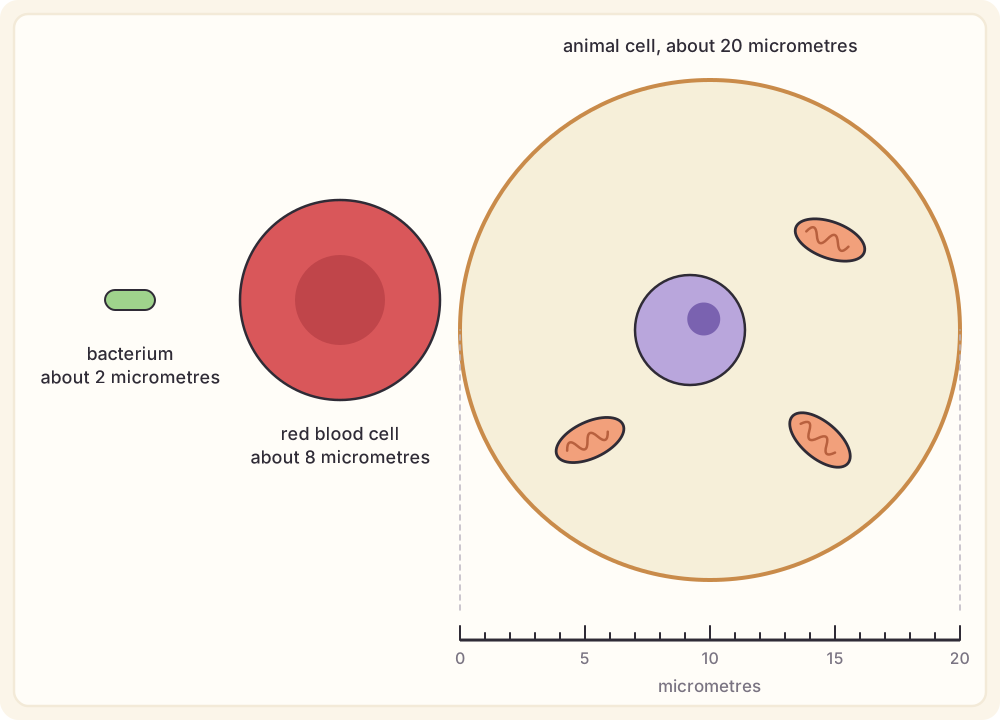
That is why you need a microscope to see them. But not every cell is round and tiny. Some nerve cells reach from the bottom of your back all the way to your toes, about a metre long, yet thinner than a hair.6
Why so small?
Everything a cell needs - food, water, oxygen - has to come in through its outside edge, and its waste has to go out the same way. As a cell grows, its inside grows faster than its outside. A cell that grew very big would have too much inside to feed through too little edge. So instead of growing huge, a cell divides into two smaller cells.4
Try it yourself
Peel the very thin, see-through skin from between the layers of an onion and lay it flat on a glass slide with a drop of water. Under a school microscope you'll see rows of long box-shaped cells, like bricks in a wall.
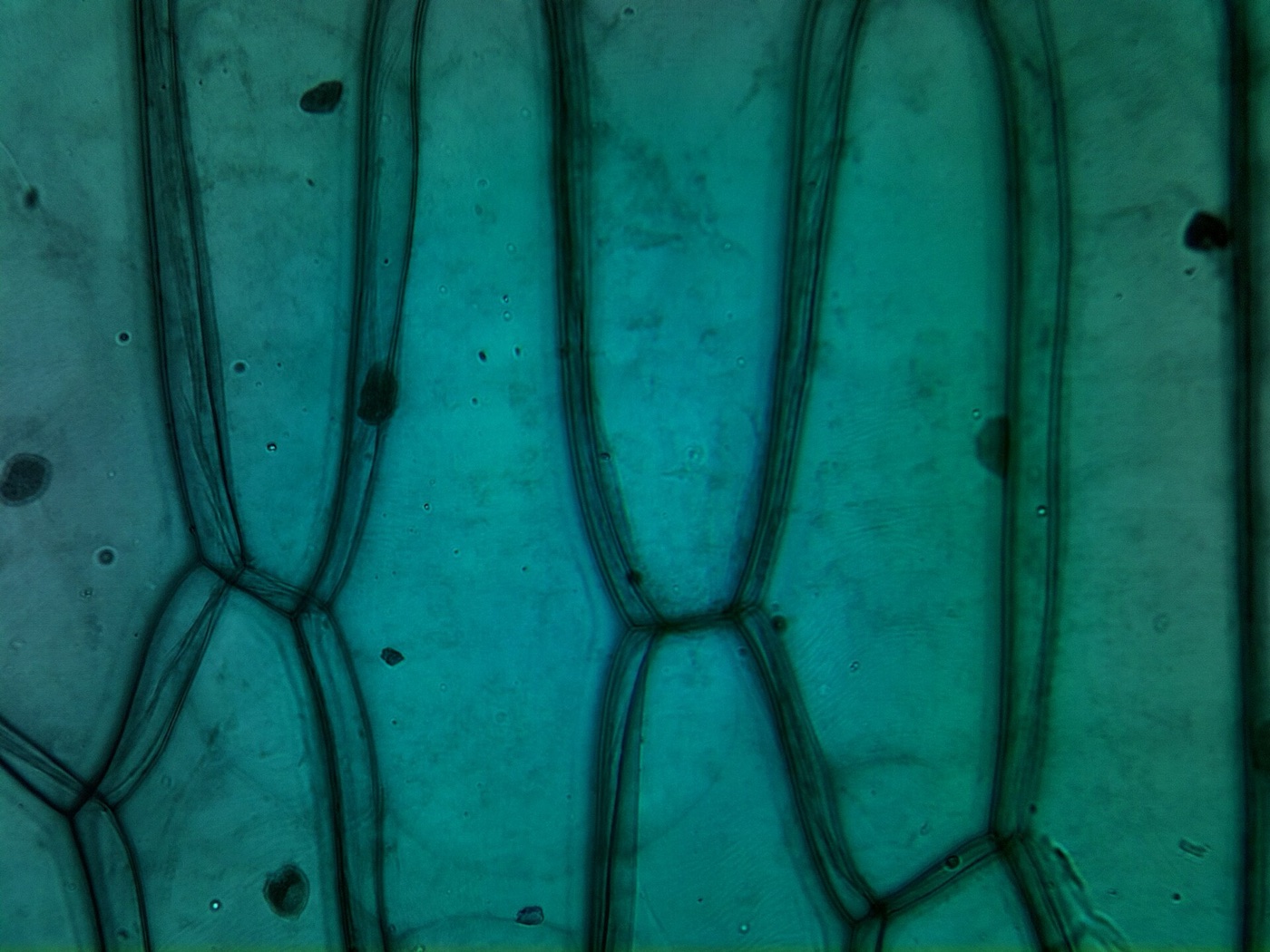
Onion skin cells under a microscope. Photo by loganrickert, CC BY 2.0, via Wikimedia Commons.

Words to know
- cell - the smallest unit of a living thing that is itself alive
- unicellular - made of a single cell, like a bacterium
- multicellular - made of many cells, like a plant or a person
- micrometre - a thousandth of a millimetre
Big idea
Every living thing is made of cells - one or trillions - and each cell is a tiny living thing in its own right.
Sources
-
OpenStax, Anatomy and Physiology 2e, 1.2 Structural Organization of the Human Body (textbook, 2022). ↩
-
Ron Sender, Shai Fuchs and Ron Milo, Revised Estimates for the Number of Human and Bacteria Cells in the Body (PLOS Biology, 2016). ↩
-
United Nations Population Fund (UNFPA), World set to reach 8 billion people on 15 November 2022 (press release, 2022). ↩
-
OpenStax, Biology 2e, 4.2 Prokaryotic Cells (textbook, 2018). ↩ ↩2 ↩3
-
OpenStax, Biology 2e, 4.1 Studying Cells (textbook, 2018). ↩
-
BioNumbers (Harvard Medical School), Length of neuron from base of spine to big toe (database entry). ↩