From Cells to Organisms
A football team is not eleven goalkeepers. Each player has a job, the players form groups - defence, midfield, attack - and the groups together make a team. Your body is organised in a similar way, starting from cells.
Myth or fact? Different kinds of cells in your body - skin, muscle, nerve - carry different DNA instructions.
Cells with special jobs
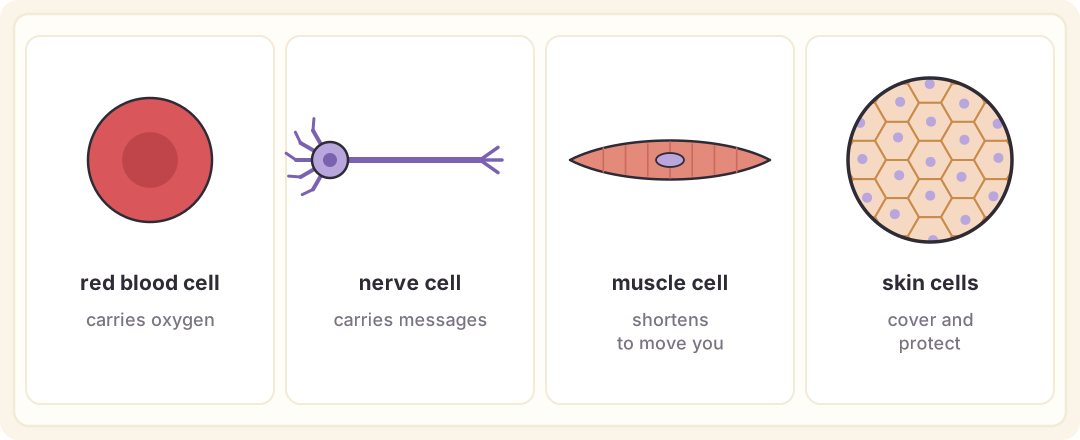
A bacterium has to do everything itself. In a many-celled body, cells share the work: each kind of cell is shaped for one job. These are called specialised cells. Your body has at least 200 different kinds.1
- Red blood cells are small and round, and carry oxygen around the body.
- Nerve cells are long and thin, and carry messages, some of them about a metre from your back to your toes.
- Muscle cells are long and can shorten, which is how you move.
- Skin cells are flat and fit together tightly, like tiles, to cover and protect you.
Show the answer
Myth. Almost every cell in your body carries the same full set of DNA instructions. A skin cell and a nerve cell differ because each uses a different part of the same instructions, like two cooks using different pages of the same recipe book.2
Five levels
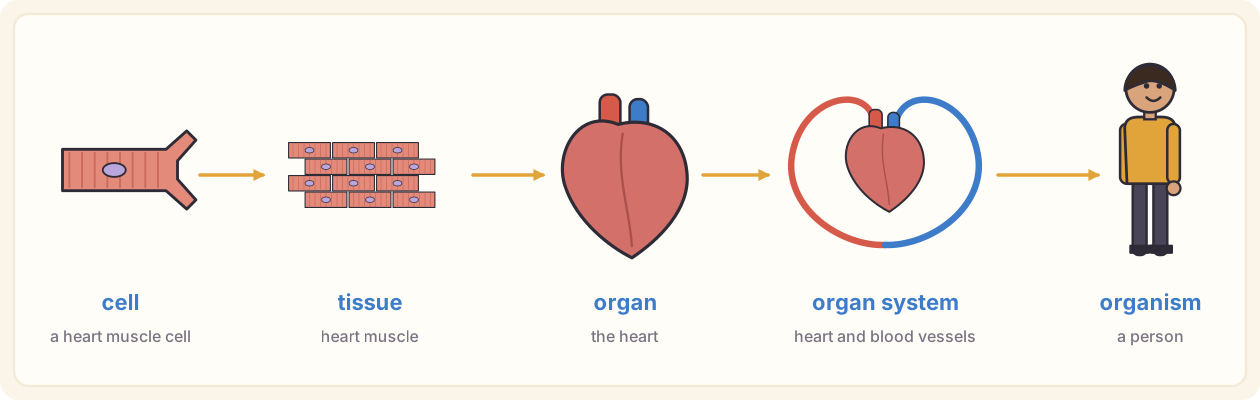
Biologists describe a body in levels, each built from the one before it:3
- Cell - the smallest living unit, such as a heart muscle cell.
- Tissue - a group of many similar cells working together, such as heart muscle.
- Organ - a part of the body made of two or more kinds of tissue, with a job of its own, such as the heart.
- Organ system - a group of organs working together, such as the heart and blood vessels, which carry blood around the body.
- Organism - a whole living thing: you.
Plants have the same levels. Cells that catch light make a tissue, several tissues make a leaf (an organ), and leaves, stems and roots work together to keep the plant alive.
The human body has eleven organ systems,3 and they depend on each other: muscles need oxygen from the lungs, delivered by the blood and the heart, with the brain and nerves telling them when to move. Some of those systems have lessons of their own, starting with Your Body's Systems.
Try it yourself
Pick one part of your body - your hand, say - and walk down the levels: what organ system is it part of, what organs and tissues are in it (skin, muscle, bone), and what kinds of cells make those tissues?
Words to know
- specialised cell - a cell shaped and built for one particular job
- tissue - a group of similar cells working together
- organ - a body part made of several kinds of tissue, with its own job
- organ system - a group of organs working together
- organism - a whole living thing
Big idea
In a many-celled living thing, specialised cells form tissues, tissues form organs, and organs form systems that together keep one organism alive.
Sources
-
OpenStax, Anatomy and Physiology 2e, 4 Introduction: The Tissue Level of Organization (textbook, 2022). ↩
-
OpenStax, Anatomy and Physiology 2e, 3.6 Cellular Differentiation (textbook, 2022). ↩
-
OpenStax, Anatomy and Physiology 2e, 1.2 Structural Organization of the Human Body (textbook, 2022). ↩ ↩2