No Two Alike
Look at a flock of sparrows, a litter of kittens or a class of children. They are all the same kind of living thing, yet no two are exactly alike. One kitten is striped, another is grey; one child is tall, another has curly hair. Where do these differences come from?
Myth or fact? Differences between living things of the same kind are just small accidents that don't matter.
Differences within one kind
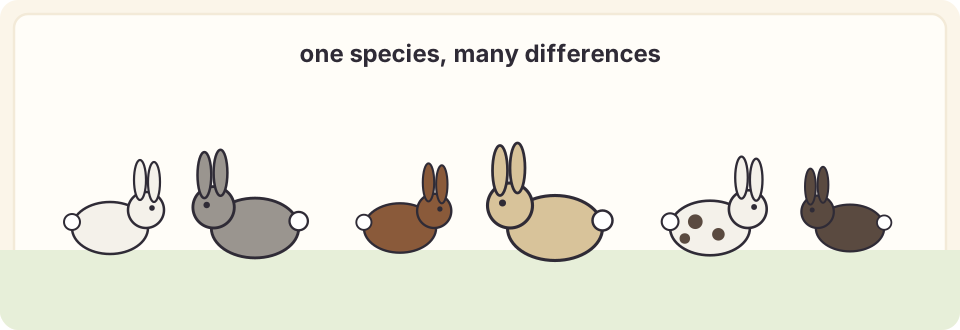
The differences between members of the same species are called variation. A species is a group of living things that can breed together and have young that can breed too. You can see variation in size, colour and shape, but it is also inside the body: in blood groups, in how fast someone runs, in which illnesses a plant can resist.
Genes, surroundings, or both
Biologists talk about two causes of variation. The first is genes, the instructions inside every cell that a living thing gets from its parents. Children look like their parents because they get their genes from them. The second is the environment: everything around a living thing and everything that happens to it, such as food, sunlight, weather and exercise.
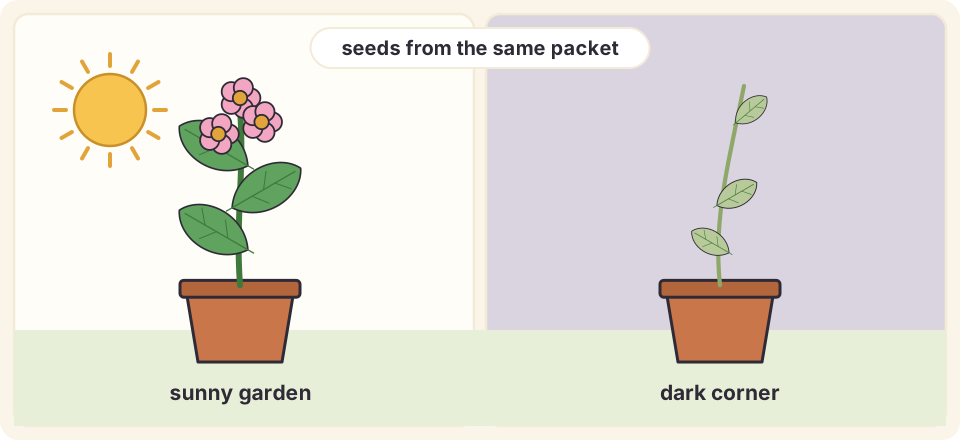
Most traits are shaped by both. The US National Human Genome Research Institute puts it simply: what we can see of a person is decided both by their genes and by their environment, and sometimes the environment matters more.1 Two seeds from the same packet can grow into very different plants if one grows in a sunny garden and the other in a dark corner. Their genes are similar; their surroundings are not.
Where new differences come from
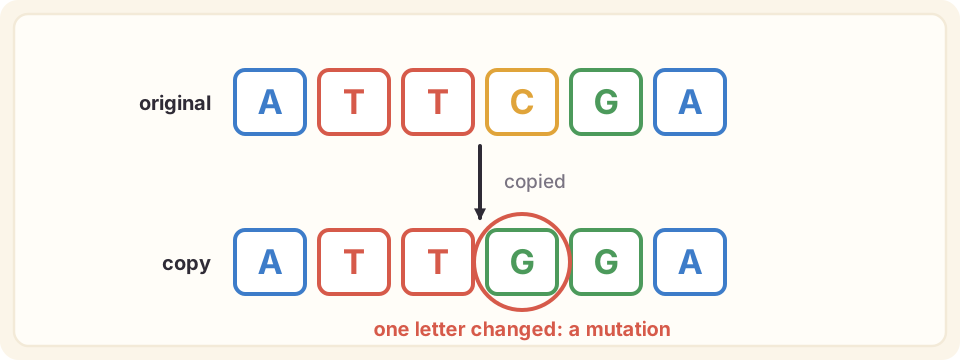
Genes are written in DNA, a long chemical code inside each cell. Every time a cell divides, its DNA is copied. Copying is very good, but not perfect. A change in the DNA code is called a mutation. Mutations can come from copying mistakes when a cell divides, or from damage by things such as some chemicals.2
Most mutations make no difference at all, and cells repair many of them. A mutation in an ordinary body cell stays in that body. But a mutation in an egg or a sperm cell can be passed on to a child, and then it is in every cell of that child.2 Over many generations, mutations add new versions of genes to a species. That is the first source of all the variation we see.
Show the answer
Myth. Variation is what makes evolution possible. If every member of a species were exactly the same, nothing could change from one generation to the next. Some differences help a living thing survive and have young, and those differences become more common over time - the idea of the next lesson, Natural Selection.
Try it yourself
Look at the hands of five people in your family or class. Compare finger length, nails and the lines on the palm. Which differences do you think come from genes, and which from what people do (work, sport, a scar)?
Words to know
- variation - the differences between members of the same species
- gene - one instruction in a living thing's DNA, passed from parents to young
- environment - everything around a living thing that can affect it, such as food, light and weather
- mutation - a change in the DNA code
Big idea
No two living things of one kind are exactly alike; their differences come from genes, from their surroundings, and from mutations that add new versions of genes.