Your Body's Systems
You run for a bus. Your legs push, your heart thumps faster, you breathe hard, and your eyes and brain keep you from tripping over the kerb. Dozens of body parts are working at the same moment, and none of them was told what to do. How does a body organise so much work?
Myth or fact? Each organ in your body does its job on its own.
Teams of organs
Every living body is built from cells, the tiny units of life. Cells of the same kind group into tissues, such as muscle tissue, and two or more kinds of tissue make an organ, such as the heart or the stomach (see levels of organisation). An organ system is a group of organs that work together on one big job.1
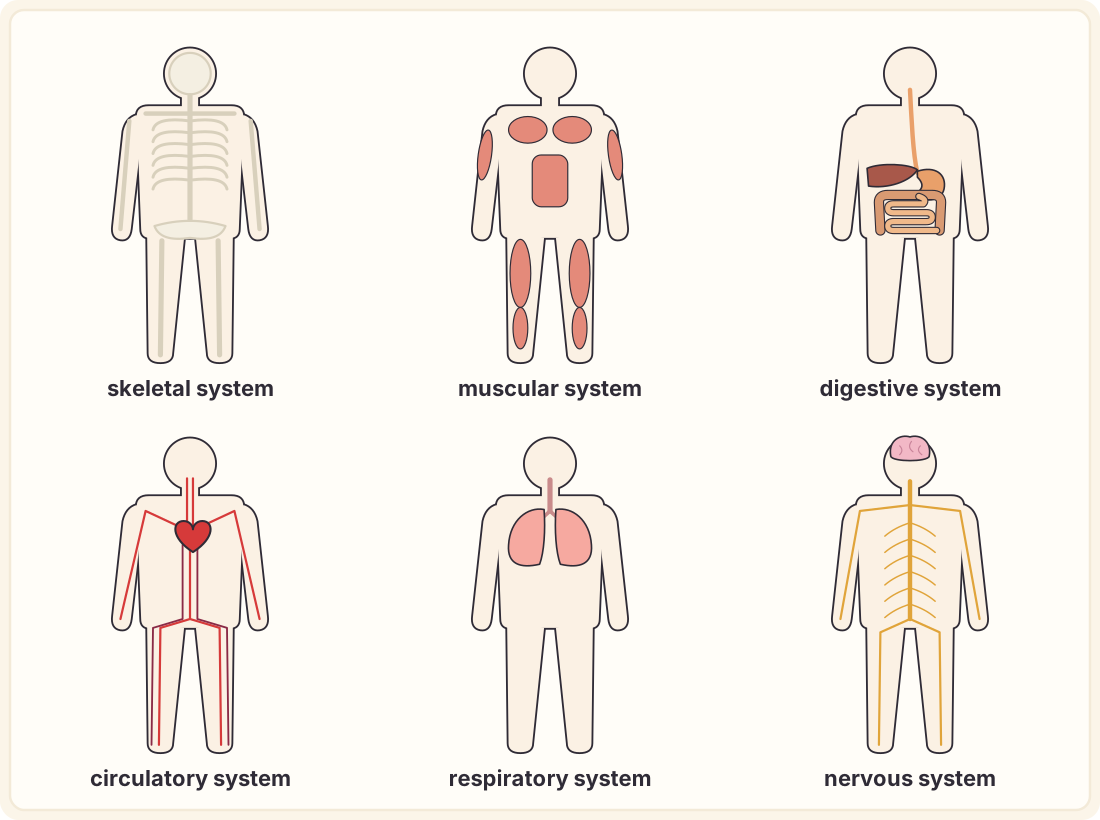
Human anatomy books usually count eleven organ systems.1 Here are the ones this module looks at, and a few more:
- Digestive system - mouth, stomach and intestines. It breaks food down and takes in what the body needs.
- Circulatory system - the heart and blood vessels. It carries blood to every part of the body.
- Respiratory system - the airways and lungs. It brings in oxygen and gets rid of carbon dioxide.
- Nervous system - the brain, spinal cord and nerves. It senses, decides and sends orders.
- Skeletal system - the bones. It holds you up and protects soft organs.
- Muscular system - the muscles. It moves the bones, and much more.
The others are the skin, the hormone (endocrine) system, the lymphatic system, the urinary system (kidneys and bladder) and the reproductive system.1
Every system needs the others
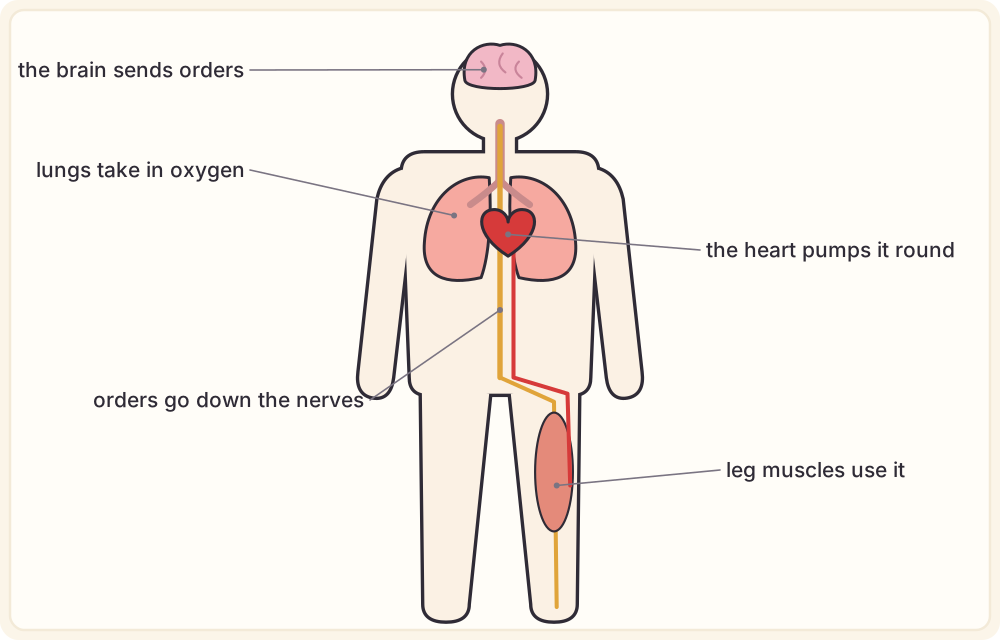
No system can work alone. Think about that run for the bus. Your leg muscles need energy, which they get by using oxygen and food (see cellular respiration). The respiratory system takes oxygen in. The digestive system takes in sugars from food. The circulatory system carries both to the muscles. The nervous system tells the heart to beat faster and the lungs to breathe harder, and moves your legs.
Show the answer
Myth. An organ is good at one job, but it can't do it alone. The stomach needs blood from the heart, the heart needs orders from the nerves, and the brain needs oxygen from the lungs. A body is a team, and the systems are always passing work to each other.
Keeping things steady
The systems also work together to keep the inside of your body steady. When you run, you get hot, so your skin sweats and the sweat cools you. When you haven't drunk for a while, your kidneys keep more water in. Your body temperature stays near 37 °C whether you are in snow or in summer sun.2
Try it yourself
Sit still and count your heartbeats for 30 seconds: press two fingers gently on the side of your neck or the inside of your wrist. Then walk quickly up and down stairs for a minute and count again. Which systems had to work harder, and which one gave them their orders?
Words to know
- tissue - a group of similar cells doing the same job
- organ - a body part made of two or more kinds of tissue, with its own job, like the heart
- organ system - a group of organs that work together on one big job, like the digestive system
Big idea
Your organs are grouped into systems, and the systems keep you alive only by working together.
Sources
-
OpenStax, Anatomy and Physiology 2e, 1.2 Structural Organization of the Human Body (textbook, CC BY). ↩ ↩2 ↩3
-
MedlinePlus (US National Library of Medicine), Vital signs. ↩