Lungs and Breathing
Hold your breath and count. Somewhere around half a minute, most people feel an urge to breathe that grows until they give in. Your body is not asking for "air" in general. It wants one gas from it, and it wants to get rid of another. Which ones, and why?
Myth or fact? Breathing and respiration are the same thing.
The way in
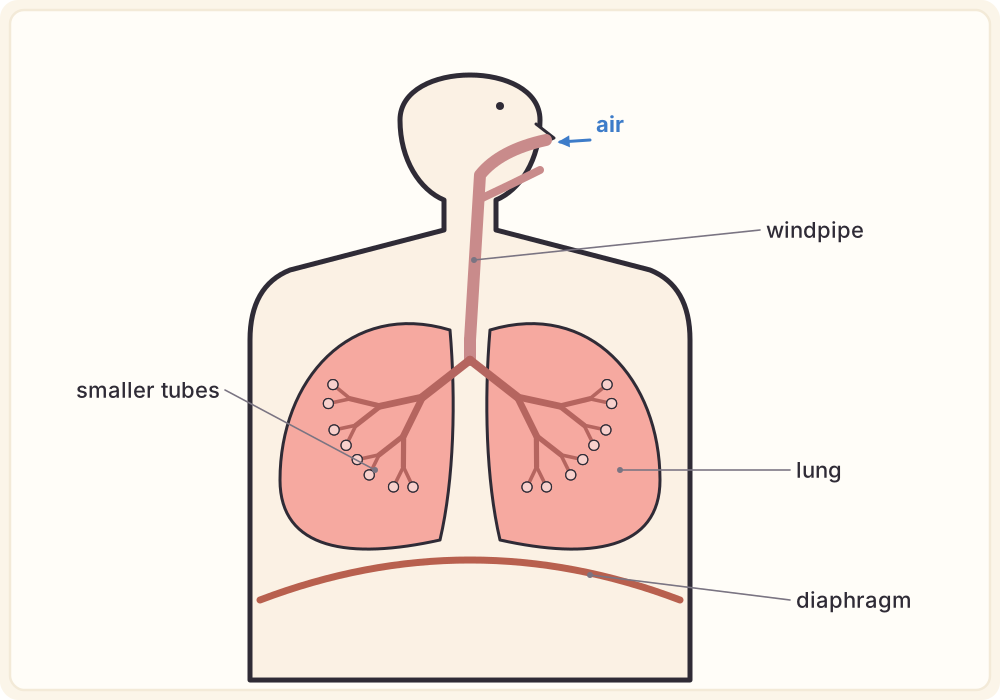
When you breathe in, air goes in through your nose or mouth and down your windpipe (trachea), a tube in your neck. In your chest the windpipe splits into two branches, one for each lung. Each branch splits again and again, into thinner and thinner tubes, like the branches of an upside-down tree.1
At the very ends of the smallest tubes are bunches of tiny air sacs called alveoli. They are so small and so many that your lungs hold hundreds of millions of them.1
Swapping gases
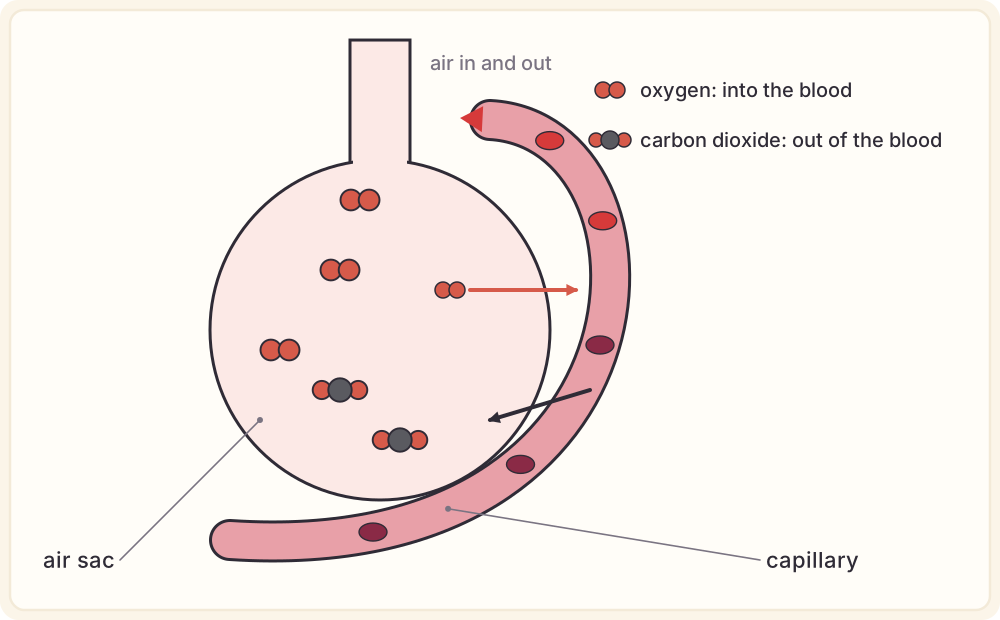
Each air sac is wrapped in a net of capillaries, the tiniest blood vessels. The wall of an air sac is only one cell thick, and so is the wall of a capillary.1 Gases can pass straight through both:
- Oxygen goes from the air in the sac into the blood. The blood carries it to every cell.
- Carbon dioxide, a waste gas the cells make, goes from the blood into the air sac. You breathe it out.
This swap is called gas exchange. The blood that leaves the lungs, full of oxygen, goes to the heart, which pumps it round the body (see Heart and Blood).
Why the body needs oxygen
Your cells use oxygen to release energy from food. That process, inside every cell, is called respiration, and it makes carbon dioxide as waste (see cellular respiration).
Show the answer
Myth. Breathing is moving air in and out of the lungs. Respiration is what cells do with the oxygen: release energy from food. Breathing brings oxygen to the blood so that cells can respire, and takes away their carbon dioxide.
The muscle that breathes
Your lungs have no muscles of their own. Under them is a dome-shaped sheet of muscle, the diaphragm. When it tightens, it flattens and pulls down, the chest gets bigger and air rushes in. When it relaxes, it moves back up and air is pushed out.2 You don't have to think about it: a part of the brain called the medulla keeps you breathing, even in your sleep.3 A resting adult breathes about 12 to 18 times a minute.4
Try it yourself
Put one hand on your belly, just below your ribs, and breathe in slowly and deeply. Feel your belly push out? That is your diaphragm moving down. Then count your breaths for one minute while you sit still.
Words to know
- windpipe (trachea) - the tube that carries air from the throat towards the lungs
- alveoli - tiny air sacs at the ends of the lungs' smallest tubes
- gas exchange - oxygen going into the blood and carbon dioxide coming out, in the air sacs
- diaphragm - the sheet of muscle under the lungs that does most of the work of breathing
Big idea
Breathing brings air to tiny air sacs, where oxygen passes into the blood and carbon dioxide passes out.
Sources
-
OpenStax, Biology 2e, 39.1 Systems of Gas Exchange (textbook, CC BY). ↩ ↩2 ↩3
-
OpenStax, Biology 2e, 39.3 Breathing (textbook, CC BY). ↩
-
OpenStax, Psychology 2e, 3.4 The Brain and Spinal Cord (textbook, CC BY). ↩
-
MedlinePlus (US National Library of Medicine), Vital signs. ↩