Is It Alive?
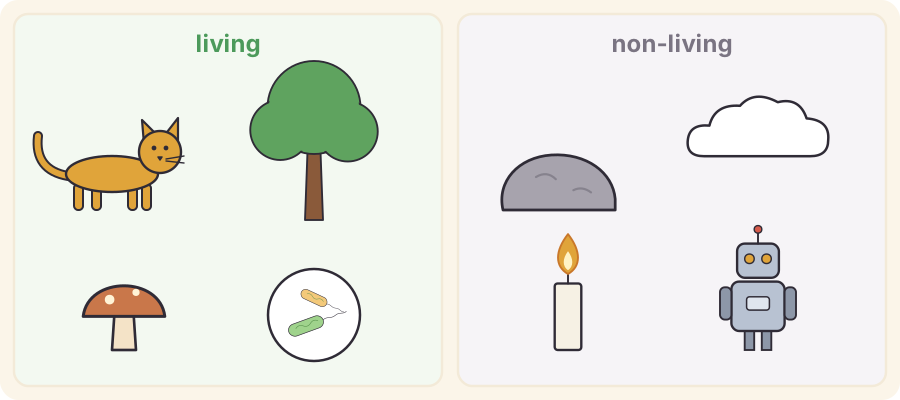
A cat is alive. A rock is not. That much is easy. But what about a dry seed in a jar, a candle flame that grows and moves, or the virus that gives you a cold? Biology is the science of living things, so it has to start with a question that sounds simple: what does it mean to be alive?
Myth or fact? If something moves and grows, it must be alive.
The signs of life
A living thing is called an organism. Biologists don't use one test to decide what is alive. They look for a set of signs of life, and an organism shows them all:1
- It is organised - built in an ordered way, out of tiny units called cells.
- It uses energy - from sunlight or from food.
- It grows and develops.
- It senses and responds to what is around it: a plant bends towards light, you pull your hand from a hot pan.
- It keeps its inside steady - your body stays at about the same temperature on a hot day and a cold one.
- It reproduces - makes more of its own kind, passing its instructions on to its young.
One sign is not enough
A candle flame grows, moves, uses oxygen and gives off heat. A crystal grows too, and a toy robot moves. None of them is alive. A flame is not built of cells, and it doesn't pass on instructions to "baby flames": it simply spreads wherever there is fuel.
Show the answer
Myth. Fire moves and grows, and so does a crystal, but neither is alive. A living thing shows all the signs of life together, not just one or two.
Alive, but resting
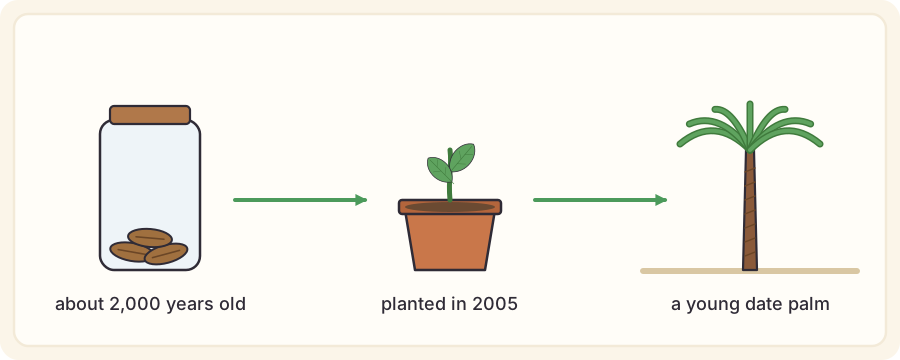
A dry seed doesn't seem to do anything at all. But it is alive: it is resting, using very little energy, waiting for water and warmth. In the 1960s, archaeologists dug up date seeds at Masada, an ancient fortress by the Dead Sea. In 2005, scientists planted one. It sprouted. Tests on the seed's shell showed it was about 2,000 years old, and it grew into a healthy young date palm the scientists named Methuselah.2
The hard case: viruses
A virus is far smaller than any cell. It can make copies of itself, but only by getting inside a living cell and using the cell's machinery. On its own, it does nothing. Most biology books say viruses don't meet the definition of life, because they are not made of cells and can't reproduce alone.1
Careful
Scientists still argue about viruses. Some say they are on the edge of life rather than clearly outside it. There is no single answer everyone agrees on yet.
Try it yourself
Look around the room and outside the window. Make two lists, living and non-living. Which things were hard to place? Which signs of life did you check?
Words to know
- organism - a living thing
- signs of life - what all living things do: they are organised, use energy, grow, sense and respond, keep their inside steady and reproduce
- virus - a tiny thing that can only make copies of itself inside a living cell
Big idea
Something is alive when it shows all the signs of life together; one sign, like moving or growing, is not enough.
Sources
-
Mary Ann Clark, Matthew Douglas and Jung Choi, Themes and Concepts of Biology (Biology 2e, OpenStax, section 1.2). ↩ ↩2
-
Sarah Sallon and others, Germination, Genetics, and Growth of an Ancient Date Seed (Science, 2008). ↩