When Good Values Clash
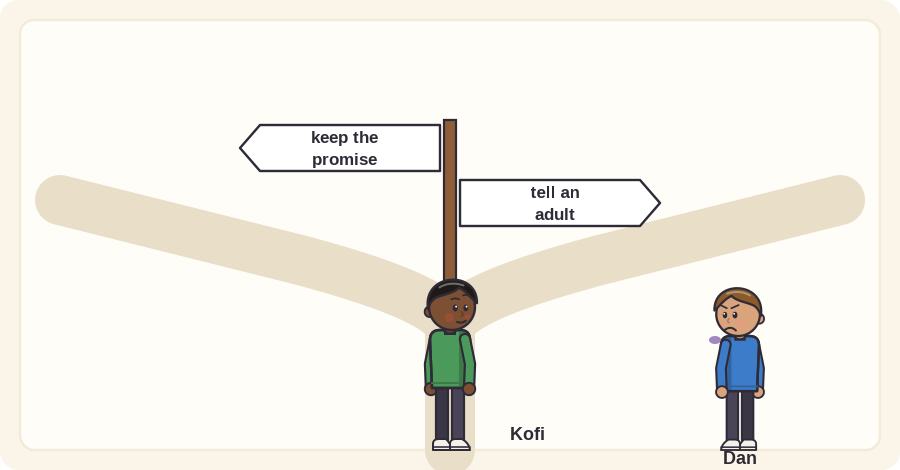
Dan tells Kofi a secret: some older pupils have been taking his lunch money and pushing him around on the way home. "Promise you won't tell anyone," Dan says. "It'll only get worse." Kofi promises. But a week later Dan comes to school with a bruise on his arm. Kofi made a promise. Kofi is also afraid his friend is being hurt. What should he do?
Two good things, one choice
Kofi's problem isn't that he doesn't know what is good. He knows two good things, and they point in opposite directions:
- Keep the promise. As the Keeping a Promise lesson showed, a promise is an obligation, and Dan trusted him.
- Protect his friend from harm. As the Do No Harm lesson showed, harm is one of the strongest reasons there is.
A choice where good values pull in different directions, so that something good is lost whatever you choose, is called a dilemma (say it "dih-LEM-uh"). Dilemmas are where ethics is hardest - and where the reasons of this course matter most.
Thinking it through
There is no formula, but there are good steps.
1. Check the facts. Is Dan really being hurt, or did he fall? Is there another explanation? As the What Ethics Asks lesson said, facts change the answer.
2. Weigh the reasons. How strong is each one here? The promise matters. But Dan made Kofi promise before anyone knew how bad things would get, and a bruise is serious harm that may grow. Many people would say the reason to protect Dan has become the stronger one.
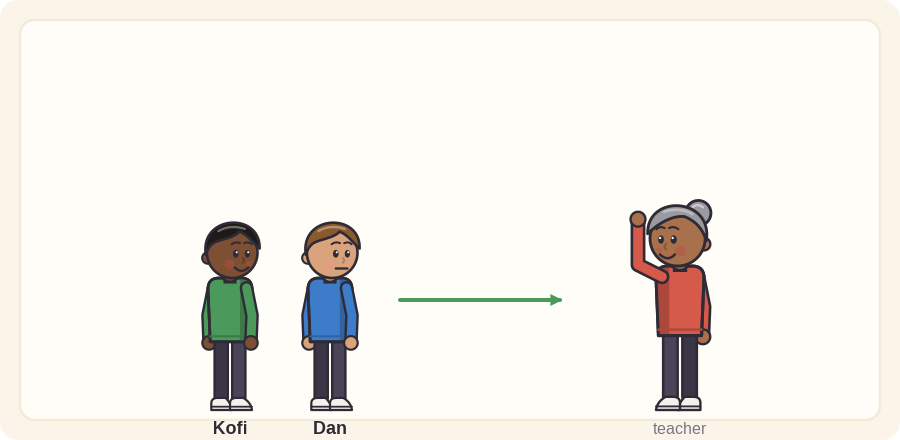
3. Look for a third way. As in the Kind Lie lesson, the two obvious choices aren't always the only ones. Kofi could go back to Dan first: "I'm worried. Let's tell a teacher together. I'll come with you." That respects Dan's trust and protects him.
Something is still owed
Even when you have chosen well, a dilemma leaves something behind. If Kofi does tell, he still broke a promise, and he owes Dan an honest explanation: why he did it, and that he is sorry it came to that. Feeling bad about the good thing you had to give up isn't a sign that you chose wrong. It is a sign that you saw both good things clearly.
Try it at home
- Think of a time you had to choose between two good things: being honest and being kind, helping one friend or another, finishing a job or keeping a promise.
- Write the reason on each side.
- Was there a third way? What was still owed afterwards?
Words to know
- dilemma - a choice where good values pull in different directions, so something good is lost whatever you choose
Big idea
In a dilemma, good values clash. Check the facts, weigh the reasons, and look for a third way. Even after a good choice, something may still be owed - and seeing that is part of seeing clearly.