The Runaway Trolley
A runaway tram (in America it is called a trolley) is racing down a track. Its brakes have failed. Ahead, five workers are on the track, and they can't get out of the way in time. You are standing next to a lever. If you pull it, the tram will switch onto a side track, where there is one worker. What should you do?
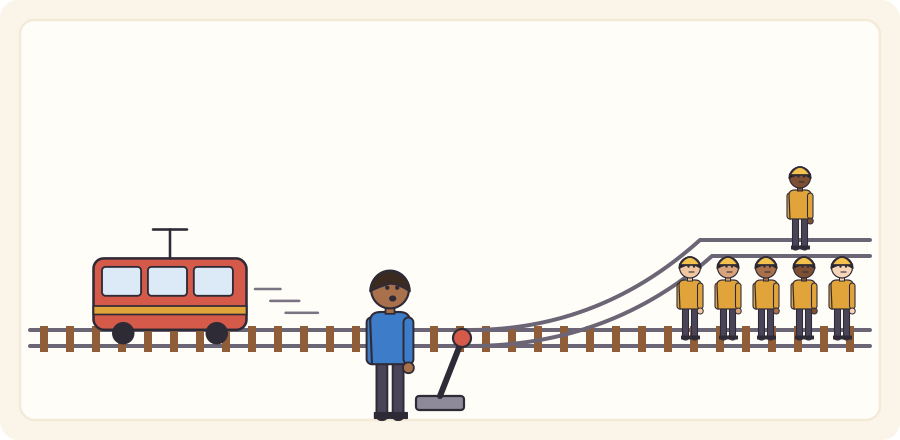
A story made to test an idea
Nobody expects to meet a runaway tram. The story is made up on purpose, to test an idea - like a fair test in science, where everything is kept the same but one thing. A made-up case like this, used to test an idea, is called a thought experiment. This one was first told by the English philosopher Philippa Foot in 1967. The American philosopher Judith Jarvis Thomson later named it "the trolley problem".
Most people who hear the story say they would pull the lever. Their reason is about results: one person dies instead of five. That is just what the Greatest Good lesson would say.
The same results, a different feeling
Now change one thing. This time there is no lever. You are on a bridge over the track, next to a very large stranger. The only way to stop the tram is to push the stranger off the bridge in front of it. The stranger would die; the five would be saved.
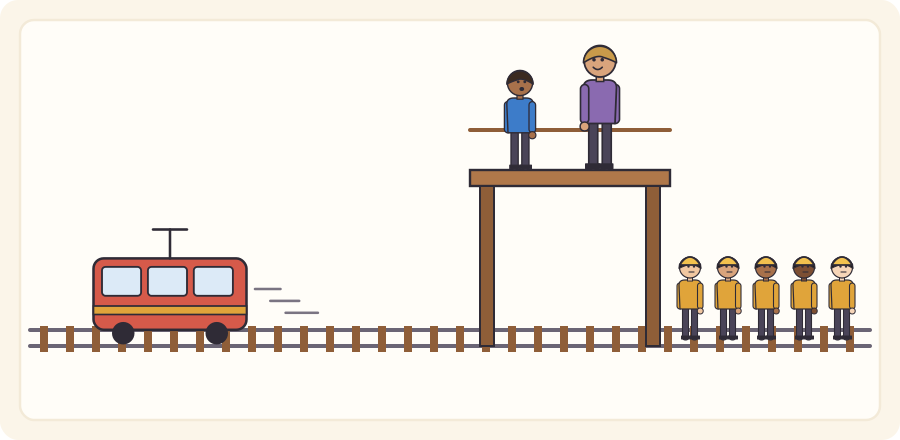
The results are exactly the same: one dies, five are saved. Yet most people say they would not push. Many say it would be clearly wrong. Why?
What the difference might be
People have given many answers. A few of them:
- In the first case, the one worker dies as a side effect of saving the five. In the second, the stranger is used - his body is the thing that stops the tram.
- Pushing someone with your own hands seems different from moving a lever.
- The stranger has a say over his own body, which the lever case doesn't take away in the same way.
Nobody has found an answer everyone accepts, and this course won't pick one. But notice what the experiment shows. If only results mattered, the two cases would be the same. Most people feel they are not. So perhaps something besides results matters too. The next module looks at what it might be.
Try it at home
- Tell someone both versions of the story, the lever first.
- Ask what they would do in each, and why.
- Write down the difference they gave between the two cases. Does it matter, in the way the Treat Like Cases Alike lesson asked?
Words to know
- thought experiment - a made-up case, used to test an idea by changing one thing at a time
Big idea
The trolley cases have the same results, yet most people judge them differently. That suggests results may not be all that matters - and asking what the difference is is how ethics finds out what else does.