What If Everyone Did It?
There is a long queue for the school canteen. Leo is hungry and he is at the back. He sees a friend near the front and slips in beside him. "It's just one person," he says. "It makes no difference." Is he right?
Imagine everyone did it
There is a simple test, made famous by Immanuel Kant: what if everyone did it? Don't ask what happens if you do it once. Ask what would happen if the rule behind your action were a rule for everyone.
The rule behind Leo's action is something like: "When I'm hungry and see a friend near the front, I can slip in." Imagine every hungry pupil followed it. Everyone would rush to the front. There would be no queue at all - just a crowd, with the strongest and pushiest first.
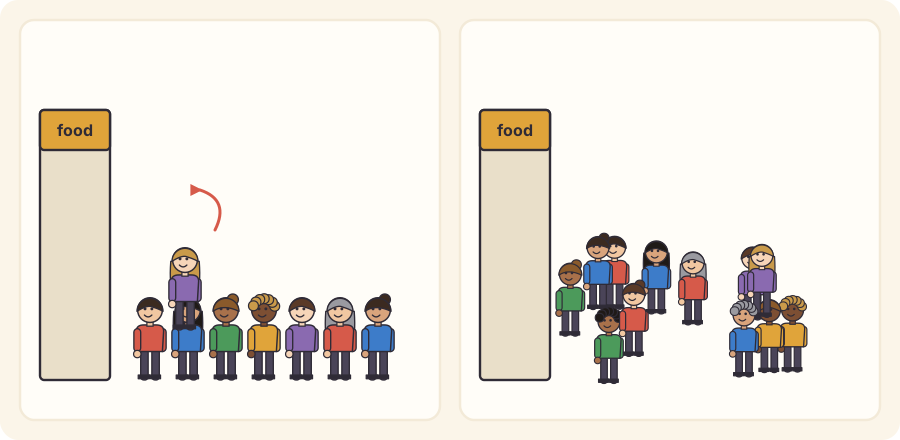
Leo's plan only works because everyone else keeps to the queue. He is making an exception of himself: using a rule he needs others not to follow.
Kant's sharpest example
Kant's own example was a promise. Suppose you need money and borrow it, promising to pay it back, while knowing you won't. Now imagine everyone did that: everyone made promises they didn't mean whenever it suited them. Soon nobody would believe a promise at all. Then your false promise wouldn't even work - nobody would lend you anything.
If everyone made false promises, nobody would believe a promise.
Then a false promise couldn't work.
So making a false promise is making an exception of yourself.
Not "what if everyone did the same thing"
The test needs care. "What if everyone became a dentist?" would be a disaster, but being a dentist isn't wrong. The test is not about everyone doing the same job. It is about the rule you are acting on. "Choose a job you are good at" works fine when everyone follows it.
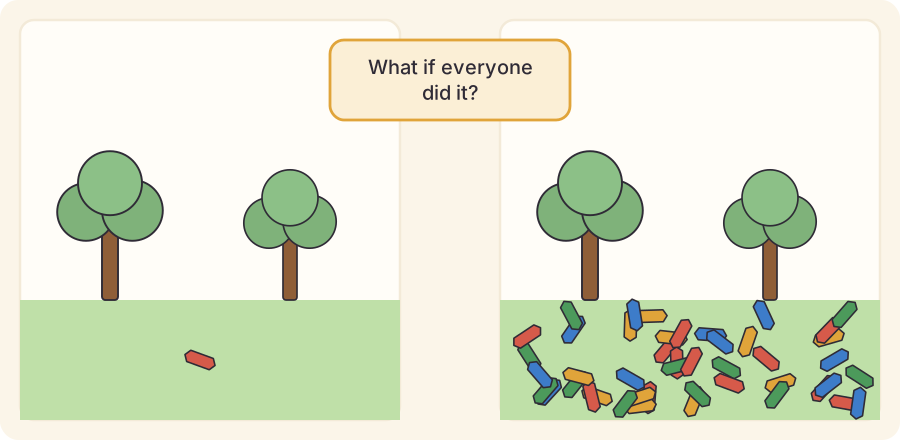
The same test shows why dropping "just one wrapper" in a park matters. One wrapper hardly harms anyone, so looking only at results might let it go. But the rule behind it - "drop litter when it's only one piece" - would cover the park if everyone followed it. Like the golden rule, the test asks you to see yourself as one of everyone, not a special case.
Try it at home
- Think of something people do because "just one won't hurt".
- Write the rule behind it, as a rule for everyone.
- Imagine everyone followed that rule. What would happen?
Words to know
- the everyone test - asking what would happen if the rule behind your action were a rule for everyone
- making an exception of yourself - acting on a rule you need others not to follow
Big idea
Kant's test asks what would happen if everyone acted on the rule behind your action. If the rule only works because others don't follow it, you are making an exception of yourself.