Some Things You Must Not Do
Someone keeps drawing on the classroom wall, and nobody will say who. The teacher has an idea: "No break for anyone until I know who did it." It might work. Somebody might own up, or be named, and the drawing would stop. But Mei didn't do it, and neither did twenty-five others. Is it right to punish them?
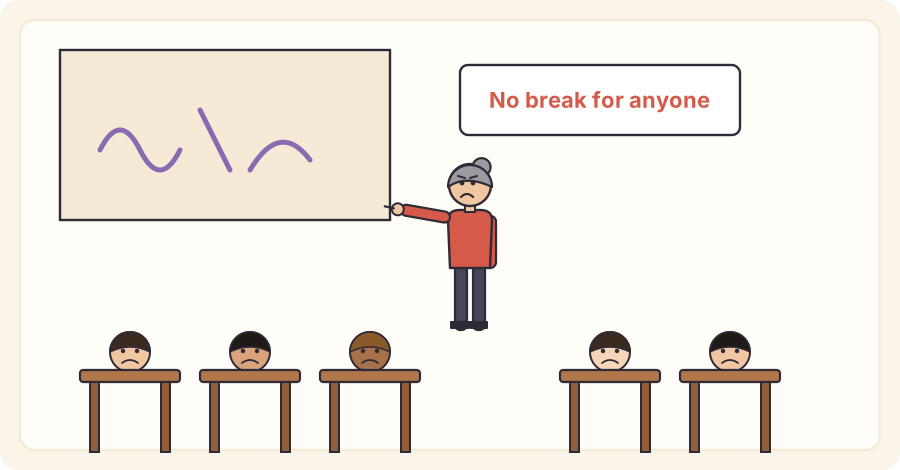
Wrong in itself
If you only look at results, the teacher's plan might be fine: one afternoon without break, and the drawing stops for good. But many people feel there is something wrong with it however well it works. Punishing someone who did nothing wrong seems wrong in itself, not just because of what it leads to.
This is a second way of reasoning about right and wrong. It says some actions are required, and some are forbidden, whatever their results. What you must do, or must not do, whether or not it brings the best results, is called a duty.
Punishing someone for what they didn't do is wrong in itself.
Mei and twenty-five others didn't draw on the wall.
So punishing them is wrong, even if it would stop the drawing.
A list most people share
People who reason this way usually agree on some duties, found in many traditions:
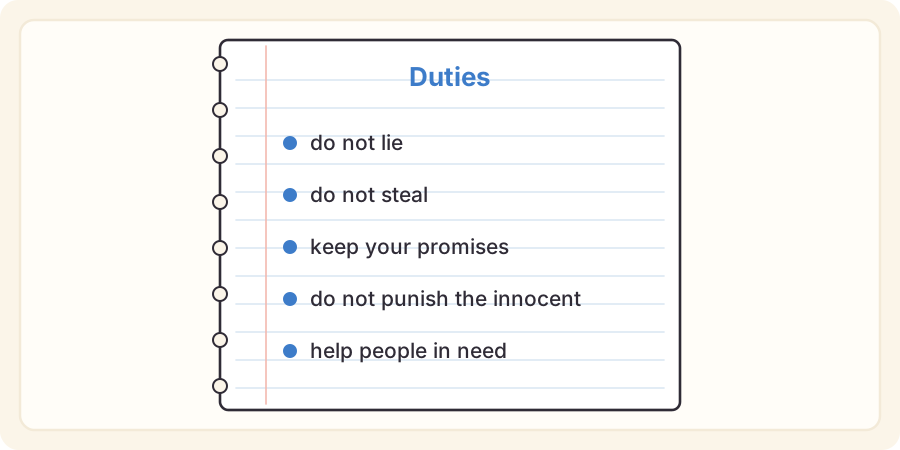
Notice that you have met several already. The Keeping a Promise lesson was about the duty to keep promises; the Kind Lie lesson about the duty not to lie. The last one on the list is different: it is a duty to do something, not a duty not to. Duties not to do things (don't steal) can always be kept by doing nothing. Duties to do things (help people) can't always be kept by everyone, all the time.
The German philosopher of duty
The thinker most famous for this way of reasoning is Immanuel Kant, who lived in the German city of Königsberg. In 1785 he wrote a short book arguing that what makes an action right is not its results but the rule behind it - and whether that rule is one you could ask everyone to follow. He held that lying is always wrong, even a white lie, even to save someone trouble. The next two lessons look at his two most famous tests.
Its strength, and its puzzle
The strength of duties is that they protect people from being sacrificed for someone's plan. The teacher can't use Mei's break as a tool, however good the goal. That is just what troubled people in the Runaway Trolley footbridge case.
The puzzle is what to do when duties clash, or when keeping one leads to terrible results. If a lie would save a life, must you still not lie? Kant said yes; most people find that very hard to accept. The last module returns to clashes like this.
Try it at home
- Write down three rules you think hold "whatever happens".
- For each, try to imagine a case where breaking it would lead to better results.
- Does the rule still hold? Write your reason.
Words to know
- duty - something you must do, or must not do, whether or not it brings the best results
Big idea
A second way of reasoning says some actions are right or wrong in themselves - they are duties, not just means to good results. Duties protect people from being sacrificed for a plan, but they can clash.