The Greatest Good
At the Riverside meeting, a woman stands up with a notebook. "Let's count," she says. "Two hundred children use the park. Forty older people do. Each person counts the same. Which choice makes the most people better off, and by how much?" She is using an idea that is about 250 years old.
The most good for everyone
In 1776, the English thinker Jeremy Bentham wrote that what matters is "the greatest happiness of the greatest number". The right choice, he thought, is the one that does the most good - the most happiness, the least suffering - for everyone it touches, added up. Later the philosopher John Stuart Mill made the idea famous in a short book, Utilitarianism (1863).
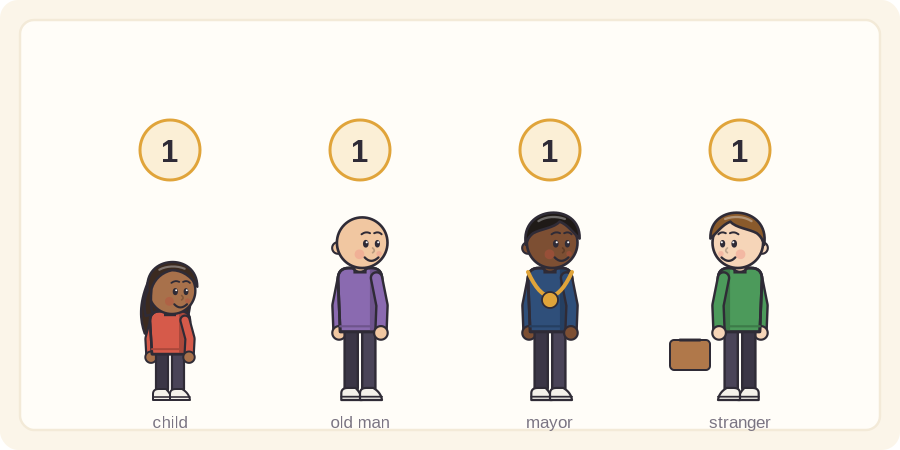
The heart of the idea is that each person counts for one, and nobody counts for more than one. The mayor's happiness counts the same as a child's. A stranger's suffering counts the same as your best friend's.
Its strengths
This way of reasoning has real strengths, which is why so many people use it, often without knowing its name:
- It cares about what matters to people: whether their lives go better or worse.
- It is fair in one important way: nobody gets extra weight because they are rich, powerful or your friend - the same idea as the Treat Like Cases Alike lesson.
- It gives a way forward when people disagree: look at the results and add them up.
Hard to count
But adding up happiness is hard. The woman with the notebook can count people, but how much good is a swing to a child, against a bench to an old woman with bad knees? Two hundred children get a little more fun; forty older people get the only chance to sit outside all summer. Which adds up to more?
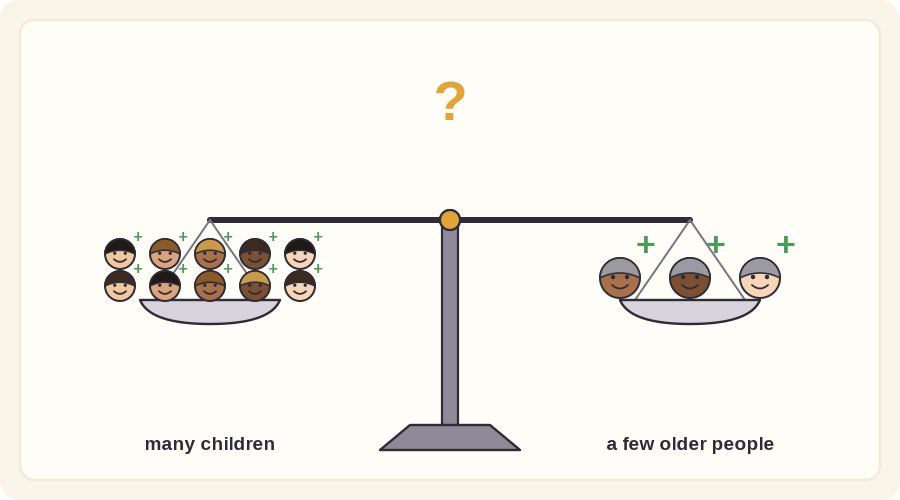
There is no ruler for happiness. People who use this way of reasoning usually make their best guess, and that is often good enough to see that one choice is clearly better.
A deeper puzzle is coming. What if the greatest good for the greatest number could only be reached by doing something terrible to one person? The next two lessons look at that question.
Try it at home
- Think of a choice that affects many people: what to cook for a family meal, what game to play at a party.
- List who is affected, and guess how much each one gains or loses.
- Which choice does the most good, counting each person once? Was it hard to decide how much each one counted?
Words to know
- the greatest good - the idea that the right choice does the most good for everyone it touches, added up
- impartial - counting everyone's good the same, with no favourites
Big idea
Bentham and Mill said the right choice is the one that does the most good, counting each person once. It cares about what matters to people and plays no favourites - but good is hard to add up.