What Happens Next?
The town of Riverside has saved some money for its park. There is enough for one thing only. The children want a new playground: the old swings are broken. The older people want benches and trees for shade: in summer there is nowhere to sit. The town meeting has to choose. How should it decide?
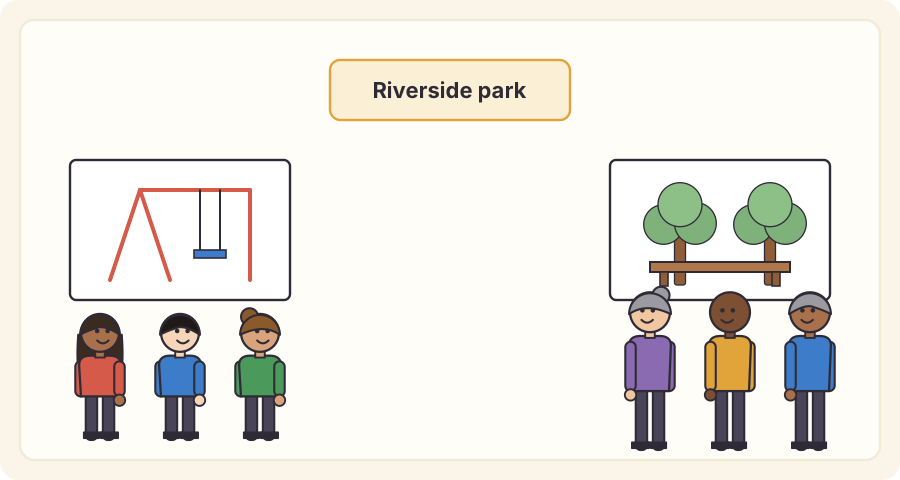
Look at what happens
One very natural way to decide is to ask: what will each choice lead to? Who will be helped, how much, and for how long? Who will lose out?
Everything that follows from an action is called its consequences (say it "CON-suh-kwen-siz"). A new playground has consequences: children play outside more, parents meet each other, and perhaps the older people find the park noisier. Benches and trees have consequences too: older people can sit outside in summer, and in twenty years the trees will shade everyone.
Set out as an argument, this way of reasoning goes:
Choice A would lead to better results than choice B, for everyone it touches.
So choice A is the one to make.
Near and far, seen and unseen
Looking at results sounds easy. It isn't, because consequences spread like ripples when you drop a stone into a pond. The first ring is easy to see: the children who play on the swings. Further rings are harder: the parents, the shopkeepers by the park, the children who aren't born yet but will play there in ten years.
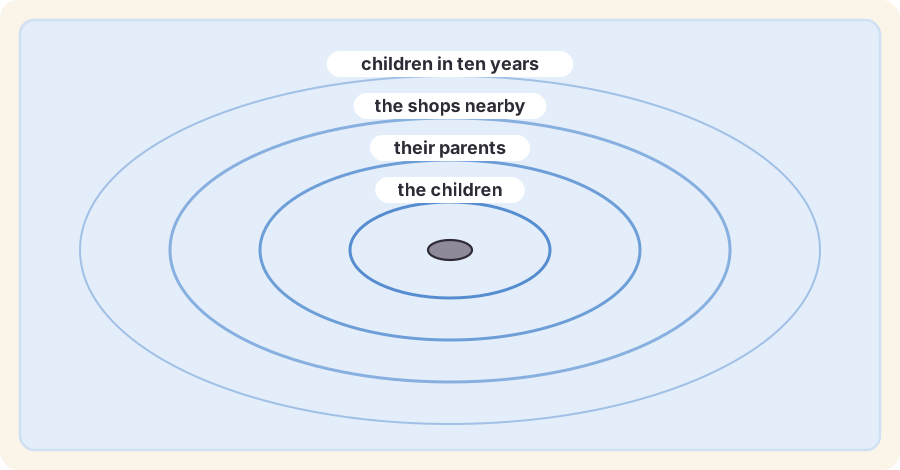
Some consequences nobody wanted or expected. A playground built next to a busy road might bring more children near the traffic. Looking carefully at results means looking for these too - not just the results you hoped for.
Why results matter to nearly everyone
Almost everyone thinks results matter in ethics. The reason harm is so important, as the Do No Harm lesson showed, is a fact about results: someone ends up worse off. A plan that sounds kind but leaves everyone worse off is hard to defend.
Some thinkers go further and say results are the only thing that matters: the right choice is always the one with the best results. The next lesson looks at that idea, and the lessons after it look at the puzzles it runs into.
Try it at home
- Pick a choice your family or class made recently.
- Draw it as a stone in a pond. Write the consequences in rings: the nearest first, then further out.
- Did anyone think about the outer rings when the choice was made?
Words to know
- consequences - everything that follows from an action, near and far, wanted and unwanted
- looking at results - judging an action by its consequences for everyone it touches
Big idea
One way to reason about right and wrong is to look at results: what each choice leads to, for everyone it touches. Consequences spread like ripples, so a careful look goes beyond the first ring.