The Widening Circle
Imagine drawing a circle around everyone whose good counts - everyone you think must be treated fairly and kindly. For most of history, for most people, that circle was small: your family, your village, your own people. Strangers, enemies and many others were outside it. How did it grow?
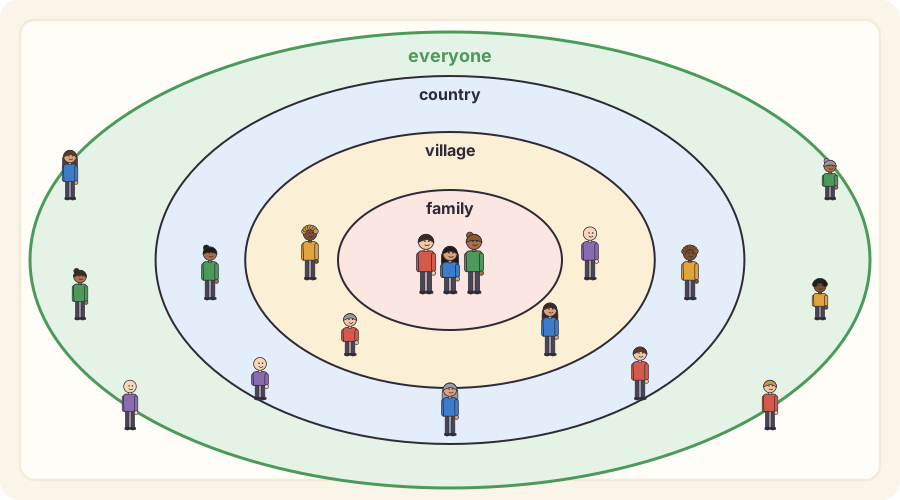
The circle grows
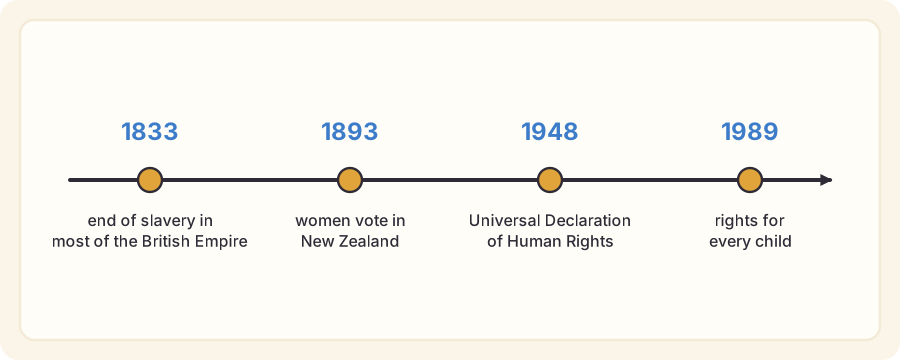
The Australian philosopher Peter Singer wrote a book in 1981 called The Expanding Circle. His idea was that much of moral history is the story of this circle growing wider. Some of the steps are now settled history:
- The end of slavery. For thousands of years, in many parts of the world, people were bought and sold. Britain passed a law to end slavery in most of its empire in 1833; the United States ended it in 1865.
- Votes for women. In 1893 New Zealand became the first country where women could vote in national elections. Many countries followed in the next fifty years.
- Rights for everyone. In 1948, the Universal Declaration of Human Rights, from the What a Right Protects lesson, said that every person has the same rights.
- Rights for children. In 1989, the United Nations agreed a list of rights that every child has.
What pushed it
The people who widened the circle used the same tools as this course. Above all they asked the question from the Treat Like Cases Alike lesson: what is the difference, and does it matter? A famous badge made in England in 1787 against the slave trade showed a chained man asking: "Am I not a man and a brother?" In other words: what difference between us could possibly justify this?
People feel pain, hope and love, whatever their skin, sex or birthplace.
Those are the things that make someone's good count.
So their good counts the same as anyone's.
Empathy helped too, as the In Their Shoes lesson showed: stories of enslaved people's lives, read by people who had never met them, moved many to act. But empathy runs short with strangers, so the reasons did the rest.
Is the circle finished?
Nobody thinks the work is done. People still argue about who and what is inside the circle, and how much each one counts. Some argue animals belong inside it, at least in part; others disagree. You don't have to decide those questions now. But the history shows something hopeful: people can come to see, by reasoning, that they were wrong - and change.
Try it at home
- Ask an older person what was thought normal when they were young that isn't now, or the other way round.
- Write down what changed people's minds, if you can find out.
- Was it a reason, a story, or both?
Words to know
- the widening circle - the idea that, over history, the group of people whose good counts has grown wider
- moral progress - a change in what people think is right that is better supported by reasons than what came before
Big idea
Over history, the circle of people whose good counts has grown - often pushed by the question "what is the difference, and does it matter?". It shows that people can reason their way to seeing they were wrong.