What a Right Protects
Back in Riverside, a building company makes an offer. It will pay for a new playground and new benches - if the town lets it build a car park on Mrs Okafor's garden. She has lived there for forty years and doesn't want to sell. Everyone else in town would be better off. Can the town just take her garden?
A protection around each person
Many people answer: no - it is her garden. Even if the whole town gains, something belongs to her that the town can't simply take. A right is something each person is owed, which protects them. Rights work like a shield around each person: they say what may not be done to you, even if doing it would be better for everyone else.
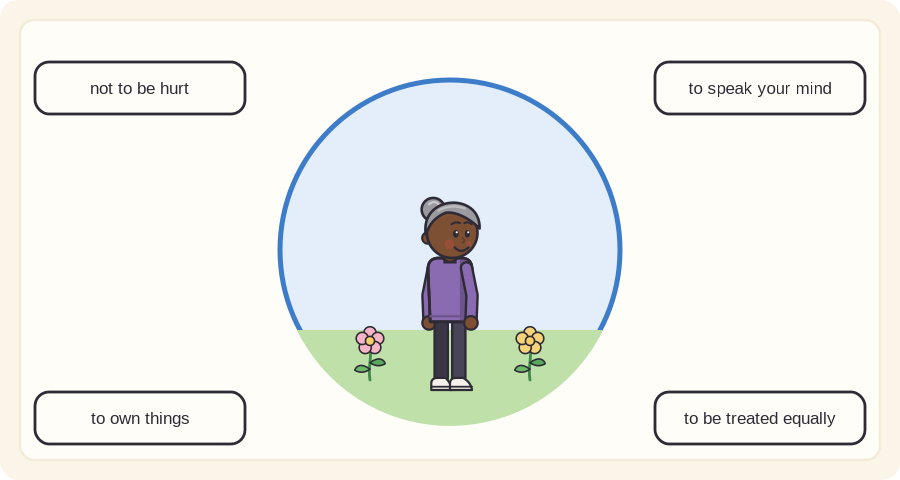
Rights join up with the last few lessons. Looking at results, as in the Greatest Good lesson, adds up everyone's good. Rights say some things can't be added up and traded: a person isn't just a share of the total. That is the same idea as the People Are Not Tools lesson, written as a protection.
A right is someone else's duty
Every right comes with a duty for somebody else. If Mrs Okafor has a right to her garden, everyone else has a duty not to take it. If a child has a right to go to school, someone has a duty to provide a school.
Mrs Okafor has a right to her garden.
A right of one person is a duty of others.
So the town has a duty not to take her garden, even for a playground.
Rights don't settle every case. The town could offer her a fair price and ask again; she could agree. And rights can clash with each other: one person's right to speak and another's right not to be hurt by lies. But a right means that her "no" must be weighed, not just outvoted.
Rights for everyone, written down
After the Second World War, in which millions of people were killed and whole groups of people were treated as if they had no rights at all, the countries of the world wrote down a list of the rights every person has. The Universal Declaration of Human Rights was agreed by the United Nations on 10 December 1948. It has 30 short articles: the right to life, to not be tortured, to be equal before the law, to go to school, to think and speak freely, and more.
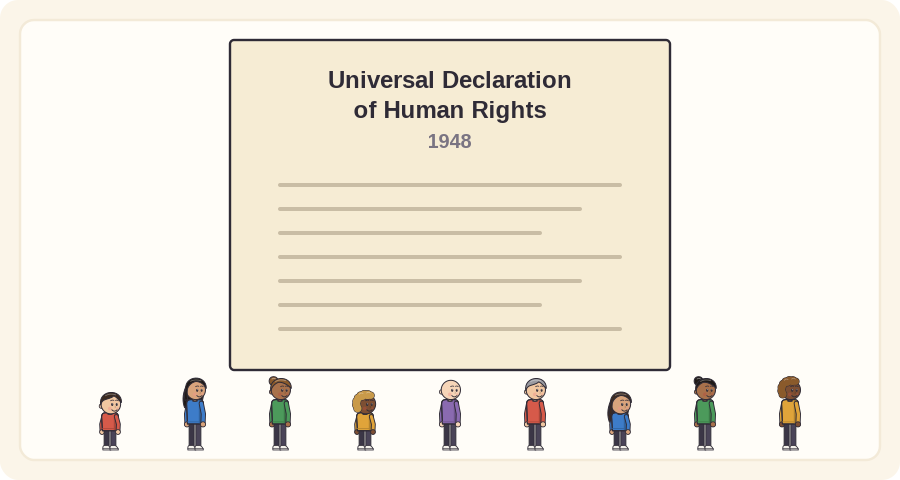
Human rights are rights every person has just because they are a person - not because of where they were born, how rich they are, or what anyone else thinks of them.
Try it at home
- Write down three rights you think every child should have.
- For each one, write whose duty it is.
- Find one case where two of these rights might clash.
Words to know
- right - something each person is owed, which protects them, even against what would be best for others
- human rights - rights every person has just because they are a person
Big idea
A right is a protection around each person, which can't just be outvoted by everyone else's gain. Every right is someone else's duty. In 1948 the world wrote down the rights every person has.