Square Numbers
A chessboard has 8 rows of squares, with 8 squares in each row. A tiled floor in a square room, a box of chocolates 4 across and 4 down, the windows on the front of a tower block: the same shape keeps coming back. Which numbers can be laid out like that, as a perfect square?
Dots in a square
In the Factors lesson we laid out dots as rectangles. A square is a special rectangle: it has as many rows as there are dots in each row.
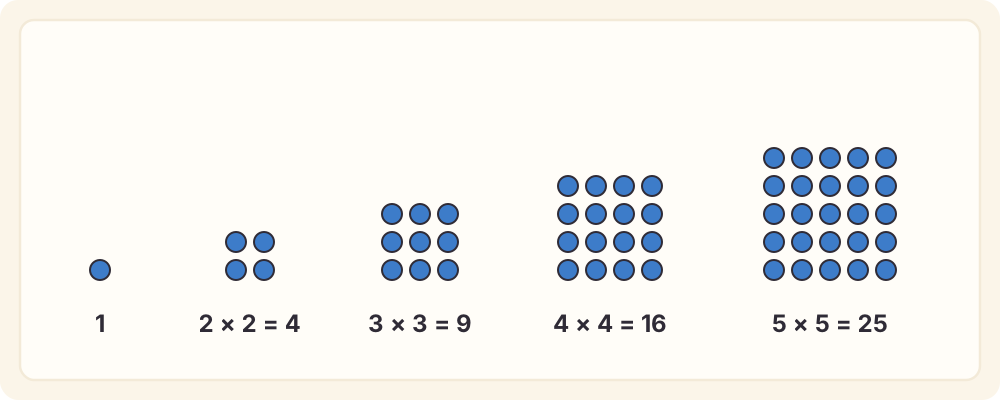
- 1 dot is a square: 1 row of 1.
- 4 dots make 2 rows of 2: 2 × 2 = 4.
- 9 dots make 3 rows of 3: 3 × 3 = 9.
- 16 dots make 4 rows of 4: 4 × 4 = 16.
- 25 dots make 5 rows of 5: 5 × 5 = 25.
A number you get by multiplying a whole number by itself is called a square number. The chessboard has 8 × 8 = 64 squares, so 64 is a square number too.
Most numbers are not square
Try 12 dots. You can make 3 rows of 4, or 2 rows of 6, or 1 row of 12. Each of those is a rectangle, but none is a square: the number of rows never matches the number of dots in a row. So 12 is not a square number.
From 1 to 100 there are only ten square numbers: 1, 4, 9, 16, 25, 36, 49, 64, 81 and 100. They get further and further apart as they grow.
Growing a square
Look at how one square becomes the next. To turn the 3 by 3 square into the 4 by 4 square, you add a new row along the bottom and a new column down the side. The new strip is shaped like a corner, an L:
- 3 dots along the bottom, 3 dots up the side, and 1 dot in the corner: 3 + 3 + 1 = 7.
So 9 + 7 = 16. Do the same at every step, and the corner strips have 1, 3, 5, 7, 9 ... dots. These are the odd numbers, one after another:
- 1 = 1
- 1 + 3 = 4
- 1 + 3 + 5 = 9
- 1 + 3 + 5 + 7 = 16
- 1 + 3 + 5 + 7 + 9 = 25
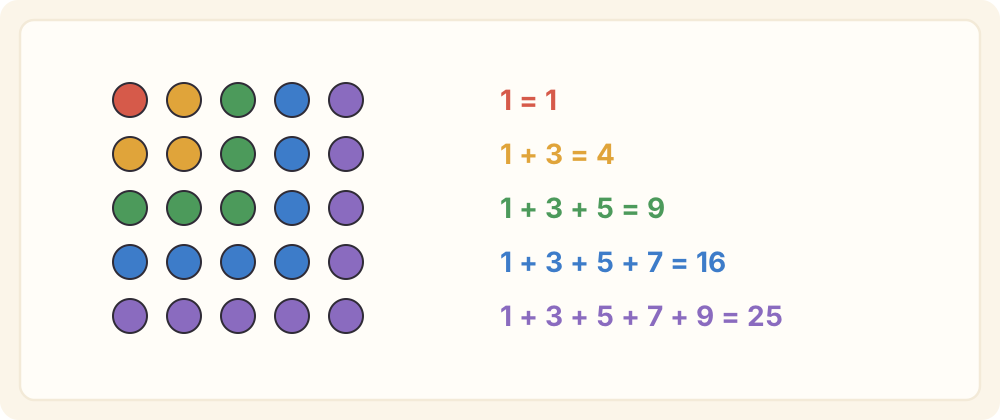
Adding the odd numbers in order always gives a square number. The picture shows why, and not just for these five: any square grows into the next one by one more corner strip, and each strip has 2 more dots than the one before.
Try it at home
- Lay out 36 buttons or coins as a square. How many rows does it have?
- Can 20 buttons make a square? Try it.
- Add 1 + 3 + 5 + 7 + 9 + 11. Is the answer a square number?
Answers: 1. 6 rows of 6. 2. No: 4 rows of 4 is 16, and 5 rows of 5 is 25. 3. 36 = 6 × 6, so yes.
Words to know
- square number - a number of dots that can be laid out as a square; a whole number times itself, like 16 = 4 × 4
Big idea
Square numbers are the numbers of dots that make a perfect square: 1, 4, 9, 16, 25 ... Each one is a whole number times itself, and each is the one before plus the next odd number.