Checking Is Not Proving
Draw a circle and put two points on it. Join them with a straight line: the circle is cut into 2 parts. With 3 points, joined every way, you get 4 parts. With 4 points, 8 parts. With 5 points, 16. The number of parts doubles each time: 1, 2, 4, 8, 16. So 6 points must give 32 parts. Must it?
A pattern that breaks
Draw it and count. Put 6 points on the circle, not evenly spaced, so that no three lines cross at the same point inside. Join every point to every other one, and count the parts. You get 31, not 32.
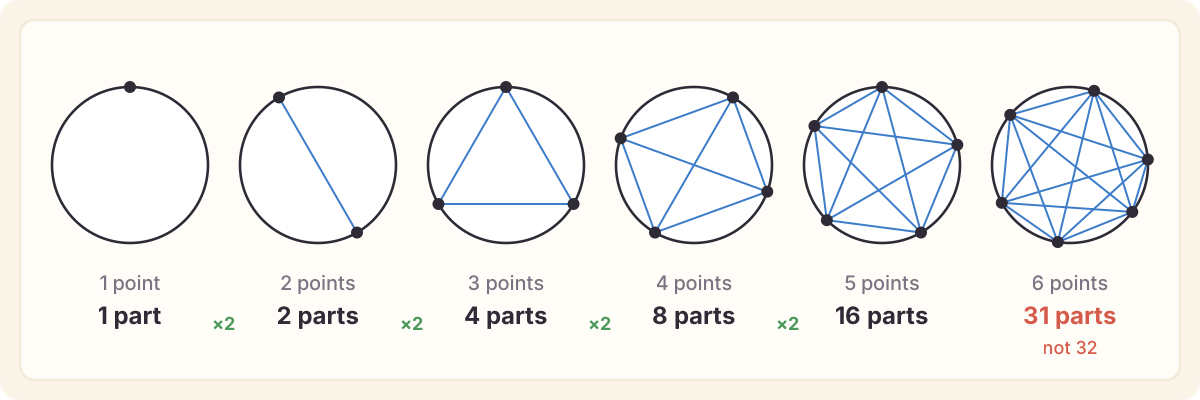
The pattern held five times, and then it broke. Nobody made a mistake in the first five circles: doubling was never the real rule, it only looked like it for small numbers.
This is why mathematicians don't stop at checking. One case that breaks an "every" claim is enough to show it is false. That case is called a counterexample (Logic Level 1 has a lesson on it, "Can You Imagine It Wrong?"). Six points on a circle are a counterexample to "the parts always double".
Why checking is never enough
Suppose you check that odd + odd is even for a hundred pairs of odd numbers: 3 + 5 = 8, 7 + 9 = 16, 21 + 13 = 34, and so on. Every one comes out even. Have you shown it for every odd number?
No. The odd numbers never run out, so however many you try, there are always more you haven't tried. And the circles show that a pattern can break late.
A proof covers every number at once
In Even and Odd, Again we did something better than checking. We drew any odd number as pairs of dots with one dot left over. We didn't say how many pairs: the picture works for 3, for 21 or for a million and one.
Now put two odd numbers together. Each one has a lonely dot. The two lonely dots make a new pair. So every dot has a partner, and the sum is even.
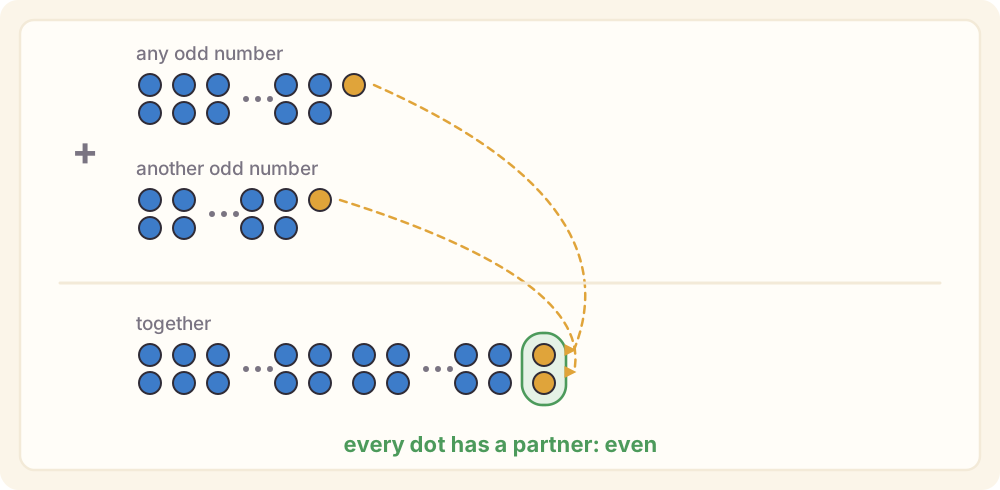
That is a proof: an argument that shows why something is true, so that it must be true in every case, including the ones nobody will ever check. A proof doesn't get weaker as the numbers get bigger. Once a statement is proved, no counterexample can ever turn up.
Try it at home
- Draw the circles with 1 to 5 points yourself and count the parts. Then try 6 points (it takes care: use a big circle and a ruler).
- Someone says: "Add 1 to a number and you always get an even number. Look: 1 + 1 = 2, 3 + 1 = 4, 5 + 1 = 6." Find a counterexample.
- Explain with pairs of dots why even + even is always even.
Answers: 2. Any even number will do: 2 + 1 = 3 is odd. 3. Pairs added to pairs are still all pairs, with nothing left over.
Words to know
- counterexample - one case that shows an "every" claim is false
- proof - an argument that shows why something is true in every case, not just the ones checked
- prove - to show something is true with a proof
Big idea
Checking examples, however many, can't show something is true for every number: a pattern can hold five times and break on the sixth. A proof shows why it is true, so it covers every number at once, and one counterexample is enough to break a claim that has no proof.