Multiplying Again and Again
Take a sheet of paper and fold it in half. Now it is 2 layers thick. Fold it again: 4 layers. Again: 8 layers. After only a few folds the paper is too thick to fold any more. How fast does the number of layers grow, and is there a short way to write it?
Doubling again and again
Each fold doubles the layers, and doubling means multiplying by 2:
- 1 fold: 2 layers.
- 2 folds: 2 × 2 = 4 layers.
- 3 folds: 2 × 2 × 2 = 8 layers.
- 4 folds: 2 × 2 × 2 × 2 = 16 layers.
- 5 folds: 32 layers. 6 folds: 64 layers. 7 folds: 128 layers.
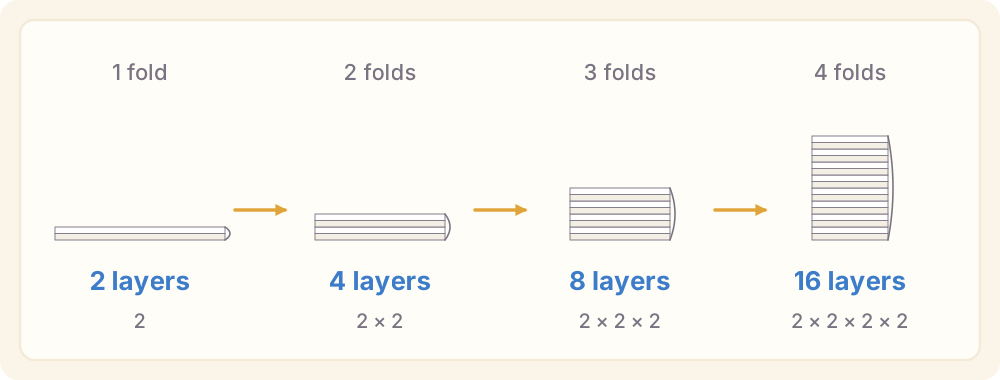
A sheet of everyday paper is hard to fold more than about 7 times. By then it is 128 layers thick, and it gets smaller with every fold. Doubling grows fast.
A short way to write it
Writing 2 × 2 × 2 × 2 × 2 × 2 × 2 takes time, and it is easy to lose count of the 2s. So we write the number once, with a small raised number after it. The small number says how many copies to multiply:
- 2 × 2 × 2 = 2³. We say "2 to the power 3".
- 2 × 2 × 2 × 2 × 2 × 2 × 2 = 2⁷ = 128.
The small number counts copies. It is not a number to multiply by: 2³ is 2 × 2 × 2 = 8, not 2 × 3 = 6.
Two powers have names of their own, taken from shapes:
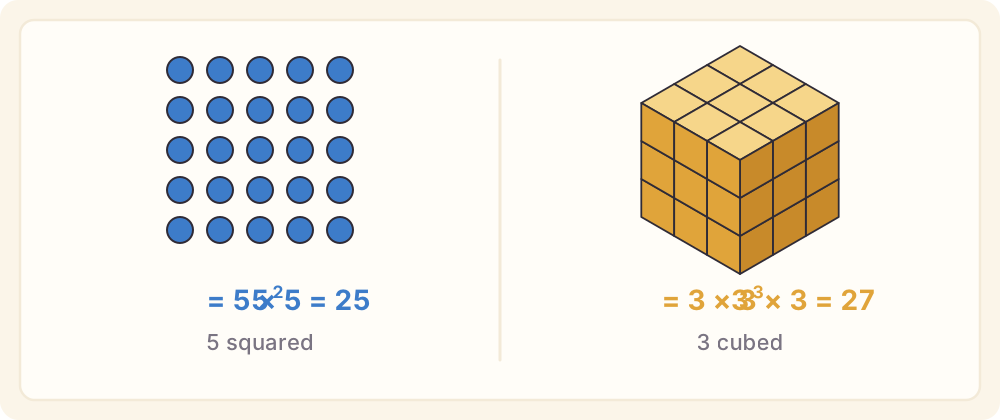
- 5² = 5 × 5 = 25 is said "5 squared", because 5 rows of 5 dots make a square. Every one of the square numbers is a number squared.
- 3³ = 3 × 3 × 3 = 27 is said "3 cubed", because 27 small blocks, 3 long, 3 wide and 3 tall, make a cube.
Powers of ten
Multiply 10 by itself, and something neat happens:
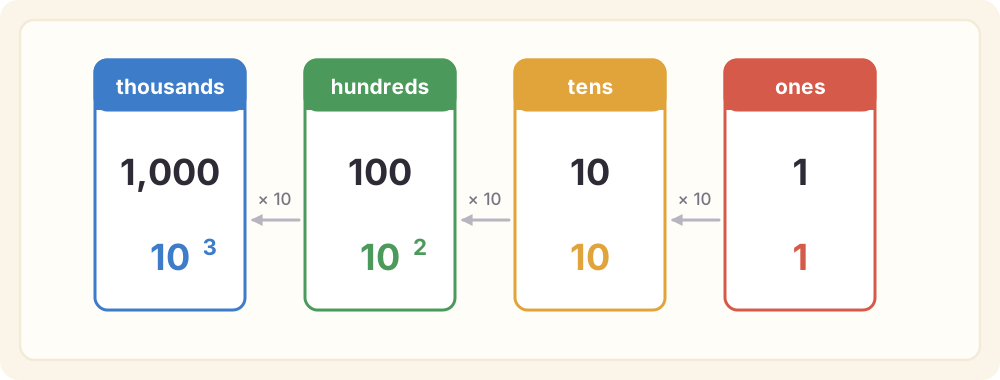
- 10² = 10 × 10 = 100.
- 10³ = 10 × 10 × 10 = 1,000.
- 10⁶ = 1,000,000, a million.
The power says how many zeros come after the 1. That is no accident. In Numbers Level 1 we saw that multiplying by ten moves every digit one place to the left. Each 10 in the power moves the 1 one more place. So the places in our numbers - tens, hundreds, thousands and on - are the powers of ten.
Try it at home
- Fold a sheet of paper in half as many times as you can. How many layers did you reach?
- Work out 3⁴.
- Write 100,000 as a power of ten.
Answers: 2. 3 × 3 × 3 × 3 = 81. 3. 10⁵, because it has 5 zeros.
Words to know
- power - a number multiplied by itself again and again, written with a small raised number that counts the copies: 2³ = 2 × 2 × 2
- squared - to the power 2: 5² = 5 × 5
- cubed - to the power 3: 3³ = 3 × 3 × 3
Big idea
A power is a short way to write multiplying the same number again and again: 2⁴ = 2 × 2 × 2 × 2 = 16. Powers grow very fast, and the powers of ten are the places of our numbers.