Tests for 2, 5 and 10
A market seller has 1,235 marbles and wants to put them in bags of 5. Will any marbles be left over? She could fill bag after bag and see - that would take a long time. Or she could divide 1,235 by 5, which takes a while too. Is there a quicker way to know whether a number divides by 5?
There is, and it takes one glance. Such a quick way of checking is called a test.
Every ten splits
Look at one ten: ten dots in a row.
- Ten splits into twos: 5 pairs, none left over.
- Ten splits into fives: 2 fives, none left over.
- Ten splits into tens: 1 ten, of course.
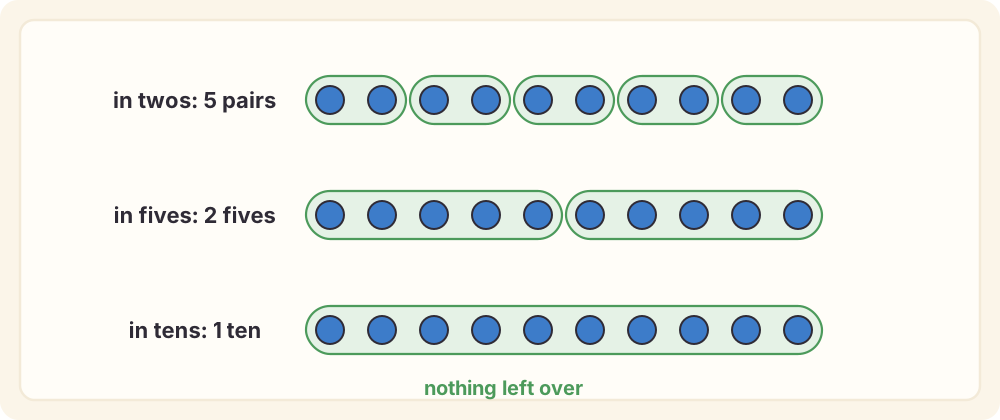
Now think of 1,235 the way the place value columns write it: 123 tens and 5 ones. Every one of those tens splits into fives with nothing left over, so the 123 tens are no trouble at all. Only the 5 ones are left to decide. And 5 ones make exactly one more bag of 5.
So 1,235 marbles fill bags of 5 with none left over. The seller only had to look at the last digit.
The three tests
Because tens never leave anything over, the last digit decides for 2, 5 and 10:
- Divisible by 10: the last digit is 0. (370 yes, 375 no.)
- Divisible by 5: the last digit is 0 or 5. (375 yes, 376 no.)
- Divisible by 2: the last digit is 0, 2, 4, 6 or 8 - the number is even. (376 yes, 377 no.) This is the even-and-odd rule from Numbers Level 1, which works for the same reason.
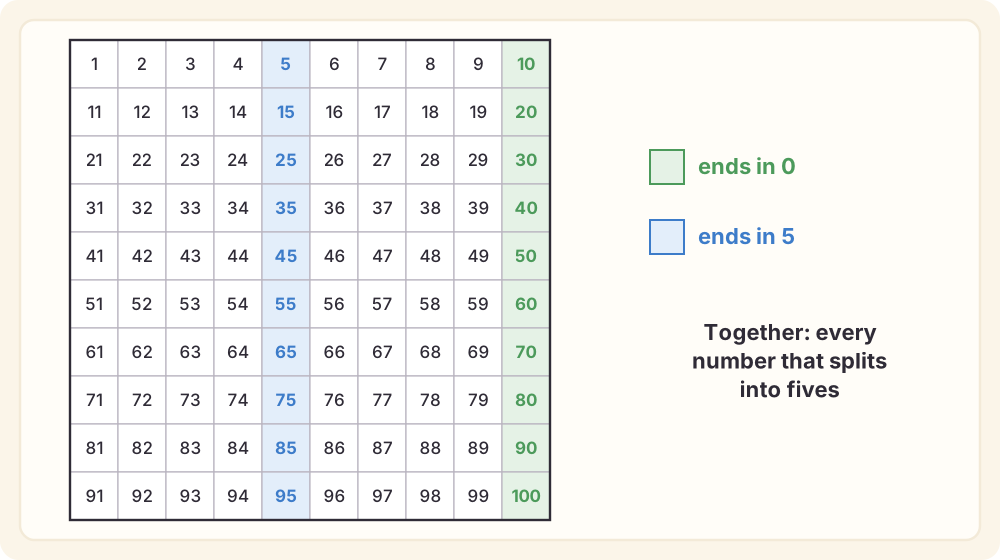
On a hundred square, the numbers that pass each test make straight columns, because only the last digit matters:
The last digit even tells you what is left
The tens never leave anything over, so whatever is left over comes from the ones. Take 1,237 marbles in bags of 5. The last digit is 7, and 7 is one bag of 5 with 2 left over. So 1,237 ÷ 5 leaves a remainder of 2.
Be careful: this only works for 2, 5 and 10, because they are the numbers that split ten exactly. It does not work for 3. 13 ends in 3, but 13 doesn't split into threes: 4 threes and 1 left over. A test for 3 needs a different idea, in the next lesson.
Try it at home
- Look at prices in a shop or on a receipt. Which ones divide by 5? By 10?
- Divisible by 2, 5, 10, or none: 4,560; 785; 2,222; 1,001?
- What is left over when 3,148 is split into fives? Answers below.
Answers: 4,560 by all three; 785 by 5; 2,222 by 2; 1,001 by none. 3,148 ends in 8, which is one five and 3 more, so 3 are left over.
Words to know
- test - a quick way of checking something without doing the whole sum; here, whether one number divides another
- last digit - the ones digit, at the right end of a number
Big idea
Every ten splits into twos, fives and tens with nothing left over, so only the last digit decides. A number divides by 10 if it ends in 0, by 5 if it ends in 0 or 5, and by 2 if it ends in an even digit.