Questions Nobody Can Answer Yet
Mathematicians notice a pattern, check it, then try to prove it. Sometimes the proof never comes. Some questions about whole numbers are easy to say and a 10-year-old can check them, yet the best mathematicians in the world have failed to answer them for hundreds of years. This last lesson takes you to the edge of what anyone knows.
Two primes for every even number
In 1742 a German mathematician, Christian Goldbach, wrote a letter to his friend Leonhard Euler, one of the greatest mathematicians who ever lived. Goldbach had noticed something about primes. In the form we use today, it says:
- Every even number bigger than 2 is two primes added together.
Check the first few:
- 4 = 2 + 2, 6 = 3 + 3, 8 = 3 + 5, 10 = 3 + 7
- 12 = 5 + 7, 14 = 7 + 7, 16 = 3 + 13, 18 = 5 + 13, 20 = 7 + 13
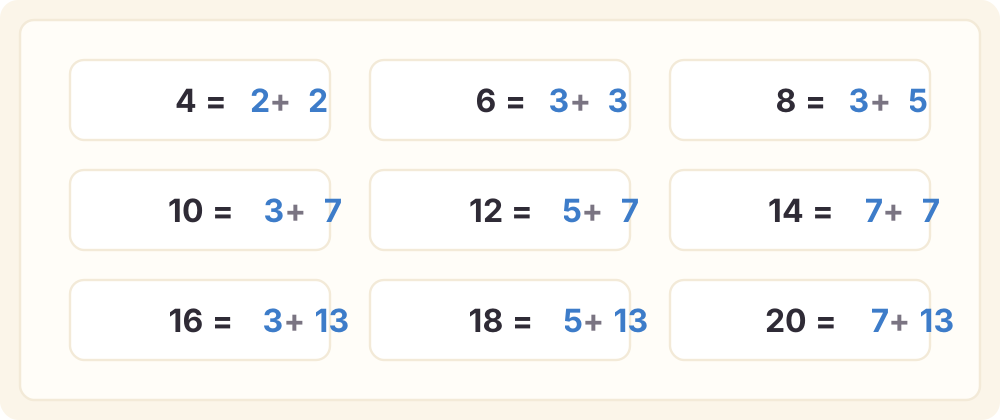
It keeps working. Computers have checked every even number up to 4,000,000,000,000,000,000 (four billion billions), and every one is two primes added together. Euler wrote back that he was sure it was true, but he could not prove it. Nobody has since.
As Checking Is Not Proving showed, all that checking is not a proof: there could be a counterexample further on. Most mathematicians think there isn't one. But thinking is not knowing.
A statement that mathematicians believe and have checked, but cannot prove, is called a conjecture. This one is Goldbach's conjecture.
Twin primes
Of two numbers next to each other, one is always even, and the only even prime is 2. So two primes are never next to each other, except 2 and 3. The closest they can be is with one number between them, like 11 and 13. Such a pair is called twin primes:
- 3 and 5, 5 and 7, 11 and 13, 17 and 19, 29 and 31, 41 and 43, ...
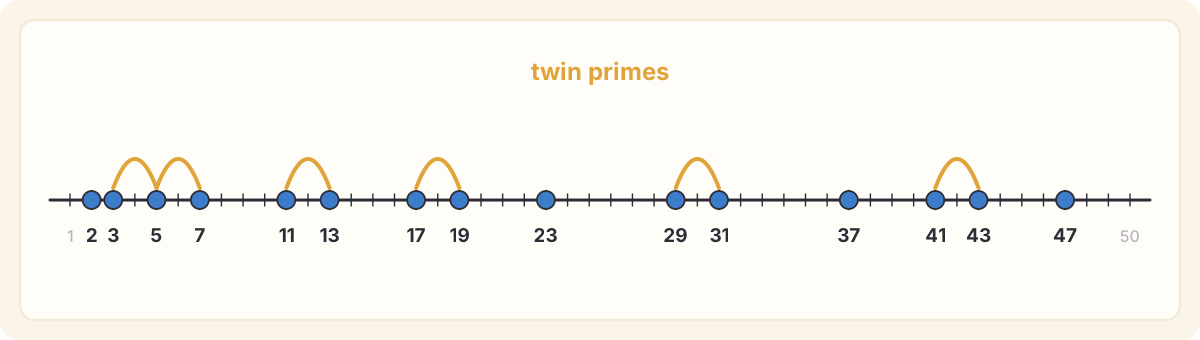
Twin primes get rarer as the numbers grow, but they keep turning up. Do they go on forever, like the primes themselves in Primes Never Run Out? That is the twin prime conjecture, and nobody knows. In 2013 a mathematician called Yitang Zhang proved something close to it, and the work of others since has brought it closer. But the question itself is still open.
Some guesses do get proved
Conjectures are not hopeless. Around 1637, the French lawyer and mathematician Pierre de Fermat wrote a guess about whole numbers in the margin of a book. It was proved in 1994 by Andrew Wiles, more than 350 years later. Once proved, it can never be broken.
Perhaps one of these will be proved in your lifetime. Perhaps by someone who first met them in a lesson like this one.
Try it at home
- Write 22, 24 and 30 as two primes added together. Can you find more than one way for 30?
- Find the twin primes between 50 and 75.
Answers: 1. 22 = 3 + 19, 24 = 5 + 19, 30 = 7 + 23 (also 11 + 19 and 13 + 17). 2. 59 and 61, 71 and 73.
Words to know
- conjecture - a statement that is believed and checked on many examples, but not yet proved
- twin primes - two primes with just one number between them, like 11 and 13
Big idea
A conjecture is a statement checked on many examples but not proved. Goldbach's conjecture (every even number bigger than 2 is two primes added together) and the twin prime conjecture are simple to say, and nobody has proved them yet.