Going Back from a Square
Amira wants to tile a square patio. She has bought exactly 49 square tiles, and the patio must use all of them. How many tiles long should each side be? She knows how to answer "7 × 7 = ?". Now she has the opposite question: which number, times itself, makes 49?
Undoing a square
Squaring starts from the side and gives the whole square: 7² = 7 × 7 = 49. Going back, from the whole square to its side, is called taking the square root. We write it with the sign √:
- √49 = 7, because 7 × 7 = 49.
- √9 = 3, because 3 × 3 = 9.
- √100 = 10, because 10 × 10 = 100.
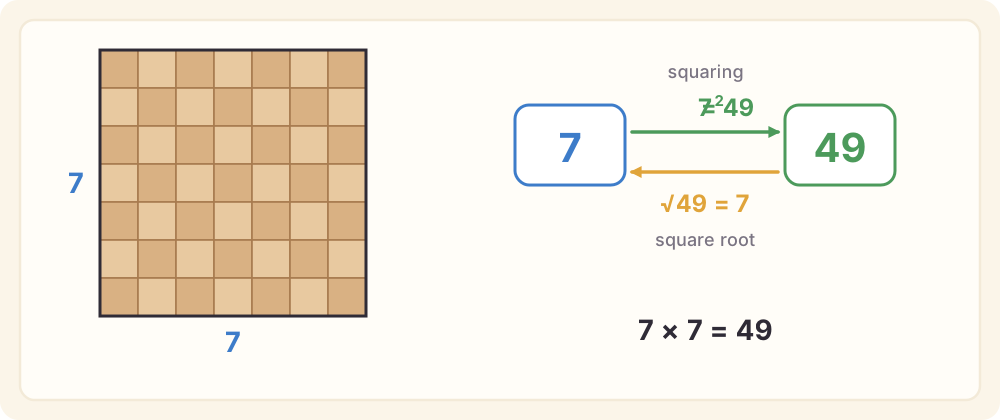
So the square root of a number is the number that, multiplied by itself, makes it. Amira's patio is 7 tiles long on each side.
Finding one by trying
To find √64, try numbers one by one, and multiply each by itself until you get 64:
- 6 × 6 = 36. Too small.
- 7 × 7 = 49. Still too small.
- 8 × 8 = 64. So √64 = 8.
Knowing the square numbers makes this quick. Their square roots are just 1, 2, 3 and so on:
- √1 = 1, √4 = 2, √9 = 3, √16 = 4, √25 = 5, √36 = 6, √49 = 7, √64 = 8, √81 = 9, √100 = 10.
When it isn't a square number
Amira's neighbour Tomás has 30 tiles. Can he make a square patio with all of them? 5 × 5 = 25 is too few, and 6 × 6 = 36 is too many. No whole number times itself makes 30. So √30 is not a whole number. It lies between 5 and 6, because 30 lies between 25 and 36.
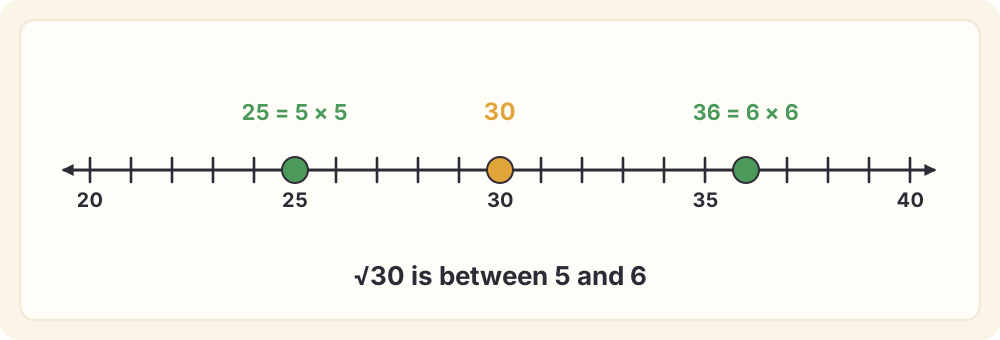
This works for any number: find the two square numbers it lies between, and its square root lies between their square roots. Even √2 is not a whole number: it is somewhere between 1 and 2.
Try it at home
- What is √36? And √81?
- Between which two whole numbers is √50?
- You have 20 coins. What is the biggest square you can make with them, and how many coins are left over?
Answers: 1. 6 and 9. 2. Between 7 and 8, because 50 is between 49 and 64. 3. 4 rows of 4, with 4 coins left over.
Words to know
- square root - the number that, multiplied by itself, makes a given number: √49 = 7 because 7 × 7 = 49
- √ - the sign for a square root
Big idea
A square root goes back from a square to its side: √49 = 7, because 7 × 7 = 49. Only square numbers have whole square roots. The square root of any other number lies between two whole numbers.