Even and Odd, Again
Five friends each bring an odd number of marbles to a game: maybe 3, maybe 7, maybe 101. Could they have 20 marbles altogether? You could try lots of different numbers and see. But however many you try, there are always more you haven't tried. Is there a way to be sure?
A picture of any even number
In Numbers Level 1 we saw that an even number splits into pairs, and an odd number always leaves one over. Let's draw that as a shape:
- An even number is a rectangle of dots two rows high. It is a multiple of 2.
- An odd number is the same rectangle with one extra dot sticking out at the end.
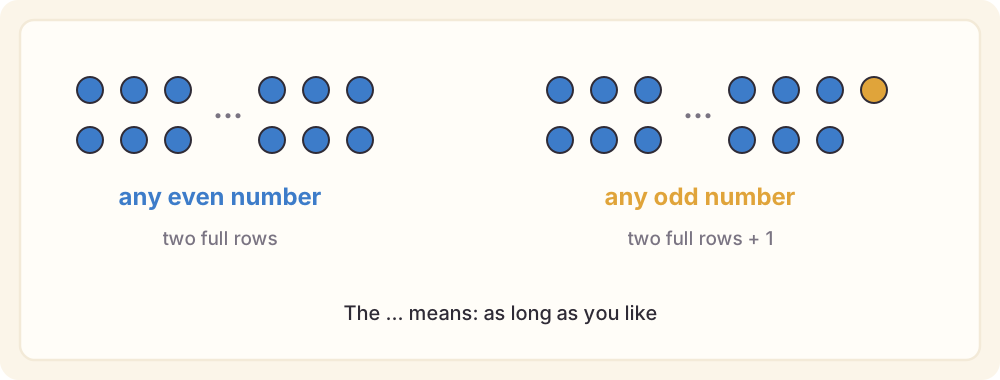
The gap in the middle of each row means "as long as you like". So this one picture is not 8, or 12, or 1,000. It is every even number at once, and every odd number at once.
Adding, for every number
Now put two odd numbers together. Each one is a two-row rectangle with one dot sticking out. Push the two shapes together, and the two extra dots fit into a pair of their own.
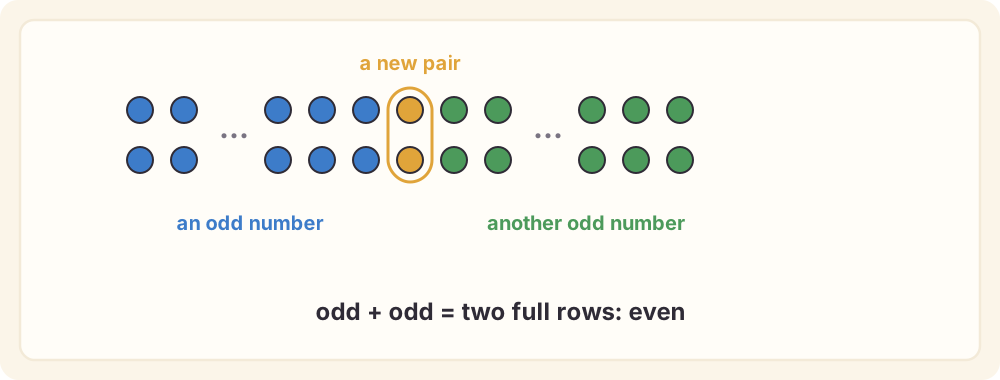
The result is two full rows: an even number. This is true however long the rows are, so odd + odd is even for every pair of odd numbers - including ones nobody has ever written down. We didn't check examples; we saw why.
With the same picture: even + even is two rectangles, still two rows high (even). Even + odd keeps its one extra dot (odd).
Multiplying
What about times? 3 × 5 is 3 rows of 5 dots.
- Each row of 5 makes 2 pairs and has 1 dot over.
- There are 3 rows, so 3 dots are over. Two of them pair up, and 1 is still alone.
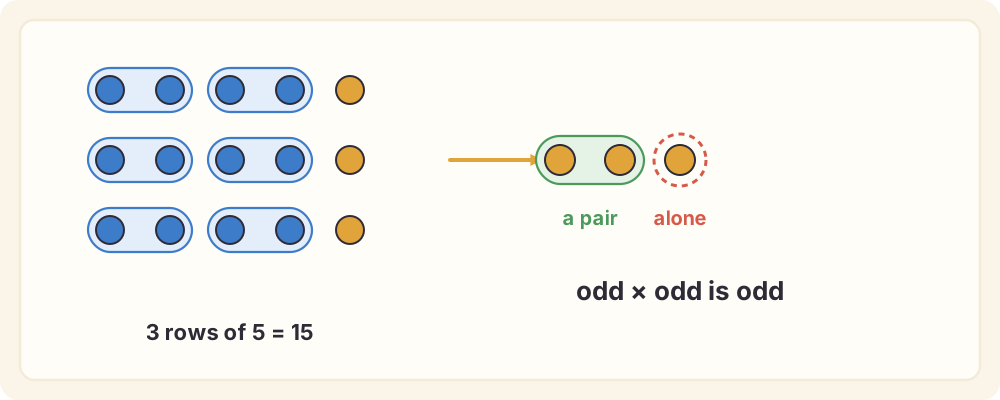
An odd number of rows, each with one dot over, always leaves one dot over in the end. So odd × odd is odd. And if either number is even, every row (or the number of rows) pairs up, so even × anything is even.
Back to the marbles
Each friend's odd number has one marble sticking out. Five friends means five extra marbles. Four of them pair up, and one is left alone. So the total is always odd, and it can never be 20. We know this without trying a single number.
Try it at home
- Without working them out: even or odd? 17 + 26; 15 + 33; 7 × 9; 7 × 10.
- Can three odd numbers add up to 30?
- Arrange buttons in two rows to show 9 + 7. Where do the extra buttons go? Answers below.
Answers: odd, even, odd, even. No: three extra dots leave one alone, so the total is odd. The two extra buttons make one more pair.
Words to know
- for every number - true of all numbers, not only the ones we tried; a picture with "as long as you like" rows can show it
Big idea
An even number is two rows of dots; an odd number has one dot sticking out. Putting the shapes together shows why odd + odd is even and odd × odd is odd - for every number at once, not just the ones we checked.