Only One Way to Build It
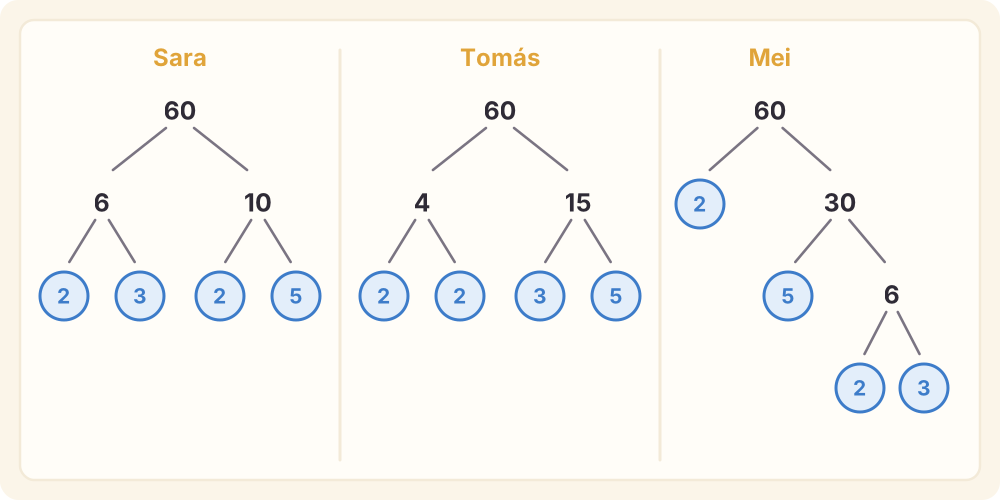
Sara, Tomás and Mei each draw a factor tree for 60. Sara starts with 6 × 10. Tomás starts with 4 × 15. Mei starts with 2 × 30. Their trees look different. Will they find different primes at the ends?
Three trees, the same primes
Let's grow all three trees:
- Sara: 6 × 10, then 6 = 2 × 3 and 10 = 2 × 5. Primes: 2, 3, 2, 5.
- Tomás: 4 × 15, then 4 = 2 × 2 and 15 = 3 × 5. Primes: 2, 2, 3, 5.
- Mei: 2 × 30, then 30 = 5 × 6, then 6 = 2 × 3. Primes: 2, 5, 2, 3.
Put each set in order, from small to big, and all three say the same thing:
- 60 = 2 × 2 × 3 × 5.
Always the same
This is not luck. Whichever factor pair you start with, the tree of a number always ends with the same primes, only perhaps in a different order. In other words, every whole number bigger than 1 is built from primes in exactly one way. Mathematicians call this the fundamental theorem of arithmetic, "fundamental" meaning that a great deal is built on it.
Proving that it is always true takes more than this course. Euclid, a Greek mathematician, had the key step about 2,300 years ago. The first complete proof was published by the German mathematician Carl Friedrich Gauss in 1801.
A number's own recipe
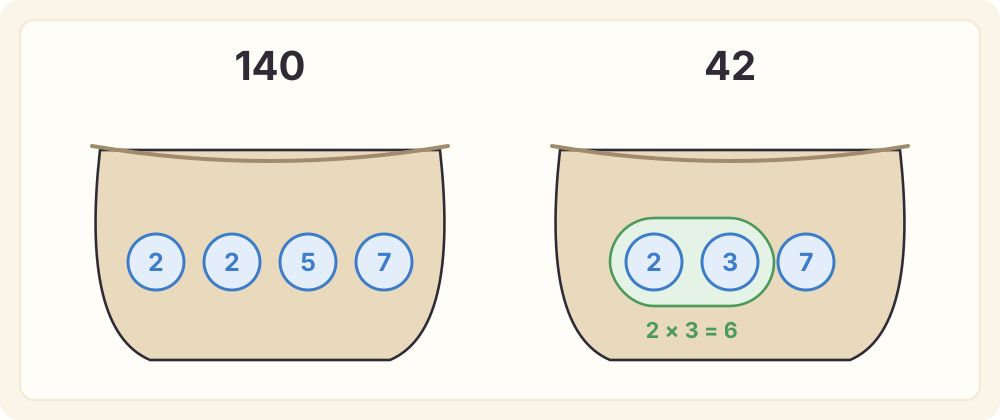
Because the prime factors never change, they are like a recipe that belongs to that number and no other. The recipe answers questions without any dividing:
- Is 3 a factor of 140 = 2 × 2 × 5 × 7? There is no 3 in the recipe, so no.
- Is 6 a factor of 42 = 2 × 3 × 7? 6 is 2 × 3, and both are in the recipe, so yes: 42 = 6 × 7.
Why 1 is not a prime
Now we can see why mathematicians keep 1 out of the primes. If 1 were a prime, it could go into any recipe as often as you like, and nothing would change:
- 60 = 2 × 2 × 3 × 5 = 1 × 2 × 2 × 3 × 5 = 1 × 1 × 2 × 2 × 3 × 5 ...
Then every number would be built from "primes" in endless ways, and the rule "exactly one way" would break. Leaving 1 out keeps the rule true.
Try it at home
- Draw two different factor trees for 72: one starting with 8 × 9, one starting with 2 × 36. Do they end with the same primes?
- 90 = 2 × 3 × 3 × 5. Without dividing, is 7 a factor of 90? Is 15?
Answers: 1. yes, both give 72 = 2 × 2 × 2 × 3 × 3; 2. 7 is not (there is no 7 in the recipe); 15 is, because 15 = 3 × 5 and both are there.
Words to know
- fundamental theorem of arithmetic - the fact that every whole number bigger than 1 is built from primes in exactly one way, apart from the order
Big idea
Every factor tree of a number ends with the same primes. Each number bigger than 1 has exactly one prime recipe, and that recipe tells you its factors. Keeping 1 out of the primes is what keeps the recipe unique.