Dividing Exactly
Ama has a bag of 24 sweets to share at her birthday in Accra. If 4 friends come, each gets 6. If 6 friends come, each gets 4. But if 5 friends come, something goes wrong. Why do some numbers of friends work and others don't?
Nothing left over
Share 24 sweets between 5 friends, one round at a time. After 4 rounds each friend has 4 sweets, and 20 sweets are given out. 4 sweets are left, not enough for another round. So 24 ÷ 5 is 4 remainder 4.
With 4 friends, the sweets run out exactly: 24 ÷ 4 = 6, remainder 0.
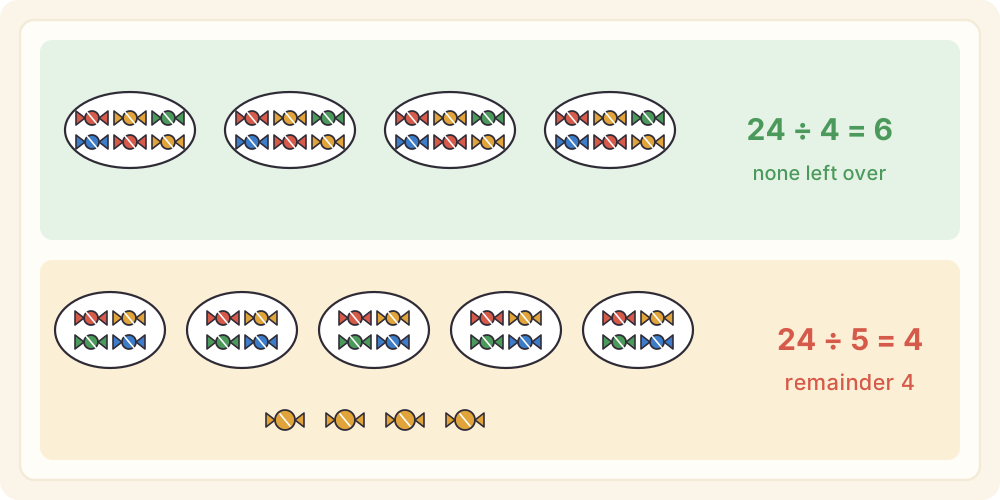
When dividing leaves remainder 0, we say that 4 divides 24, or that 24 is divisible by 4. 5 does not divide 24: 24 is not divisible by 5.
One fact, three ways of saying it
Look at 3 × 8 = 24 as an array: 3 rows of 8. This one picture says three things:
- 3 is a factor of 24 (24 makes a rectangle with rows of 3);
- 24 is a multiple of 3 (eight jumps of 3 land on 24);
- 3 divides 24 (24 shared into 3 rows gives 8 each, none left over).
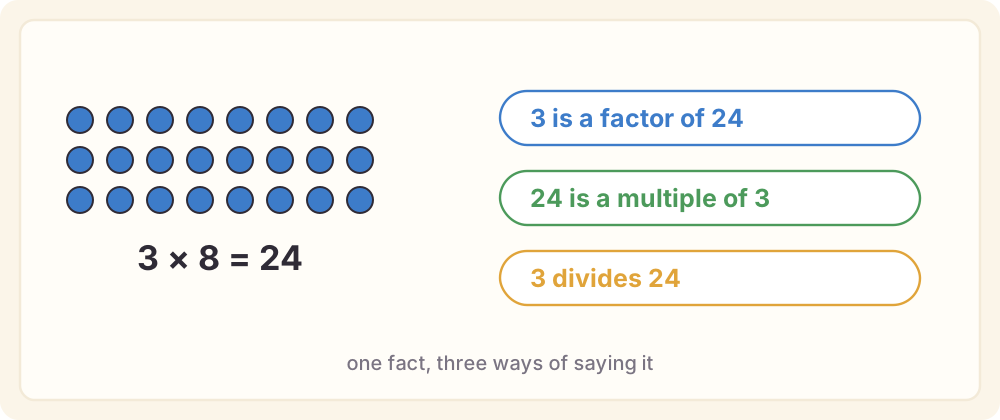
These are three ways of saying the same thing. A factor is also called a divisor - the number that divides. So the factors of 24 are exactly the numbers that divide 24: 1, 2, 3, 4, 6, 8, 12 and 24.
A few that always work
- 1 divides every number: sharing between one person leaves nothing over.
- Every number divides itself: 7 sweets between 7 friends is 1 each.
- Every number divides 0: 0 sweets between 5 friends is 0 each, with nothing left over. (But nothing can be divided by 0, as we saw in Numbers Level 1.)
To check whether one number divides another, you can always divide and look at the remainder. For some numbers there is a much faster way, and that is the next module, starting with Tests for 2, 5 and 10.
Try it at home
- Take 30 buttons. Which numbers of piles from 2 to 10 share them with none left over?
- Which of these does 4 divide: 16, 18, 28, 30?
Answers: 1. 2, 3, 5, 6 and 10 piles. 2. 16 and 28.
Words to know
- divides - one number divides another when sharing leaves remainder 0: 4 divides 24
- divisible - 24 is divisible by 4 because 4 divides it
- divisor - another word for a factor: the number that divides
Big idea
"3 is a factor of 24", "24 is a multiple of 3" and "3 divides 24" are one fact, seen from three sides. You can always check it by dividing: if nothing is left over, it divides.