Simplest Form
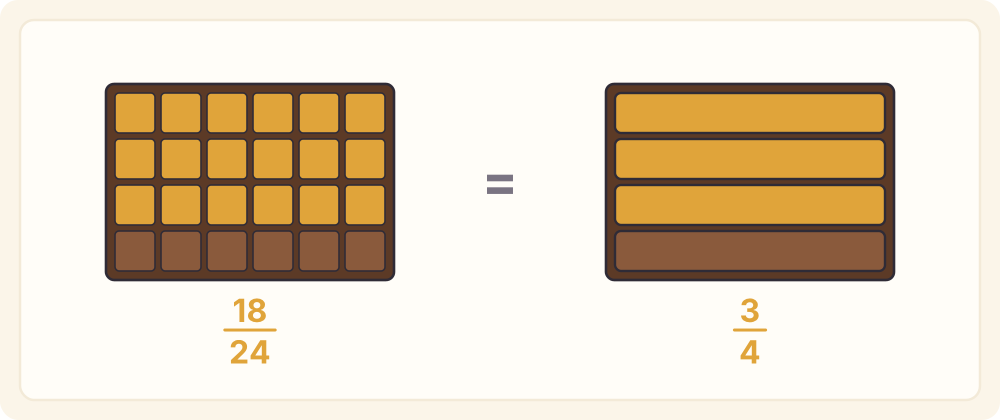
A chocolate bar has 24 small squares: 4 rows of 6. After the film, Tomás counts what his family ate: 18 squares, so 18/24 of the bar. "Is that a lot?" his sister asks. It is hard to tell from 18/24. Is there a simpler name for the same amount?
Dividing the top and the bottom
In Numbers Level 1 we saw that multiplying the top and the bottom of a fraction by the same number gives an equivalent fraction: the same amount with a different name (1/2 = 2/4). It also works the other way: dividing the top and the bottom by the same number gives an equivalent fraction.
Look at the bar again, but see each row of 6 squares as one big piece. Then the bar is 4 big pieces, and the 18 eaten squares fill 3 of them (3 rows of 6 is 18).
- 18 ÷ 6 = 3 and 24 ÷ 6 = 4, so 18/24 = 3/4.
Three quarters of the bar is gone. That is easy to picture.
Which number to divide by?
You can only divide by a number that goes exactly into the top and the bottom: a common factor. Tomás could go in small steps:
- divide both by 2: 18/24 = 9/12;
- divide both by 3: 9/12 = 3/4.
Or he could use the biggest common factor at once. In The Greatest Common Factor lesson we saw how to find it: the greatest common factor of 18 and 24 is 6. Dividing by 6 gets there in one step: 18/24 = 3/4.
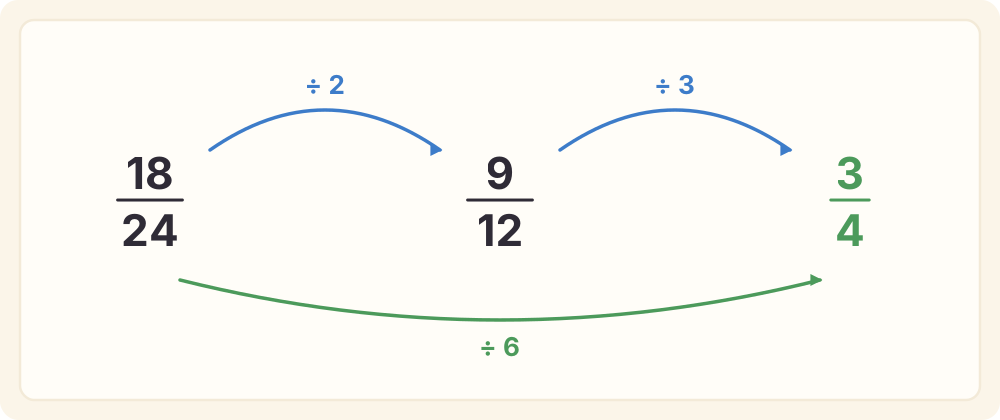
Both ways end at the same place. Small steps are fine; the greatest common factor is just quicker.
When to stop
Can 3/4 be made simpler? The factors of 3 are 1 and 3; the factors of 4 are 1, 2 and 4. The only common factor is 1, and dividing by 1 changes nothing. So we stop. A fraction whose top and bottom have no common factor except 1 is in its simplest form.
- 8/15 is already in simplest form: 8 and 15 share only 1.
- 10/15 is not: both divide by 5, so 10/15 = 2/3.
Every fraction has exactly one simplest form. That gives a quick check for whether two fractions are the same amount: simplify both. 10/15 and 14/21 look different, but 10/15 = 2/3 and 14/21 = 2/3 (dividing by 7). So they are equal.
Try it at home
- Draw a bar of 3 rows of 4 squares and colour 8. What fraction is coloured? Group the squares to find its simplest form.
- Put 6/9, 12/16 and 20/30 in simplest form.
- Are 6/8 and 9/12 the same amount?
Answers: 1. 8/12 = 2/3. 2. 2/3, 3/4, 2/3. 3. Yes, both are 3/4.
Words to know
- simplest form - the name of a fraction whose top and bottom have no common factor except 1, like 3/4
Big idea
Dividing the top and bottom of a fraction by the same number keeps the amount the same. Dividing by their greatest common factor gives the simplest form in one step: 18/24 = 3/4. Two fractions are the same amount exactly when their simplest forms are the same.