Adding Fractions with Different Bottoms
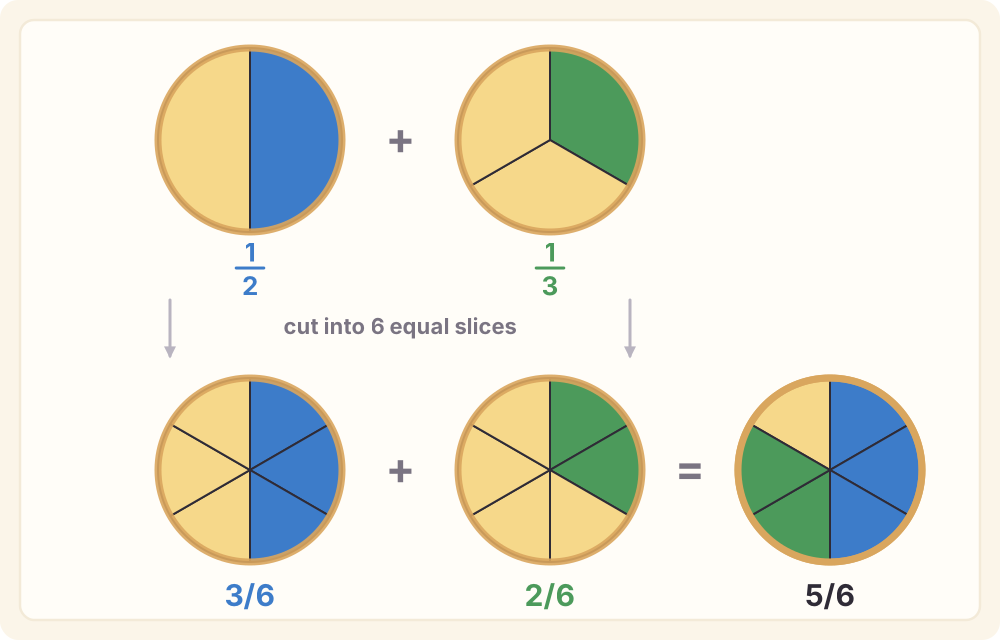
Mina and Kai have two pizzas of the same size. Mina eats 1/2 of hers, and Kai eats 1/3 of his. How much pizza did they eat together? Kai says, "1 + 1 is 2, and 2 + 3 is 5, so we ate 2/5 of a pizza." Is Kai right?
Same bottom: just count
When two fractions have the same bottom number, their pieces are the same size, so you can count them together:
- 1/5 + 2/5 = 3/5: one fifth and two fifths make three fifths.
The bottom number stays 5. It tells the size of the pieces, and adding doesn't change the size of a piece.
Different bottoms: pieces of different sizes
Mina's piece is a half and Kai's is a third. They are different sizes, so we can't count "1 piece + 1 piece" and call it 2 of anything.
Kai's answer can't be right anyway. 2/5 is less than 1/2: it is less than what Mina ate on her own.
The way out is to cut both pizzas into pieces of the same size. Cut each half into 3, and each third into 2: then both pizzas are in sixths.
- Mina's 1/2 is 3/6 (multiply the top and bottom by 3).
- Kai's 1/3 is 2/6 (multiply the top and bottom by 2).
- Now count: 3/6 + 2/6 = 5/6.
Together they ate five sixths of a pizza.
Which size of piece?
Why sixths? The new bottom number must be one that both 2 and 3 go into exactly, so a common multiple of 2 and 3. The smallest is easiest, the least common multiple from the When Do They Meet Again? lesson. Here it is 6. This shared bottom number is called a common bottom number (mathematicians say "common denominator").
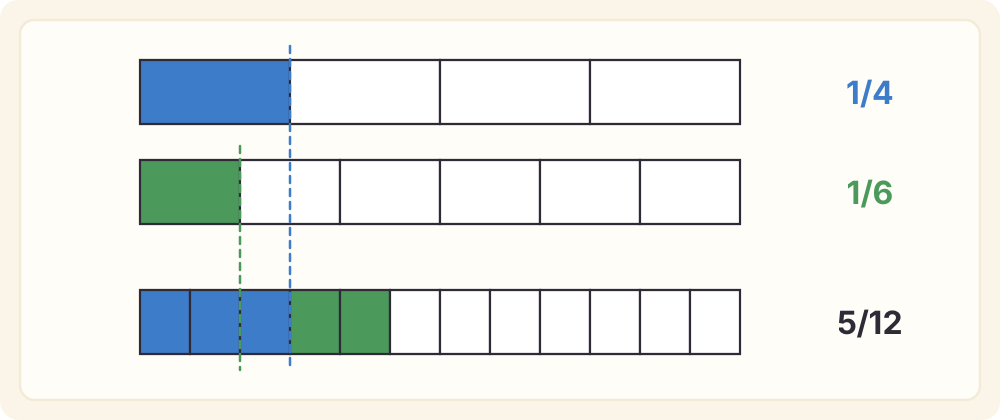
One more: 1/4 + 1/6. The least common multiple of 4 and 6 is 12, so cut both into twelfths:
- 1/4 = 3/12 and 1/6 = 2/12;
- 3/12 + 2/12 = 5/12.
Taking away works the same way: 1/2 - 1/3 = 3/6 - 2/6 = 1/6. And if an answer can be simplified, simplify it, as in the Simplest Form lesson: 1/6 + 1/3 = 1/6 + 2/6 = 3/6 = 1/2.
Try it at home
- Fold one strip of paper in half and another into quarters. Colour 1/2 of the first and 1/4 of the second. Fold the first strip into quarters too. How many quarters are coloured in all?
- Work out 1/2 + 1/4, 1/3 + 1/4 and 1/2 - 1/5.
Answers: 1. 3 quarters, 3/4. 2. 3/4; 7/12; 3/10.
Words to know
- common bottom number (or common denominator) - one bottom number that two fractions are both written with, so their pieces are the same size
Big idea
You can only count pieces of the same size. To add fractions with different bottoms, first write them with a common bottom number - the least common multiple of the bottoms is easiest - and then add the tops: 1/2 + 1/3 = 3/6 + 2/6 = 5/6.