Breaking Numbers Apart
A baker in Lagos takes a tray out of the oven. The buns sit in 7 rows, with 12 buns in each row. How many buns are there? That is 7 × 12, and most people don't know it by heart. Can we work it out from sums that are easy?
In this course "number" means a whole number: 0, 1, 2, 3 and so on. In Numbers Level 1 we saw that things in equal rows make a rectangle called an array, and that multiplying counts it: 4 rows of 6 is 4 × 6 = 24. This lesson looks at that rectangle again.
Cut the rectangle in two
Take the tray of 7 rows of 12, and draw a line down it after the tenth column. Now there are two smaller rectangles:
- on one side, 7 rows of 10, which is 7 × 10 = 70;
- on the other side, 7 rows of 2, which is 7 × 2 = 14.
No bun was lost and none was added. So the whole tray is the two parts put together:
- 7 × 12 = 7 × 10 + 7 × 2 = 70 + 14 = 84.
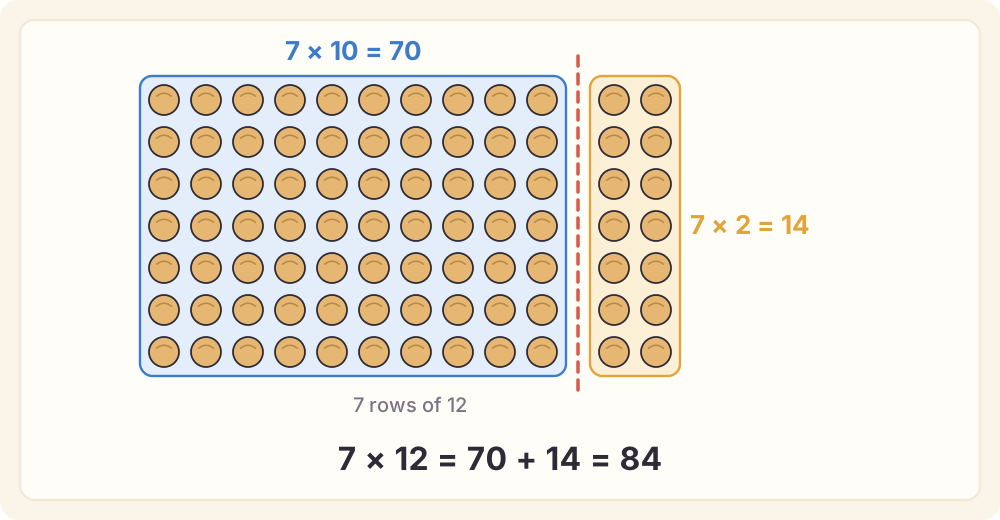
This is breaking a number apart: we broke 12 into 10 and 2, multiplied each part by 7, and added the answers. Mathematicians call this rule the distributive law, but the rectangle is all you need to remember it.
Any cut works
The line could go anywhere. Cut the 12 columns into 6 and 6, and you get 7 × 6 + 7 × 6 = 42 + 42 = 84. The same answer, because it is the same tray.
So we choose the cut that makes the sums easy. Tens are usually easiest, because multiplying by ten only moves each digit one place to the left:
- 6 × 13 = 6 × 10 + 6 × 3 = 60 + 18 = 78.
Three numbers at once
The baker has 2 trays, and each tray holds 3 rows of 4 cakes. How many cakes? That is 2 × 3 × 4. You can group it two ways:
- first one tray, 3 × 4 = 12, then two trays: 2 × 12 = 24;
- or first the rows, 2 × 3 = 6 rows of 4 in all: 6 × 4 = 24.
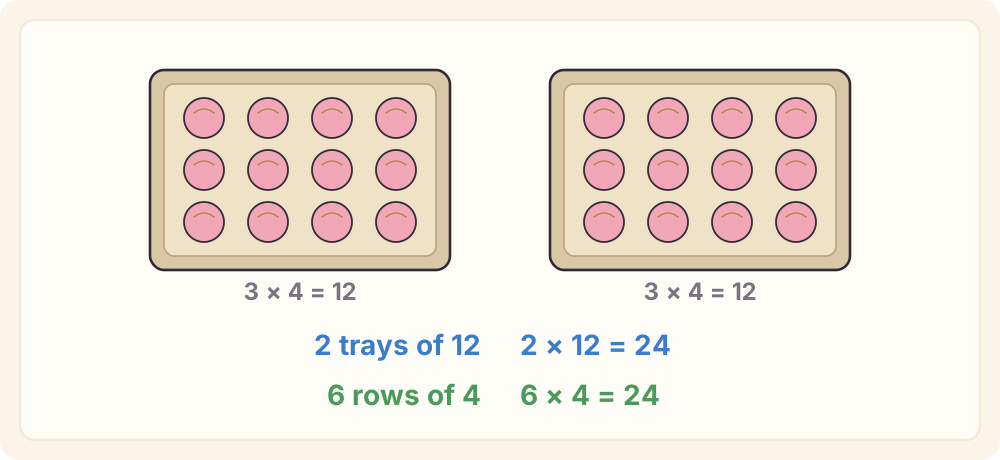
Counting a different way doesn't change the cakes. So when you multiply three numbers, you can multiply any two of them first: 5 × 7 × 2 is easier as 5 × 2 = 10, then 10 × 7 = 70.
Try it at home
- Lay out 3 rows of 14 buttons. Put a pencil after the tenth column. Count each part, then add.
- Work out 2 × 9 × 5 the easy way.
Answers: 1. 3 × 10 + 3 × 4 = 30 + 12 = 42. 2. 2 × 5 = 10 first, then 10 × 9 = 90.
Words to know
- array - things laid out in equal rows and columns, making a rectangle
- breaking a number apart - splitting a number into parts, multiplying each part, and adding the answers: 7 × 12 = 7 × 10 + 7 × 2
- distributive law - the name mathematicians give to breaking apart
Big idea
A multiplication is a rectangle, and a rectangle can be cut into smaller ones without losing anything. So 7 × 12 is 7 × 10 + 7 × 2. And three numbers can be multiplied in any grouping: 2 × 3 × 4 is 24 whichever two you do first.