Multiples: Counting in Jumps
A market stall in Lima sells eggs only in boxes of 6. You can buy one box, or two, or three - but you can't open a box. Can you buy exactly 20 eggs?
Counting in jumps
Count the eggs box by box:
- 1 box: 6 eggs;
- 2 boxes: 12 eggs;
- 3 boxes: 18 eggs;
- 4 boxes: 24 eggs.
The number of eggs goes up by 6 each time: 6, 12, 18, 24, ... So 20 is never reached. After 18 the next number is 24, and 20 is jumped over.
The numbers we land on are called the multiples of 6. A multiple of 6 is 6 times some number: 6 × 1 = 6, 6 × 2 = 12, 6 × 3 = 18, and so on.
You can see the same idea on a number line. A frog starts at 0 and jumps 3 each time. It lands on 3, 6, 9, 12, 15, ... These are the multiples of 3. Every number it jumps over, like 7 or 11, is not a multiple of 3.
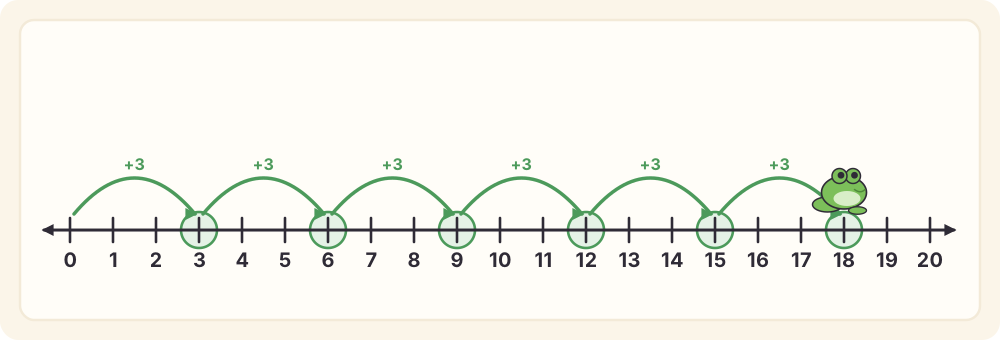
Two more things about multiples:
- They never end. The frog can always make one more jump. There is no biggest multiple of 3.
- 0 is a multiple of every number, because 6 × 0 = 0: zero boxes, zero eggs. The frog starts there before its first jump.
Is it a multiple?
To check whether 20 is a multiple of 6, you don't have to count all the way up. Divide: 20 ÷ 6 is 3 remainder 2 (remainders were in Numbers Level 1). There is something left over, so 20 is not a multiple of 6. But 24 ÷ 6 = 4 with nothing left over, so 24 is a multiple of 6.
Patterns in the multiples
Write the numbers from 1 to 50 in rows of ten, and colour the multiples. The multiples of 5 make two straight columns: every one ends in 5 or 0. The multiples of 9 make a slanting line, because each one is 10 more and 1 less than the one before.
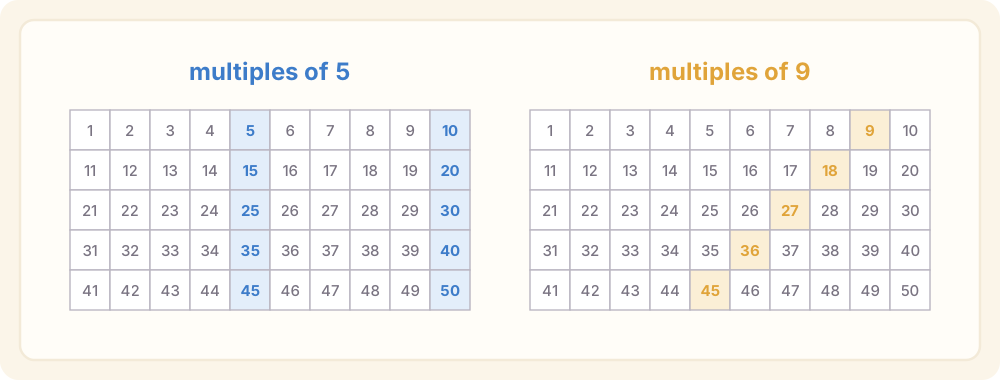
Patterns like these are a first hint that multiples follow rules. In the next module we turn them into quick tests.
Try it at home
- Write the first ten multiples of 4. Which of them are also multiples of 8?
- Buttons come in packs of 5. Can you buy exactly 35? Exactly 42?
Answers: 1. 4, 8, 12, 16, 20, 24, 28, 32, 36, 40; every second one (8, 16, 24, 32, 40) is a multiple of 8. 2. 35 yes (7 packs); 42 no, it is between 40 and 45.
Words to know
- multiple - what you get by multiplying a number by 0, 1, 2, 3, and so on: the multiples of 6 are 0, 6, 12, 18, 24, ...
Big idea
The multiples of a number are where you land counting in jumps of that number. They never end, 0 is always one of them, and a number is a multiple when dividing it leaves nothing over.