The Greatest Common Factor
Leila is making party bags for her little brother's birthday. She has 12 biscuits and 18 sweets. Every bag must be the same: the same number of biscuits and the same number of sweets, with nothing left over. She wants as many bags as possible. How many bags can she make?
Bags must share both numbers
Say Leila makes 4 bags. The 12 biscuits share fairly: 3 in each bag. But 18 sweets don't share into 4 bags: 18 ÷ 4 is 4 remainder 2, so 2 sweets are left over. 4 bags won't work.
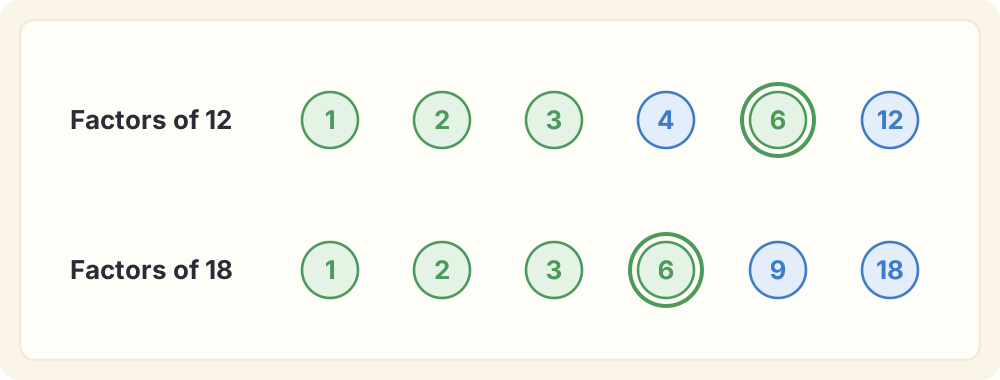
The number of bags must divide 12 exactly, so it is a factor of 12 (as in the Factors lesson). It must also divide 18 exactly, so it is a factor of 18 too. Let's list both:
- the factors of 12 are 1, 2, 3, 4, 6 and 12;
- the factors of 18 are 1, 2, 3, 6, 9 and 18.
The numbers in both lists are 1, 2, 3 and 6. These are the common factors of 12 and 18: "common" means shared. Leila could make 1, 2, 3 or 6 bags. The biggest of them is 6.
So Leila makes 6 bags, each with 2 biscuits (12 ÷ 6 = 2) and 3 sweets (18 ÷ 6 = 3).
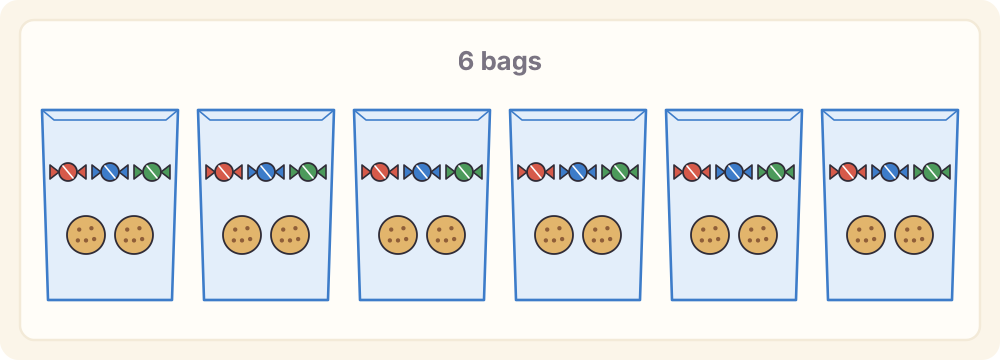
The greatest common factor
The biggest number that divides two numbers exactly is called their greatest common factor. Some books call it the highest common factor: it is the same thing. The greatest common factor of 12 and 18 is 6.
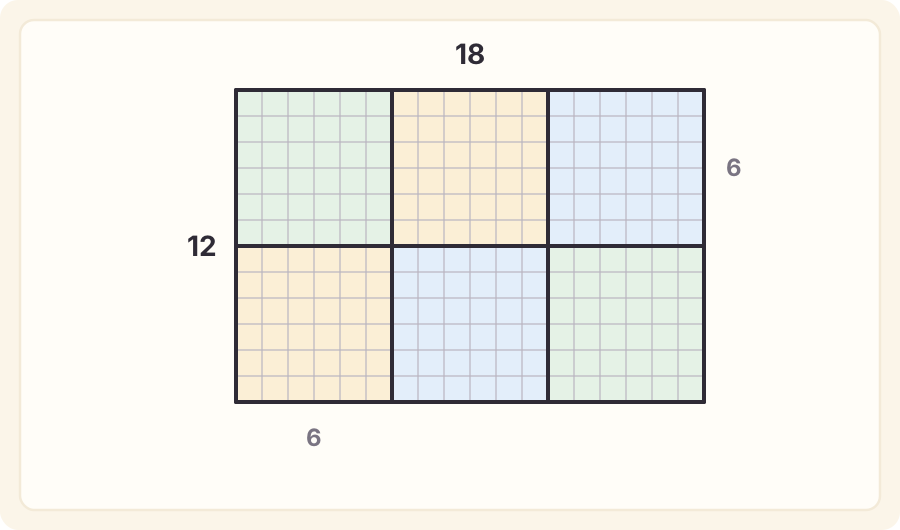
It answers more questions than party bags. A garden path is 12 steps long and 18 steps wide (one step is a small square). You want to cover it with square tiles, all the same size, as big as possible, and none cut. A tile's side must fit along 12 exactly and along 18 exactly: it is a common factor again. The biggest tile is 6 steps by 6 steps, and 6 of them cover the path.
A shortcut with prime factors
Lists work for small numbers. For bigger ones, use the prime factors from the Factor Trees lesson:
- 12 = 2 × 2 × 3;
- 18 = 2 × 3 × 3.
Both have one 2 and one 3. Multiply the ones they share: 2 × 3 = 6. That is the greatest common factor.
Sometimes two numbers share nothing but 1. The factors of 8 are 1, 2, 4, 8; the factors of 15 are 1, 3, 5, 15. Their greatest common factor is 1: with 8 biscuits and 15 sweets, the only fair way is one big bag.
Try it at home
- Take 8 buttons and 12 coins. Make as many equal piles as you can, each pile with the same number of buttons and the same number of coins.
- What is the greatest common factor of 10 and 15? Of 9 and 16?
Answers: 1. 4 piles, each with 2 buttons and 3 coins. 2. 5; 1.
Words to know
- common factor - a number that is a factor of two numbers at once, like 3 for 12 and 18
- greatest common factor (or highest common factor) - the biggest common factor of two numbers
Big idea
A number that divides two numbers exactly is a common factor of both. The biggest one, the greatest common factor, answers "how many equal groups at most?" For 12 and 18 it is 6, and their shared prime factors, 2 × 3, give it straight away.