Clock Arithmetic
It is 9 o'clock in the morning. A bus journey takes 5 hours. What time will the clock show when you arrive? Not 14 o'clock - an ordinary clock face only goes up to 12. It will show 2 o'clock. So on a clock, 9 + 5 = 2. Is that a mistake, or a different kind of adding?
Going round
On a number line, adding 5 means 5 hops to the right, and the line goes on forever. A clock is like a number line bent into a circle. After 12 it comes back to 1, and counting goes round again.
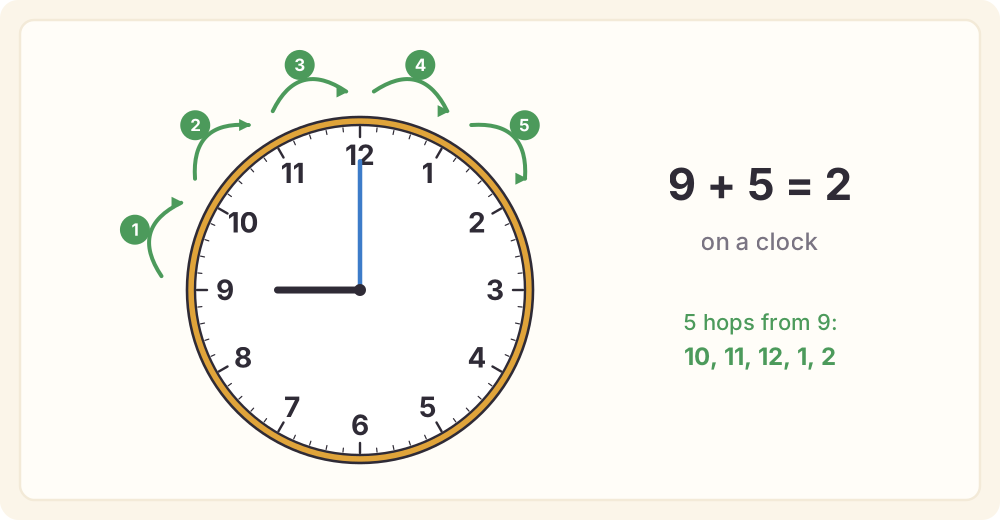
From 9, five hops go 10, 11, 12, 1, 2. Adding on a circle like this is called clock arithmetic. Mathematicians call it modular arithmetic.
Full turns don't count
What time is it 25 hours after 9 o'clock? You don't need to make 25 hops. 24 hours is two full turns of the clock, and a full turn brings the hand back to exactly where it started. So only the 1 hour left over matters: the clock shows 10.
That is a remainder, as in the When It Doesn't Share Evenly lesson of Numbers Level 1: 25 ÷ 12 = 2 remainder 1. The full turns are thrown away, and the remainder is all that counts.
The days of the week
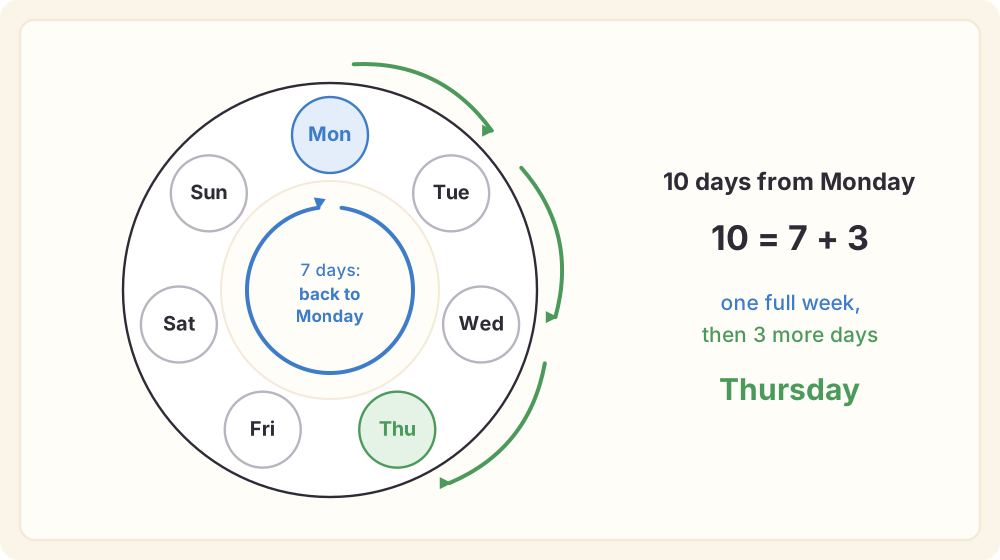
A week is a circle too: Monday, Tuesday, ... Sunday, and then Monday again. It has 7 days, so here the turns are weeks of 7.
Today is Monday. What day is it in 10 days? 10 is one full week and 3 days more (10 ÷ 7 = 1 remainder 3). The full week brings you back to Monday, and 3 more days bring you to Thursday.
Now a big one: what day is it 100 days after a Monday? 14 weeks are 98 days (14 × 7 = 98), and 100 is 2 more than 98. The 14 full weeks change nothing, so 100 days from Monday is the same as 2 days from Monday: Wednesday.
Circles everywhere
Even and odd is clock arithmetic too, on the smallest circle there is: a clock with only two places, "even" and "odd". Each step of one moves you to the other place, and two steps bring you back. Lights that blink red, green, blue, red, green, blue are a circle of 3. A seat at a round table of 8, the months of the year (a circle of 12): whenever things come round again, only the remainder matters.
Try it at home
- It is 8 o'clock. What time will it be in 7 hours? In 30 hours?
- What day of the week will it be 50 days from today?
- Your birthday is on a Tuesday this year. A year has 365 days. What day will it be next year (if there is no 29 February in between)? Answers below.
Answers: 3 o'clock; 2 o'clock (24 hours is two full turns, then 6 more). 50 days is 7 weeks and 1 day: tomorrow's weekday. 365 is 52 weeks and 1 day, so Wednesday - your birthday moves on one day each year.
Words to know
- clock arithmetic (also modular arithmetic) - counting that goes round in a circle, like the hours on a clock or the days of a week; only the remainder after the full turns matters
Big idea
On a circle of numbers, like a clock or a week, full turns bring you back to where you started. So to add on a circle, divide by the size of the circle and keep only the remainder: 100 days from Monday is Wednesday.