Factor Trees
Everything around you, water, air, your own hand, is made of a small number of kinds of tiny pieces called atoms. Whole numbers have atoms too, when you build them by multiplying: the primes. Every composite number can be broken down into primes multiplied together. How do you find which primes a number is made of?
Split, and split again
Take 60. It is composite, so it splits into a factor pair, two factors that multiply to make it. Any pair will do, say 6 × 10. Write 60 at the top and draw two branches down to 6 and 10.
Now look at each branch. 6 is composite: it splits into 2 × 3. 10 is composite too: it splits into 2 × 5. Draw their branches.
Now the ends of the branches are 2, 3, 2 and 5. They are all primes, so they can't split any more. Circle them. The drawing is called a factor tree, and the circled numbers at its ends are the prime factors of 60:
- 60 = 2 × 2 × 3 × 5.
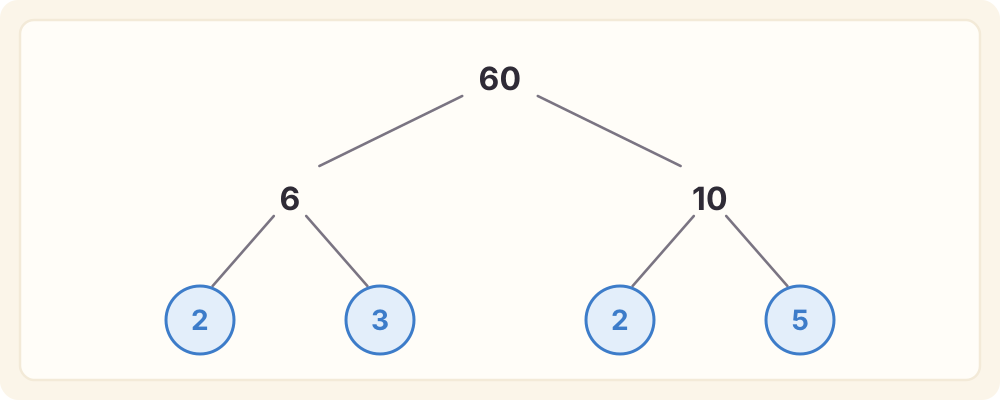
Check it by multiplying back: 2 × 2 = 4, 4 × 3 = 12, 12 × 5 = 60. Every factor tree can be checked like this.
When to stop
The rule for growing the tree is simple:
- if a number on a branch is composite, split it into a factor pair;
- if it is prime, circle it and stop.
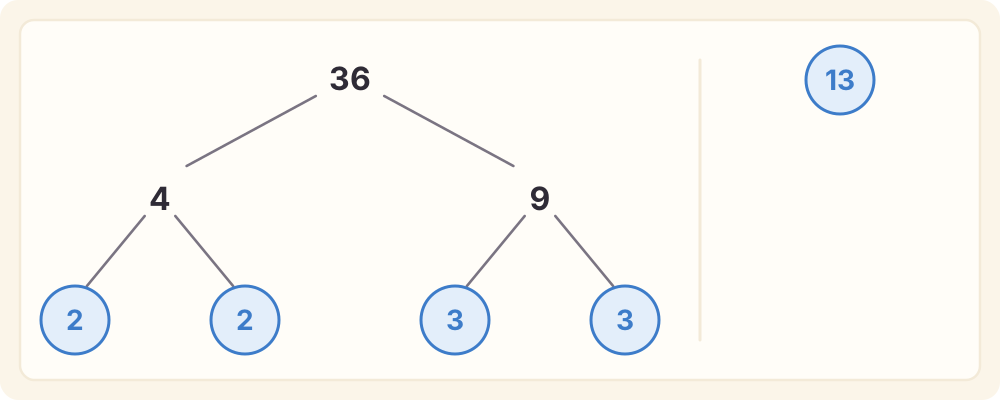
The tree is finished when every branch ends in a circle. Here is 36. It splits into 4 × 9, then 4 into 2 × 2 and 9 into 3 × 3:
- 36 = 2 × 2 × 3 × 3.
A prime is the shortest tree of all: 13 can't split, so its tree is just 13, circled.
Primes are the building blocks
Every number bigger than 1 is either a prime or can be split until only primes are left. Because each split makes smaller numbers, the splitting can't go on forever: it always ends in primes. This is what we meant by primes being the atoms of multiplying.
Putting the prime factors in order, from small to big, makes them easy to read: 60 = 2 × 2 × 3 × 5 tells you at a glance that 60 is made of two 2s, one 3 and one 5.
Try it at home
- Draw a factor tree for 24. Start with 4 × 6.
- Draw a factor tree for 45.
- Draw a factor tree for 100.
Answers: 1. 24 = 2 × 2 × 2 × 3; 2. 45 = 3 × 3 × 5; 3. 100 = 2 × 2 × 5 × 5.
Words to know
- factor pair - two factors that multiply to make a number, like 6 and 10 for 60
- factor tree - a drawing that splits a number into factor pairs again and again, until every branch ends in a prime
- prime factors - the primes at the ends of a factor tree: the primes that multiply to make the number
Big idea
Split a composite number into a factor pair, and keep splitting until only primes are left. Every number bigger than 1 is a prime or a product of primes: 60 = 2 × 2 × 3 × 5.