Tests for 3 and 9
Three friends win 471 sweets in a competition and want to share them equally. Will it come out fair, with none left over? The last digit is 1, but in the Tests for 2, 5 and 10 lesson we saw that the last digit only works for 2, 5 and 10. For 3 we need a new trick.
Add up the digits
Here is the test. Add up the digits of the number: this is called the digit sum.
- 471: the digit sum is 4 + 7 + 1 = 12.
- 12 divides by 3 (12 ÷ 3 = 4).
- So 471 divides by 3 too. Each friend gets 157 sweets.
The test for 3: a number divides by 3 if its digit sum divides by 3. The test for 9 works the same way: a number divides by 9 if its digit sum divides by 9. For example, 3,456 has digit sum 3 + 4 + 5 + 6 = 18, and 18 divides by 9, so 3,456 does too.
If the digit sum is still big, add up its digits again: 99,999 has digit sum 45, and 45 has digit sum 9. So 99,999 divides by 9.
Why it works: a ten is a nine plus one
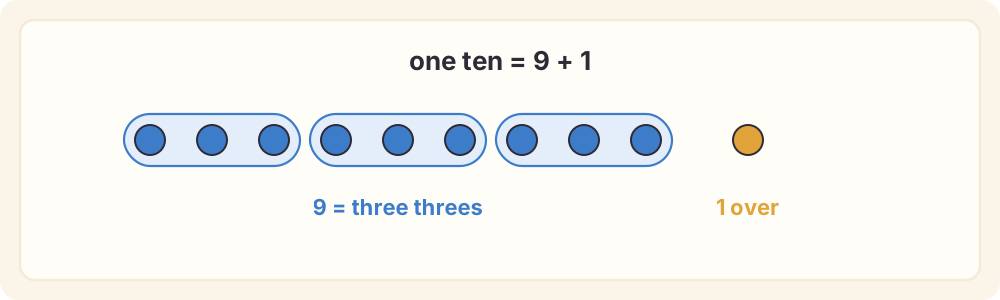
This test looks like magic, but it has a reason. Take one ten. Put 9 of its dots aside: 9 splits into threes (three threes) and into nines. One dot is left over. So every ten is a nine plus one left over.
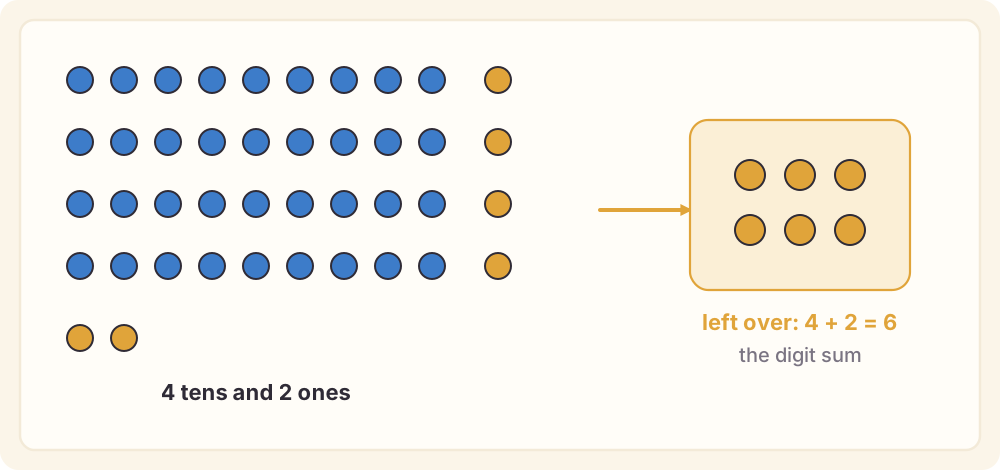
Now take 42: 4 tens and 2 ones.
- Each of the 4 tens leaves 1 over after its nine. That is 4 left over.
- The 2 ones are left over too.
- So all that is left over is 4 + 2 = 6 - the digit sum!
The nines are no trouble: they always split into threes and nines. Only the leftovers decide, and the leftovers are the digit sum. 6 divides by 3, so 42 divides by 3 (42 ÷ 3 = 14). 6 doesn't divide by 9, so 42 doesn't divide by 9: in fact it leaves exactly 6 over (4 nines are 36, and 36 + 6 = 42).
The same is true of hundreds: 100 is 99 + 1, and 99 is eleven nines. So every hundred also leaves exactly 1 over, and every digit counts its own leftovers.
A test that fails
Be careful not to mix the tests up. For 3 and 9 the last digit tells you nothing: 13 ends in 3 but doesn't divide by 3, and 12 ends in 2 but does. For 2, 5 and 10 the digit sum tells you nothing: 14 and 41 have the same digit sum, but only 14 is even. Each test works only for the reason behind it.
Try it at home
- Pick any number on a receipt or a car number plate. Find its digit sum. Does the number divide by 3? By 9?
- Divisible by 3, by 9, or neither: 111; 2,025; 1,000?
- A number divides by 9. Must it divide by 3? Answers below.
Answers: 111 by 3 only (digit sum 3); 2,025 by both (digit sum 9); 1,000 by neither (digit sum 1). Yes: a nine is three threes, so anything that splits into nines also splits into threes.
Words to know
- digit sum - what you get by adding up the digits of a number: the digit sum of 471 is 4 + 7 + 1 = 12
- test for 3 (or 9) - a number divides by 3 (or 9) if its digit sum does
Big idea
Every ten is a nine plus one, and every hundred is 99 plus one. The nines always split into threes and nines, so only the leftovers decide - one for each ten, one for each hundred, plus the ones - and the leftovers add up to the digit sum.