Numbers That Won't Split
A baker puts cookies on a tray in neat rows, with the same number in every row. Twelve cookies are easy: 2 rows of 6, 3 rows of 4, or 1 long row of 12. The next day the baker has 13 cookies. 2 rows? One cookie is left over. 3 rows? One left over again. 4, 5, 6 rows? Always something left over. Why does 13 refuse to make a neat rectangle?
Only one rectangle
In the Factors lesson we saw that the factors of a number are the rectangles its dots can make. 12 dots make three rectangles: 1 × 12, 2 × 6 and 3 × 4. So 12 has six factors: 1, 2, 3, 4, 6 and 12.
13 dots make only one rectangle: a single line, 1 × 13. Its only factors are 1 and 13 itself.
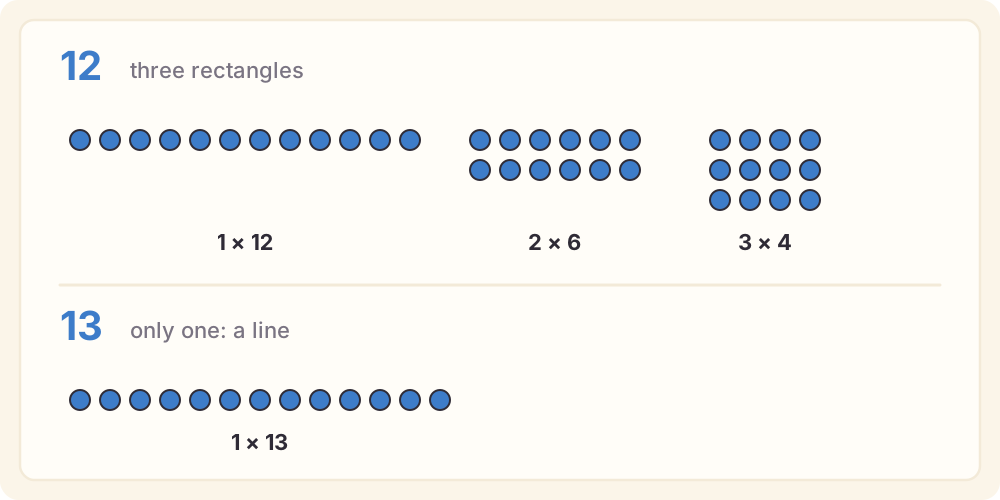
A number bigger than 1 whose only factors are 1 and itself is called a prime number, or a prime. 13 is a prime. A number bigger than 1 that has more factors, like 12, is called a composite number: it can be built from smaller numbers multiplied together (12 = 3 × 4).
The first primes
Let's check the numbers one by one, looking for a neat rectangle with more than one row:
- 2: only 1 × 2. Prime.
- 3: only 1 × 3. Prime.
- 4: 2 × 2. Composite.
- 5: prime. 6 = 2 × 3: composite. 7: prime.
- 8 = 2 × 4, 9 = 3 × 3, 10 = 2 × 5: all composite.
- 11: prime. 12: composite. 13: prime.
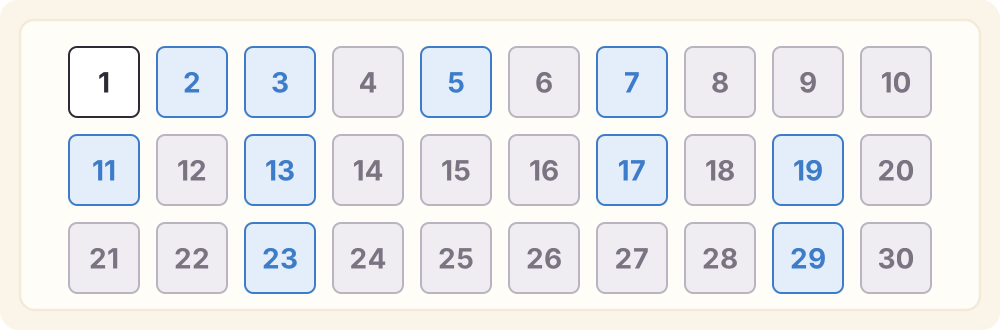
The primes up to 30 are 2, 3, 5, 7, 11, 13, 17, 19, 23 and 29. Notice that 2 is the only even prime. Every other even number is 2 rows of something, so it has 2 as a factor.
What about 1?
1 dot makes only one rectangle too. But 1 has only one factor, itself, not two. Mathematicians agreed long ago that 1 is not a prime, and not composite either. It sits on its own. This is not just a rule to remember: in the Only One Way to Build It lesson we will see why it matters.
Try it at home
- Take 7 buttons. Try to lay them out in 2 rows, 3 rows, and so on. Is 7 prime?
- Do the same with 15 buttons.
- Is 21 prime? Is 23?
Answers: 1. no rectangle except a line, so 7 is prime; 2. 3 rows of 5, so 15 is composite; 3. 21 = 3 × 7 is composite, 23 is prime.
Words to know
- prime number (prime) - a number bigger than 1 whose only factors are 1 and itself, like 2, 3, 5, 7 and 13
- composite number - a number bigger than 1 with more than two factors, like 4, 12 and 15
Big idea
A prime number makes only one rectangle of dots, a single line: its only factors are 1 and itself. A composite number can be split into smaller factors. 1 is neither.