Triangular Numbers
At a bowling alley, the 10 pins stand in a triangle: 1 at the front, then 2, then 3, then 4. On a snooker table, the 15 red balls are packed into a triangle of 5 rows. Why 10, and why 15? Which numbers can make a triangle like that?
Stairs of dots
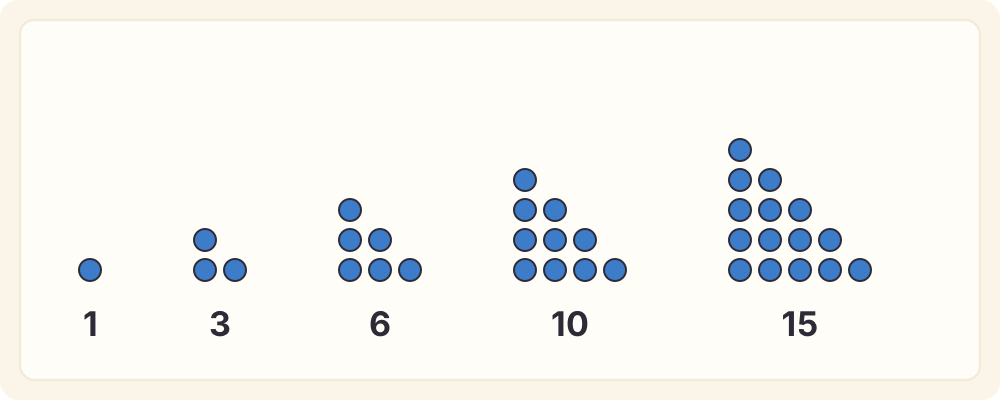
Start with 1 dot. Put a row of 2 under it, then a row of 3, then a row of 4. Each row has one more dot than the row above it. The totals are:
- 1
- 1 + 2 = 3
- 1 + 2 + 3 = 6
- 1 + 2 + 3 + 4 = 10
- 1 + 2 + 3 + 4 + 5 = 15
These are the triangular numbers: 1, 3, 6, 10, 15, 21, 28 ... To get the next one, add the next counting number: 15 + 6 = 21, then 21 + 7 = 28.
Two triangles make a rectangle
Take the triangle of 10 dots, with rows of 1, 2, 3 and 4. Make a copy, turn it upside down, and push it against the first one. The two fit together into a rectangle: 4 rows of 5 dots, so 4 × 5 = 20 dots. One triangle is half of that: 20 ÷ 2 = 10.
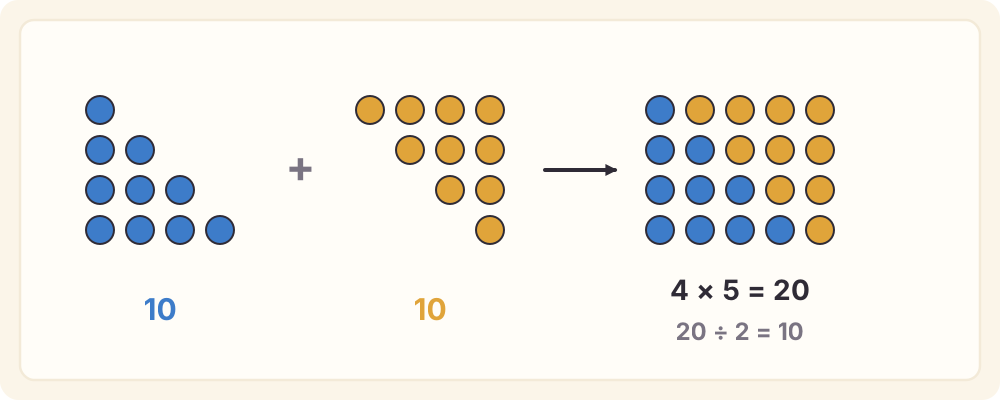
This works for every triangle. The rectangle always has as many rows as the triangle, and one dot more in each row. That gives a shortcut. To add 1 + 2 + 3 and so on up to 10, picture the triangle with 10 rows. Two of them make a rectangle of 10 × 11 = 110 dots, so one triangle has 110 ÷ 2 = 55.
A famous story says that the German mathematician Carl Friedrich Gauss, as a schoolboy in the 1780s, was told to add up all the numbers from 1 to 100. He had the answer in moments: 100 × 101 = 10,100, and half of that is 5,050. Nobody knows if the story really happened that way, but the shortcut works.
Two neighbours make a square
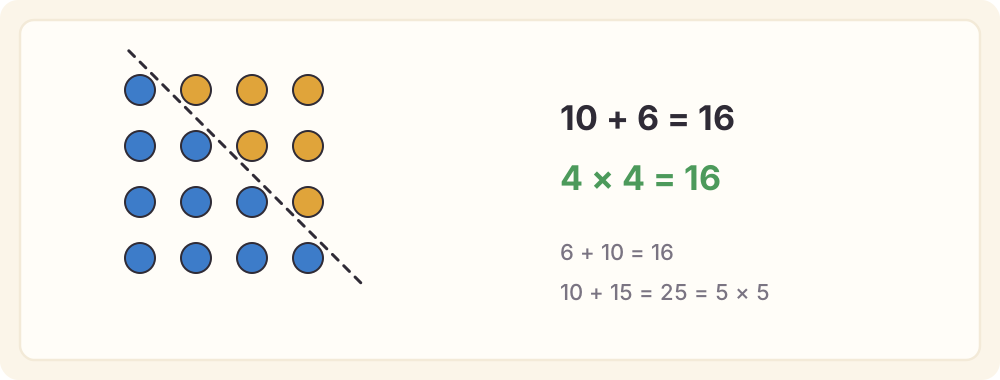
Now add two triangular numbers that sit next to each other: 6 + 10 = 16, which is 4 × 4, a square number. Try 10 + 15 = 25 = 5 × 5. A square again!
The picture shows why. Cut a square of dots along a slanting line, just beside the corner-to-corner diagonal. You get two stairs: one with 4 rows, and one with 3 rows.
Try it at home
- Make the triangle of 21 with coins. How many rows does it have?
- Use the shortcut to add 1 + 2 + 3 and so on up to 20.
- What is 21 + 28? Is it a square number?
Answers: 1. 6 rows. 2. 20 × 21 = 420, and 420 ÷ 2 = 210. 3. 49 = 7 × 7, so yes.
Words to know
- triangular number - a number of dots that can be laid out as a triangle with rows of 1, 2, 3 and so on: 1, 3, 6, 10, 15 ...
Big idea
Triangular numbers are 1, 1 + 2, 1 + 2 + 3 and so on. Two copies of a triangle make a rectangle, so adding 1 to 100 is just 100 × 101 ÷ 2. Two triangular numbers next to each other make a square.