Will the Sun Rise Tomorrow?
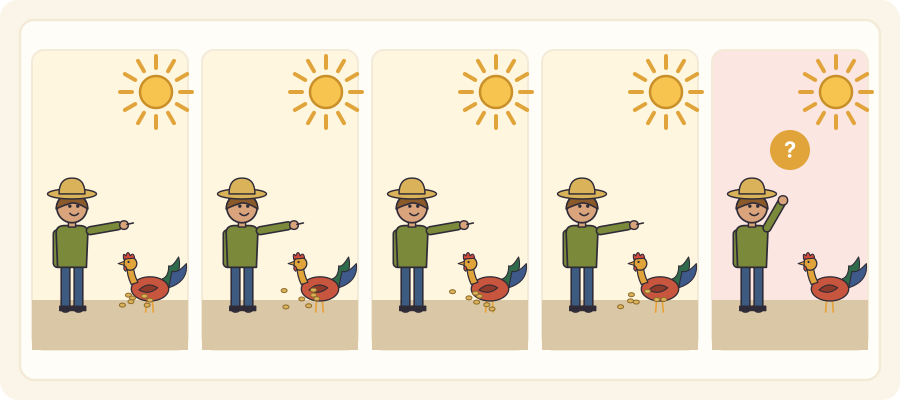
A chicken lives on a farm. Every morning, the farmer comes out and throws it some grain. After a hundred mornings, the chicken is sure: when the farmer comes, food comes. One morning, the farmer comes out - and instead of feeding the chicken, he catches it for the family's dinner. The chicken had a hundred good examples. What went wrong?
Learning from the past
The British philosopher Bertrand Russell told the story of the chicken in a small book in 1912. He wasn't really talking about chickens. He was talking about us.
Almost everything we expect, we expect because of the past. The Sun has risen every morning of your life, so you expect it tomorrow. Bread has always fed you, so you expect it to feed you today. Going from many past cases to a general rule or a future case is called induction (Logic Level 1 taught it as reasoning from examples). We do it all day long, and usually it works.
Hume's question
Nearly 300 years ago, the Scottish philosopher David Hume asked a hard question about this. His example was the Sun rising. What is our reason to believe that the future will be like the past?
- It isn't something we can know by thinking. There is no contradiction in "the Sun won't rise tomorrow", the way there is in "a triangle has four sides". (See the Knowing by Thinking lesson.)
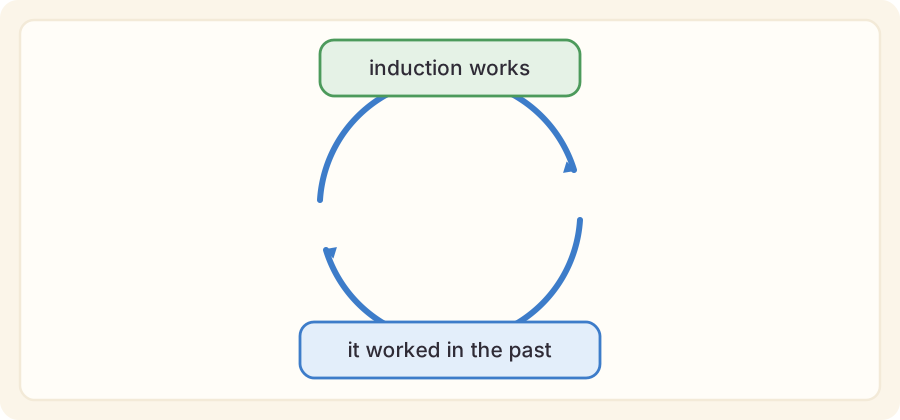
- So it must come from experience. We might say: "In the past, the future has always been like the past." But that is induction again! We would be using induction to prove that induction works. That is going round in the circle from the A Reason for Every Reason? lesson.
This is called the problem of induction: it seems we have no reason for the belief that all our other beliefs about the future depend on.
Living with the problem
Hume didn't think we should stop expecting the Sun. He thought we can't stop: it is how our minds work, a habit too deep to give up. Nobody refuses to eat bread because of Hume.
Philosophers have argued about the problem ever since, and there is no answer that everyone accepts. But two practical lessons come out of it.
- Expecting the future to be like the past works best when we know why it happens. The Sun rises because the Earth spins, and we know a lot about what would have to change to stop that. The chicken knew nothing about why it was fed.
- The more varied our past cases are, the better. The chicken saw a hundred mornings of one farmer with one plan. Our evidence about the Sun comes from thousands of years and many kinds of observation.
Try it at home
- List five things you expect tomorrow (the Sun rises, your school is still there).
- For each one, what is your reason? Is it only "it always has"?
- For which ones do you also know why it happens? Do those feel safer?
Words to know
- induction - reasoning from past cases to a general rule or to the future
- the problem of induction - Hume's question: what reason do we have to think the future will be like the past, without using induction to prove it?
Big idea
Everything we expect about the future rests on the past, and it is very hard to give a reason why the future should be like the past. We can't live without induction - but knowing why things happen makes it much safer.