A Reason for Every Reason?
Theo is four, and he has learned the best question in the world. "We're going to the bakery at eight," says his sister Rosa. "Why at eight?" "Because it opens at eight." "Why?" "Because the sign on the door says so." "Why?" "Because the baker wrote it." "Why do you believe the baker?" Rosa stops. Theo's question is a good one. Can it go on forever?
The chain of reasons
In Knowledge Level 1 we said that knowledge needs good reasons. But Theo has noticed a problem. A reason is itself a belief - "the sign says eight" - and it needs a good reason too. And that reason needs one. Each reason hangs from the one behind it, like links in a chain. We will call this the chain of reasons.
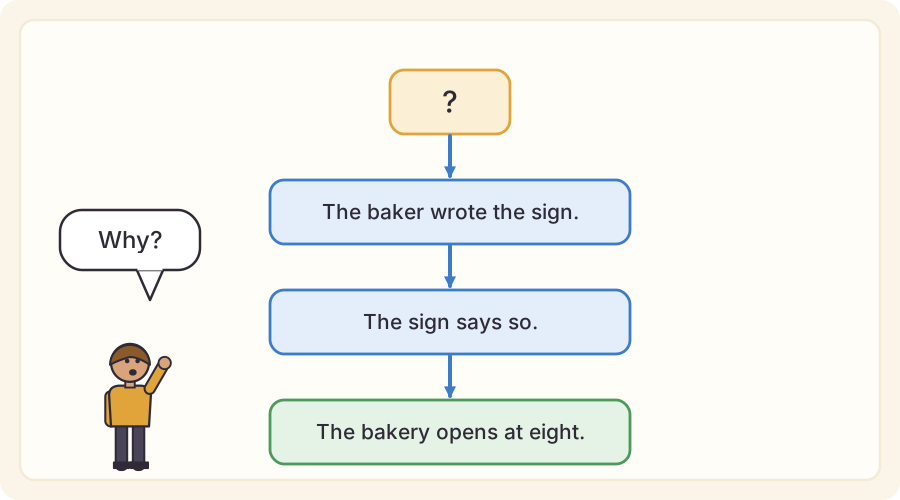
Philosophers call this the problem of the regress - a word that means "going back", because each step takes you one step further back.
Three ways it could end
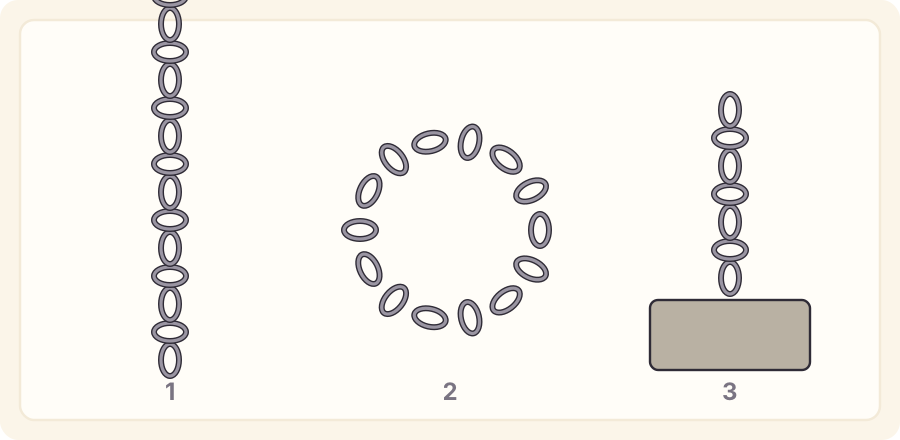
About 2,000 years ago, a Greek thinker called Agrippa saw that there are only three ways the chain can go. None of them looks good at first.
- It never ends. Every reason has a reason behind it, forever. But then you would need to have infinitely many reasons before you could know anything - and nobody has.
- It goes round in a circle. Somewhere along the chain, a reason comes back again: "I trust the sign because the baker is honest, and I know the baker is honest because the sign is right." Logic courses call this circular reasoning: the belief ends up being its own reason.
- It stops somewhere. At some point you say: "this one needs no further reason." But why is stopping there allowed, and not one step earlier?
Why this matters
You might think this is a game for four-year-olds. But it is one of the oldest puzzles about knowledge, and it doesn't go away. If every belief needs a reason, and the reasons can't go on forever or go round in circles, then something has to stop the chain - or knowledge has nothing to stand on.
Philosophers have answered in two main ways, and the next two lessons look at them. Some say the chain stops at beliefs that need no further reason (the next lesson). Others say beliefs don't hang in a chain at all: they hold each other up together, like the pieces of a puzzle (the lesson after it, Beliefs That Fit Together). Neither side has won.
Try it at home
- Pick one thing you are sure of, like "my school starts at nine".
- Ask yourself "why do I believe that?" and write the answer. Then ask "why?" about the answer. Keep going for five steps.
- How did your chain end - did it stop, go round, or could it go on?
Words to know
- chain of reasons - a belief, the reason for it, the reason for that reason, and so on
- regress - the problem that every reason seems to need another reason behind it, without end
Big idea
Every reason is a belief that needs a reason too. The chain can go on forever, go round in a circle, or stop somewhere - and since the first two look bad, the question is where and why it may stop.