The Stopped Clock
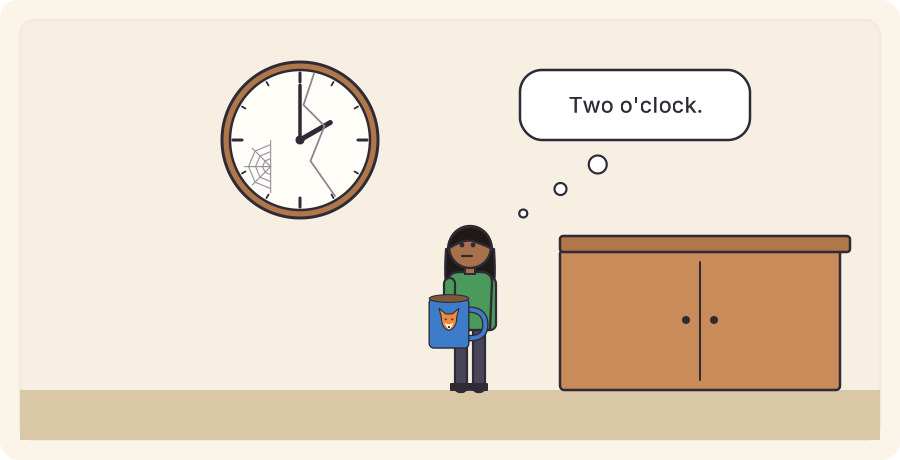
Mina comes down to the kitchen and looks at the clock on the wall. It says two o'clock. She believes it is two o'clock, and it is: it really is two o'clock. She has a good reason, too - the kitchen clock has always been right. But there is something Mina doesn't know. The clock stopped yesterday, at exactly two o'clock. Does Mina know what time it is?
All three legs, and still not knowledge
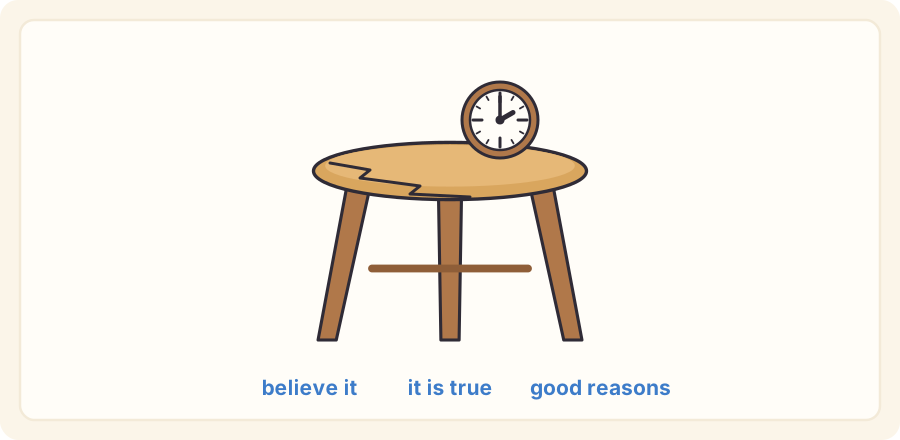
In Knowledge Level 1 we said that knowledge is like a stool with three legs: you believe it, it is true, and you have good reasons for it. Check Mina against the three legs.
- She believes it is two o'clock.
- It is true - it really is two o'clock.
- She has a good reason - a clock that has always been right.
So the stool has all three legs. But most people feel at once that Mina doesn't know the time. She looked at a broken clock. If she had come down an hour later, it would still say two, and she would have believed that too.
Lucky, with reasons
In a lucky guess, the person had no reasons at all. Mina's case is different, and that is why it is interesting. She had a real reason. The trouble is that her reason was not connected to the truth this time. The clock showed two o'clock, and it was two o'clock, but the second fact did not cause the first. They just happened to meet.
This example is old. The British philosopher Bertrand Russell wrote about a stopped clock in 1948. In 1963 an American philosopher, Edmund Gettier, wrote a famous three-page paper full of cases like it. Since then, a case where someone has a true belief with good reasons and is still right only by luck has been called a Gettier case. In this course we will call it lucky knowledge - which is really not knowledge at all.
So what is missing?
Philosophers have been arguing about this for sixty years, and they don't all agree. But the main idea most of them share is easy to say: your good reason has to be connected to the truth in the case in front of you, not just usually. A clock that works is connected to the time. A clock that stopped is connected to nothing - it is like a guess that looks like a reason.
That gives us a test to add to the stool. Ask: if the truth had been different, would my reason have shown me? If it had been three o'clock, a working clock would have said three. Mina's clock would still have said two.
The next lesson gives another case, where nothing at all is broken.
Try it at home
- Think of a time you were right for the wrong reason - a bus timetable that was out of date, but the bus came anyway.
- Check the three legs: did you believe it, was it true, did you have a reason?
- Now ask the new question: if the truth had been different, would your reason have shown you?
Words to know
- lucky knowledge (Gettier case) - a true belief with good reasons that is still right only by luck, so it is not knowledge
- connected to the truth - a reason that would have shown you something different if the truth had been different
Big idea
Believing, being true and having good reasons are not quite enough. Your reason has to be connected to the truth in this very case - a stopped clock is right twice a day, and it still can't tell you the time.