The Town of Fake Barns
Henry is driving through the countryside with his son. "Look," he says, "a barn." He is right: it is a real barn, and he sees it clearly in good light. But Henry doesn't know that he is driving through a strange town. For a film, the people here have built hundreds of fake barns - just fronts, painted to look real from the road. The one Henry looked at happens to be the only real barn for miles. Does Henry know it is a barn?
Nothing is broken this time
In the The Stopped Clock lesson, Mina's clock was broken. Henry's case is stranger, because nothing is broken. His eyes work. The light is good. He is looking at a real barn, and the barn is what makes him believe it.
So Henry believes it is a barn, it is true, and he has a good reason: he sees it. All three legs again. And yet many people feel that Henry doesn't really know. If his eyes had landed on any of the barns around it, he would have said "a barn" just as surely - and been wrong.
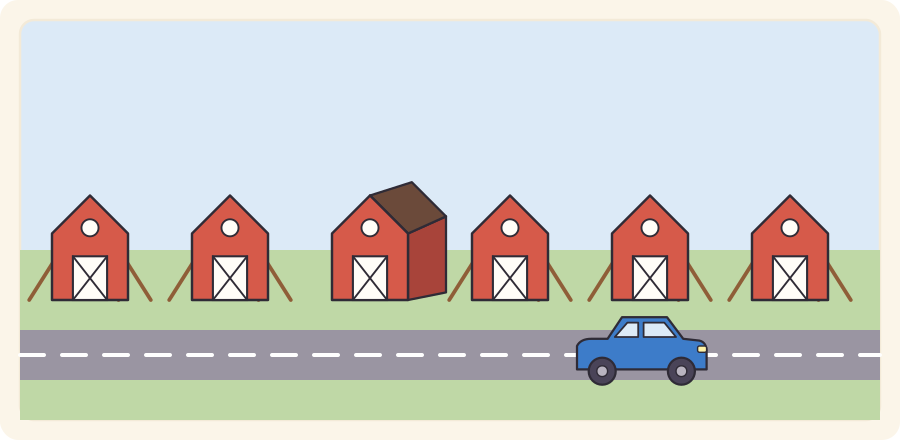
This example was told by the American philosopher Alvin Goldman in 1976, who heard it from his friend Carl Ginet.
Could you easily have been wrong?
The stopped clock gave us a question: if the truth had been different, would my reason have shown me? Henry passes that test. If there had been no barn in front of him, he wouldn't have seen one.
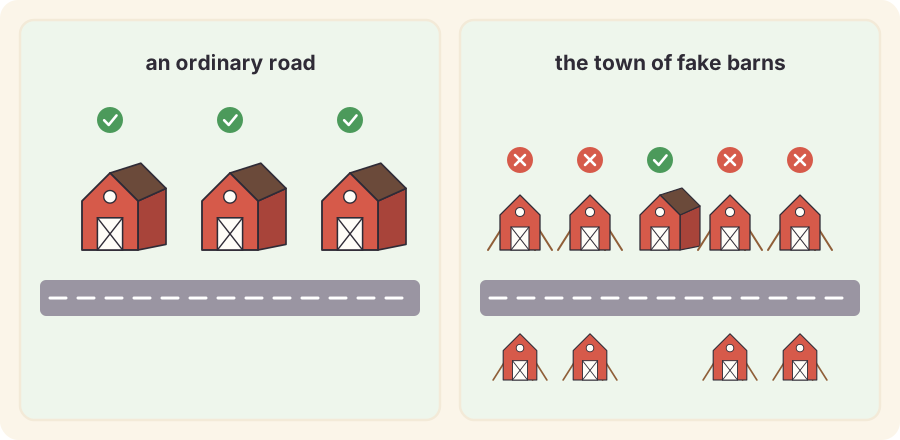
So Henry's case adds a second question: could I easily have been wrong, the way I came to believe this? Henry could. He was one glance away from a fake. His way of believing - "it looks like a barn from the road" - is a good way in most places, but not in this town. Here it would lead him wrong almost every time.
Good reasons, here
This changes how we think about good reasons. A good reason isn't only a reason that is usually reliable. It is one that wouldn't lead you wrong here, in the place and the situation you are in. "It looks like a barn" is a good reason on most roads. In the town of fake barns, it isn't.
That is also why knowing where you are matters. If Henry's son had said, "Dad, this is the town with the fake barns," Henry would have stopped to look closer - and then he really would have known.
Try it at home
- Think of a place where a usually good reason works badly: a shop where most watches are fakes, a website that copies a real one.
- In that place, what would you have to do to really know - walk round the barn, open the watch, check the web address?
- Can you think of a place where your own usual way of knowing would fool you?
Words to know
- a good reason here - a reason that wouldn't lead you wrong in the situation you are actually in
- could easily have been wrong - one small change (another barn, another glance) would have given you a false belief the same way
Big idea
To know, it isn't enough for your eyes to work and your belief to be true. Your way of believing must be one that wouldn't easily lead you wrong where you are. In the town of fake barns, a glance from the road can't tell you a barn is real.