Where Reasons Stop
Amir bumps his knee on the table. "Ouch," he says. "That hurts." His friend Lina asks, "How do you know it hurts?" Amir stares at her. What could he say? "I can feel it" isn't really a reason for the belief - it is just the belief again. And yet he doesn't seem to need a reason. Some beliefs, it seems, don't. Could those be where the chain of reasons stops?
Beliefs that need no further reason
In the A Reason for Every Reason? lesson, the chain of reasons had three possible endings, and the third was: it stops somewhere. This lesson is about that answer. It says some beliefs are special. You don't believe them because of another belief. You believe them because of what you are feeling or seeing right now:
- "I am in pain."
- "I am thinking."
- "There seems to be something red in front of me."
Philosophers call these basic beliefs - beliefs that need no further reason. The idea is that everything else you know is built on top of them.
Building a house of knowledge
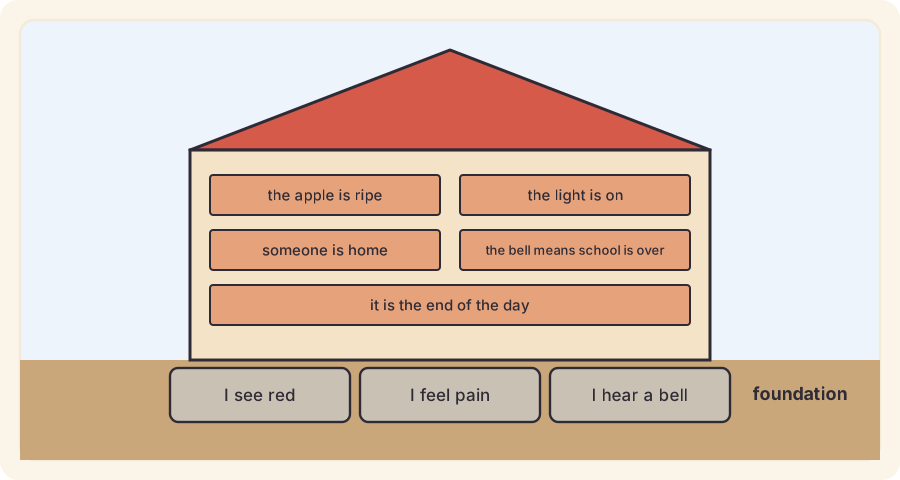
Think of knowledge like a house. A house doesn't hang from the sky; it stands on a foundation - the solid stones at the bottom that nothing else holds up. The walls rest on the foundation, and the roof rests on the walls.
In the same way: "I see a red, round shape" is a foundation stone. "There is an apple on the table" rests on it. "Someone bought apples today" rests on that. Each belief is held up by the ones below it, and the bottom ones hold themselves up. This view is called foundationalism, the view that knowledge has foundations. Descartes, the French thinker from Knowledge Level 1, believed it: he looked for one belief so certain that everything else could be built on it, and found "I am thinking".
Does the foundation hold?
The idea is attractive, but there are two hard questions.
- Are the foundation stones really safe? "I see something red" can be wrong in strange light. "That hurts" feels safe - but even here people are sometimes unsure: is it pain, or only pressure? Is it an itch?
- Are there enough of them? From "I see red" and "I feel pain" you can't build very much. How do you get from them to "Cairo is in Egypt" or "the Earth is round"? Most of what you know rests on what other people told you, not on your own feelings.
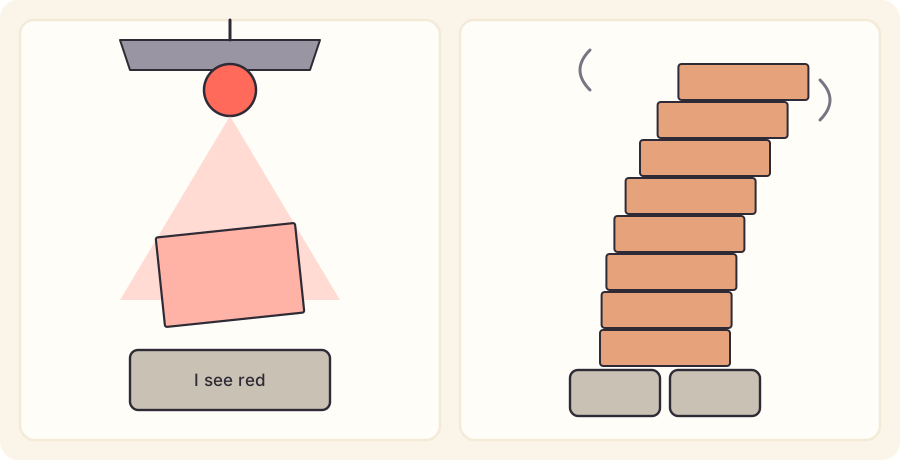
Those who like foundations reply that the stones don't have to be certain, only believable without further reasons. The argument continues.
Try it at home
- Write down three beliefs you have right now that seem to need no reason ("I am hungry", "I hear traffic").
- For each, could you be wrong? How?
- Pick one thing you know about the world, like "my friend lives on Park Street". Can you trace it back down to beliefs like these?
Words to know
- basic belief - a belief that needs no further reason, like "I am in pain"
- foundation - the beliefs at the bottom that hold the others up
- foundationalism - the view that knowledge rests on basic beliefs
Big idea
One answer to the chain of reasons is that it stops at basic beliefs - what you feel or seem to see right now - and everything else is built on them, like a house on its foundation.