The First Number
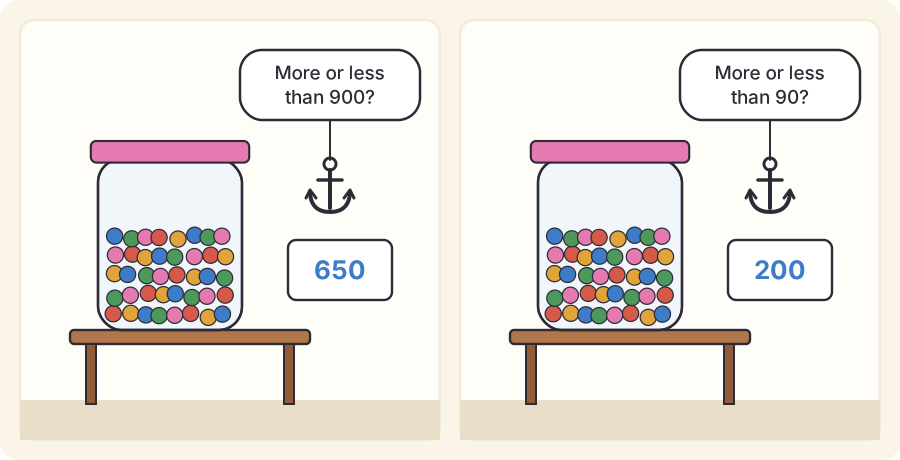
At the school fair there is a big jar of sweets. Whoever guesses closest wins the lot. Before Sara writes her guess, the boy next to her says, "Is it more or less than 900, do you think?" Sara thinks for a while and writes 650. Her brother Navid comes along later. The girl ahead of him says, "More or less than 90?" Navid writes 200. The jar has the same sweets in it for both of them. Why are their guesses so far apart?
A number that pulls
Sara and Navid both knew that the number they heard was just a question, not a clue. And yet each guess ended up near the number they had heard. Sara started from 900 and moved down, but not far enough. Navid started from 90 and moved up, but not far enough. The first number acted like an anchor: a weight that holds a boat in place, so it can only drift a little way.
Even a number that means nothing
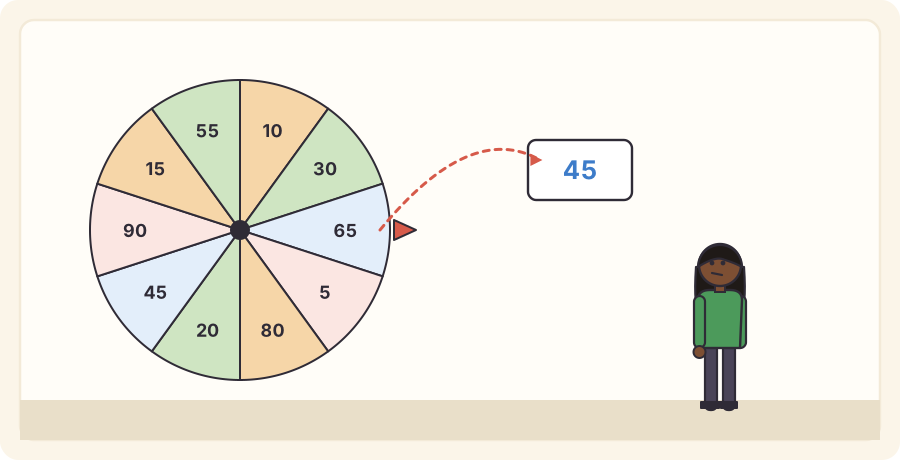
In 1974 the psychologists Amos Tversky and Daniel Kahneman showed how strong this is. They spun a wheel of numbers in front of people. The wheel was secretly set to stop on either 10 or 65. Then they asked: "Out of every 100 countries in the United Nations, are more or fewer than that many in Africa? And what is your guess?"
Everybody could see that the wheel was just luck and had nothing to do with Africa. Still, people who saw 10 guessed about 25, and people who saw 65 guessed about 45. A number that meant nothing had moved their answers a long way. This pull is called anchoring.
Where anchors are used
Anchors are everywhere once you look. A shop puts a high "old price" next to the price it wants you to pay, so the real price feels small. When people agree on a price, the first number said out loud often pulls the deal towards it. And a question like "Was it more than 100 people?" can change what a witness remembers.
Pulling up the anchor
Knowing about anchoring doesn't switch it off - even people who know about it are pulled. But a few habits help:
- Make your own guess first, before you hear anyone else's number. Write it down.
- Ask where the number came from. Is it a clue, or just the first thing someone said?
- Think of a reason it could be far off - much higher or much lower - before you settle.
Try it at home
- Ask two friends separately how many pages a long book has. Ask one "more or less than 900?" and the other "more or less than 90?" first. Compare.
- Next time you see a price with "was" and "now", ask what you would think of the "now" price on its own.
- Next time you have to estimate something, write your guess before anyone speaks.
Words to know
- anchor - the first number you hear, which your guess stays close to
- anchoring - when a number you heard pulls your own guess towards it, even if it means nothing
Big idea
The first number you hear pulls your guess towards it, even when it is pure chance. Make your own guess first, and ask whether the number is a clue or just an anchor.