Knowing by Thinking
Ana asks her brother two questions. "Is it raining in our street right now?" He goes to the window to look. "Does every triangle have three sides?" This time he doesn't move. He doesn't go and measure triangles, or count the sides of a hundred of them to be safe. He just says yes. How can he know the second answer without looking at anything?
Two ways to find out
Some things you can only find out by looking at the world - with your senses, or by asking someone who has. Whether it is raining. How many people live in Cairo. What colour your neighbour's car is. We will call this knowing by looking.
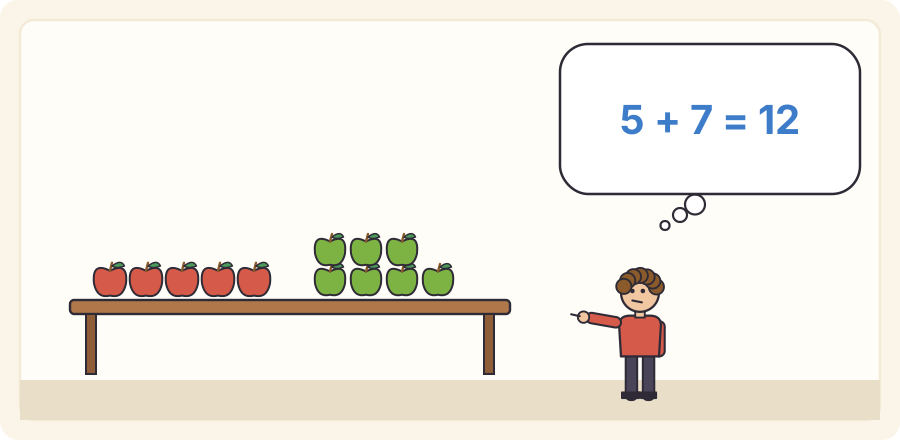
Other things you can know by thinking alone, once you understand the words. Every triangle has three sides - "triangle" means a shape with three sides. 5 + 7 is 12 - you can work it out in your head. If Ana is older than Ben, and Ben is older than Cyrus, then Ana is older than Cyrus - you don't need to see their birth certificates.
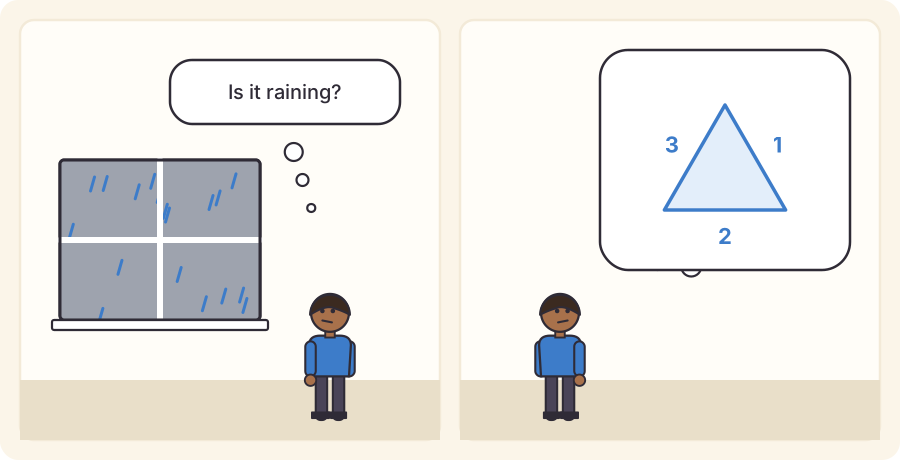
Philosophers call knowing by thinking a priori knowledge, Latin for "from what comes before" - before looking. Knowing by looking is a posteriori, "from what comes after".
No triangle can surprise you
Here is the strange thing about knowing by thinking. If you count the people in a room, someone may come in and the count changes. You could always find one more fact that surprises you. But nobody will ever find a triangle with four sides. If it had four sides, it wouldn't be a triangle. You don't need to keep checking.
That is why maths is mostly knowing by thinking. A mathematician doesn't test whether 5 + 7 is 12 by putting 5 apples next to 7 apples a thousand times. She works it out, and once it is worked out, it stays worked out.
Thinking can go wrong too
Knowing by thinking is not magic. You still had to learn what "triangle" and "seven" mean, and you learned that from the world and from other people. And you can make mistakes when you think, just as you can when you look: everyone has added up a bill wrongly. The difference is in how you check. You check "it's raining" by looking again. You check a sum by working it out again, or asking someone else to.
Try it at home
- Sort these into knowing by looking and knowing by thinking: "My bag is on the chair." "A week has seven days." "Half of 10 is 5." "The shop is open today." "Nobody is taller than themselves."
- For each "looking" one, say how you would check it. For each "thinking" one, say why looking wouldn't help.
- Find one that is hard to sort. Why is it hard?
Words to know
- knowing by looking - finding something out from the world, through the senses or from others (a posteriori)
- knowing by thinking - knowing something just by understanding it and working it out (a priori)
Big idea
Some things can be known by thinking alone - sums, the meanings of words, what follows from what. Most things about the world have to be looked at. Both can go wrong, and each is checked in its own way.