A Brain in a Jar
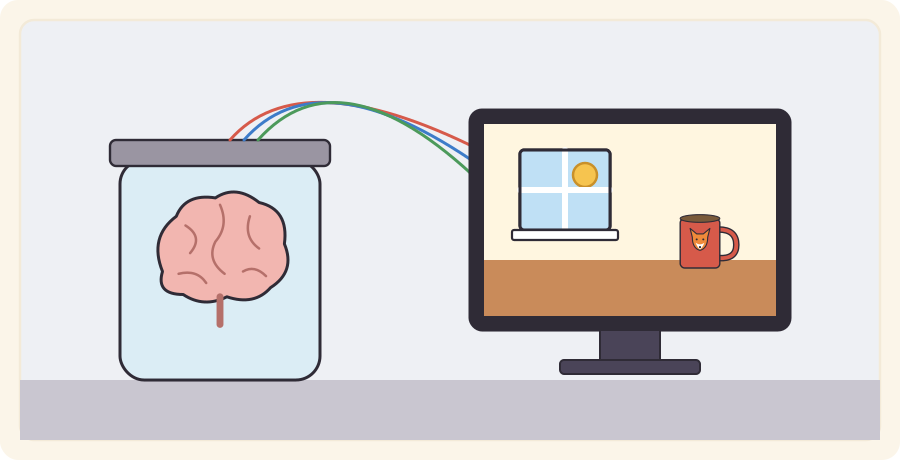
Imagine a scientist far in the future. She takes a brain, keeps it alive in a jar, and connects it to a computer. The computer sends the brain exactly the signals it would get from eyes, ears and skin. The brain "sees" a kitchen, "feels" a cup of tea, "hears" a friend laughing - but none of it is there. Now the hard part: everything you are seeing right now would feel just the same if you were that brain. Can you prove you aren't?
The dream question, sharper
In Knowledge Level 1 we met the dream question: how do you know you aren't dreaming right now? The brain in a jar makes the same question sharper. A dream ends; you wake up and see it was a dream. The brain in the jar never wakes up. Its whole life is the computer's world.
The American philosopher Hilary Putnam made this example famous in 1981 (he called it a brain in a vat). The French thinker Descartes had a similar one in 1641: an evil demon who fools you about everything.
The sceptic's argument
A sceptic turns the example into an argument with three steps.
If I know I have hands, then I know I am not a brain in a jar.
But I can't know I am not a brain in a jar.
So I don't know I have hands.
The same goes for everything else you see. The argument looks valid: if the first two lines are true, the last must be too. So if you want to say you know you have hands, you have to say which of the first two lines is false.
Answer 1: "Here is one hand"
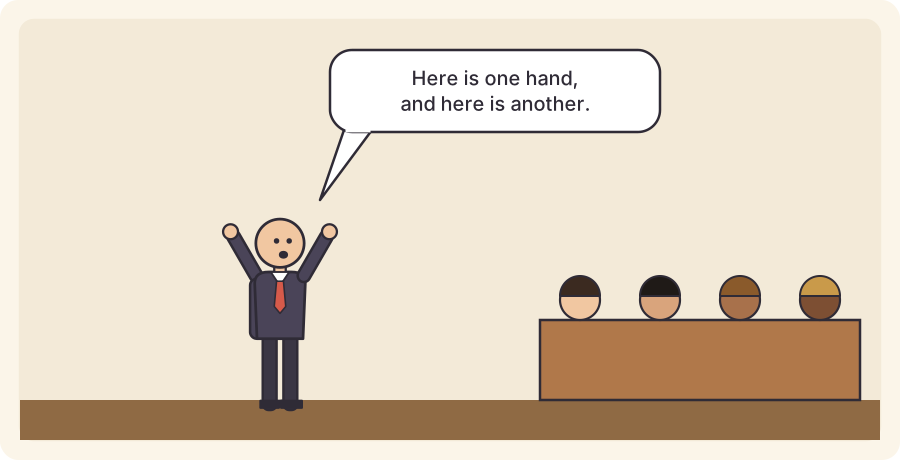
In 1939 the British philosopher G. E. Moore gave a talk. He held up his hand and said, "Here is one hand," then the other: "and here is another." He said that he was far more sure that he had hands than he was of any step in a clever argument. So if an argument says he doesn't know he has hands, it is the argument that has gone wrong. He turned the sceptic's argument around:
If I know I have hands, then I know I am not a brain in a jar.
I do know I have hands.
So I know I am not a brain in a jar.
Same first line, opposite ending. Which way you run the argument depends on which you are surer of.
Answer 2: knowing without being certain
The second answer comes from Knowledge Level 1: we can know things without being certain of them. The sceptic is right that you can't be certain you aren't a brain in a jar. But knowledge never needed certainty - only good reasons, a true belief, and a way of believing that wouldn't easily lead you wrong. On that view, you can know you have hands even though you can't rule out every strange story.
Neither answer satisfies everyone, and the debate goes on. But the sceptic has shown something important: how much of what we know rests on trusting our senses.
Try it at home
- Try to think of a test that would show you are not a brain in a jar. Why would the computer pass it?
- Which do you feel surer of: that you have hands, or that you can't rule out the jar?
- Which answer, Moore's or "knowing without certainty", do you find better? Why?
Words to know
- brain in a jar (brain in a vat) - a story in which all your experiences are made by a computer, used to doubt all knowledge from the senses
- "Here is one hand" - Moore's answer: we are surer of everyday facts than of any argument that says we can't know them
Big idea
The sceptic says you can't rule out being a brain in a jar, so you know nothing about the world. Moore answered that he was surer of his hands than of the argument; others answer that knowledge never needed certainty.