A Closed Circle
Daniel joins an online group for people who bake bread. At first it is lovely: recipes, photos, friendly tips. After a while, he notices something. Every post says the same things about how to bake. When a new member mentions another way, the others reply: "Don't listen to the bakers on TV. They're paid to say that. Only we tell the truth about bread." Daniel stops listening to anyone outside the group. Is he learning more, or less?
Two kinds of closed circle
The American philosopher C. Thi Nguyen pointed out in 2018 that there are two different ways a group can close itself off. They look alike from the inside, but they work differently.
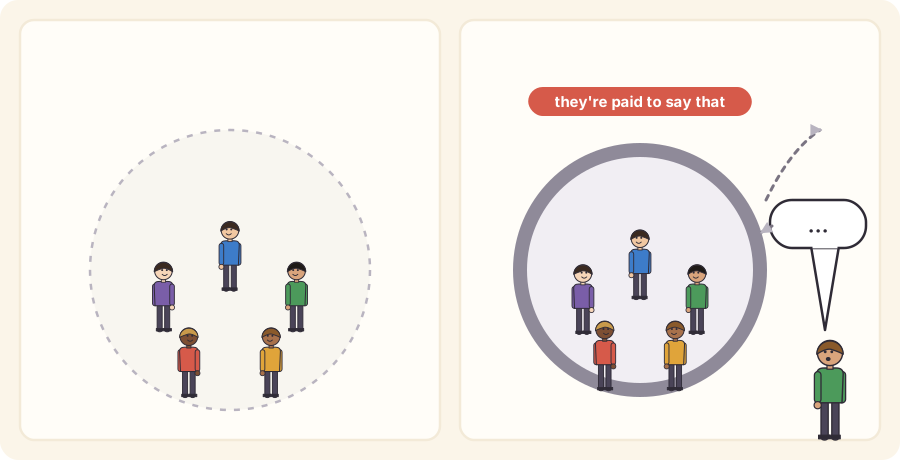
- A bubble. You only hear people who think like you - not because you were told to, but because of who you follow and talk to. Other voices are just missing.
- An echo chamber. You hear the same voices repeated back, like an echo, and you have been taught to distrust everyone outside: they are liars, paid, or fools. Other voices aren't just missing. They are shut out.
Why the difference matters
A bubble is easy to pop. Show the people inside a different view, and they can think about it. They just hadn't heard it before.
An echo chamber is much harder. When someone outside says something different, the people inside already have a reason ready to ignore it: "Of course they would say that." The more outsiders disagree, the more it seems to prove the group right. Everything coming in bounces off the wall.
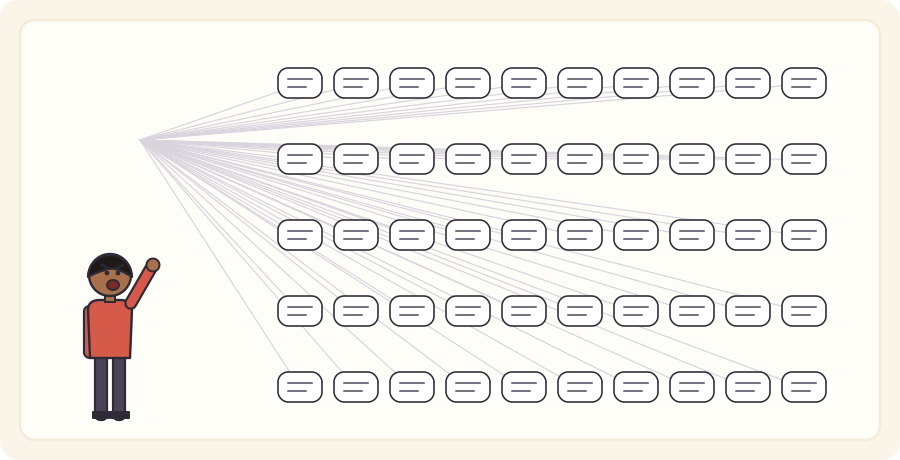
The trouble is that a chamber also breaks something from Knowledge Level 1: independent sources. Fifty members saying the same thing feels like fifty reasons. But if they all learned it from the same few voices, it is closer to one reason, repeated fifty times.
Checking your own circles
Everyone lives partly in bubbles - we all talk mostly to people like us. Echo chambers can form around anything: a sport, a hobby, a school, a way of eating. A few questions help you notice one:
- Do I hear the best case for the other side, from people who believe it?
- When an outsider disagrees, does my group answer their reasons - or only say who they are?
- Is there anyone outside the group whom my group would ever trust?
If the answer to the last one is "no", the circle is closed.
Try it at home
- Think of a group you belong to - a team, a class, an online group.
- Is there a view your group never hears? Is that a bubble or a chamber?
- Find one good source that disagrees with your group about something small, and read it fairly.
Words to know
- bubble - a group where other views are missing, because nobody happens to bring them in
- echo chamber - a group that repeats the same views and teaches its members to distrust everyone outside
Big idea
A bubble leaves other voices out; an echo chamber shuts them out and teaches you to distrust them. A bubble pops when you meet the other view. To leave a chamber, you first have to trust someone outside it again.