A Story Passed Along
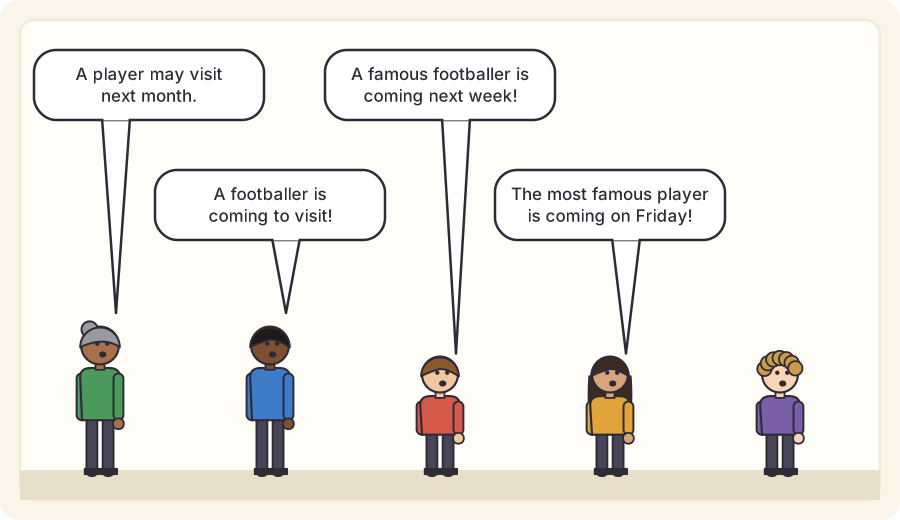
On Monday morning, the head teacher tells Mr Okoro: "A player from the town football club may visit us next month." Mr Okoro tells his class: "A footballer is coming to visit!" At break, Sami tells his friends: "A famous footballer is coming next week!" By lunch, half the school believes that the most famous player in the country is coming on Friday. Nobody lied. So where did the story go wrong?
The chain of telling
In Knowledge Level 1 we saw that most of what we know comes from what other people tell us, and that it works when each link in the chain knew what they passed on. This lesson looks closer at the chain itself - the chain of telling, from the first person to you.
The head teacher heard it first-hand: she spoke to the club herself. Mr Okoro heard it second-hand, from her. Sami heard it third-hand. Each link was honest, and each one changed the story a little: "may visit" became "is coming", "a player" became "a footballer" and then "a famous footballer", "next month" became "next week" and then "Friday".
How stories change
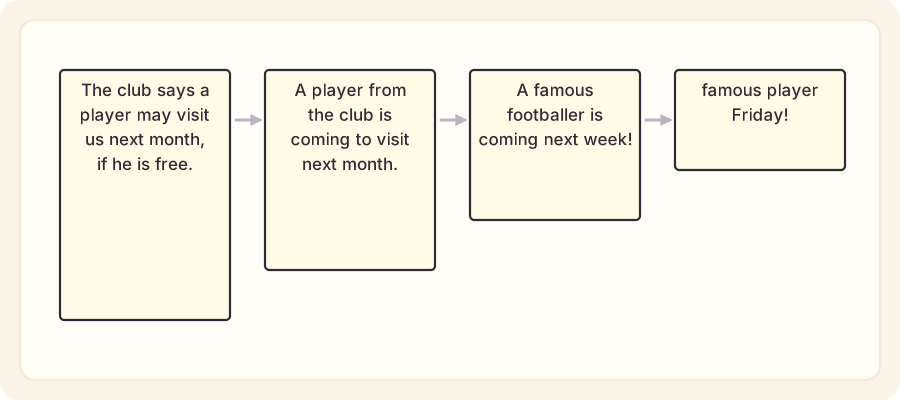
In 1932 the British psychologist Frederic Bartlett tested this. He gave people a strange old story to read, and asked them to retell it to the next person, who retold it to the next. Each time, the story got shorter. Strange details dropped out or turned into ordinary ones, and the story changed to fit what the tellers already expected.
The school's story changed in the same ways. "May" is dull, so it became "will". A visit by "a player" is ordinary, so it grew into a famous one. People pass on what they remember and what makes sense to them, not the exact words.
Checking a chain
So when news reaches you, ask three questions:
- How many links did it pass through? Every link is a chance for it to change. Fewer is better.
- Did each link know what they passed on? Or did someone fill a gap with a guess?
- Can I reach the first-hand source? Sami could have asked Mr Okoro, who could have shown him the head teacher's exact words.
That is also why good newspapers say where a fact came from, and why a careful writer quotes the exact words. They keep the chain short and let you check it.
Try it at home
- Play the passing game with three or more people: whisper a sentence with four details, pass it along, and compare the first and last versions.
- Which details changed? Did the story get shorter, stranger, or more ordinary?
- Think of a piece of news you heard this week. How many links away from the first-hand source were you?
Words to know
- chain of telling - the people a piece of news passed through on its way to you
- first-hand - from someone who saw or heard it themselves
- second-hand - from someone who heard it from someone else
Big idea
News changes as it is passed along, even when nobody lies - it gets shorter, simpler and closer to what people expect. Count the links, and try to reach the person who knew it first-hand.