Beliefs That Fit Together
Nadia is doing a crossword. She isn't sure about 3 across: is it CAT or COT? Then she solves 2 down, SEA, and its last letter is the middle square of 3 across: an A. Now 3 across must be CAT. Later, 4 down, TOP, fits neatly with the T at the end of CAT, and her confidence in CAT grows again. No single answer is the "foundation". Each one is held up by the others that cross it. Could all our beliefs work like that?
Holding each other up
In the Where Reasons Stop lesson, knowledge was a house standing on foundation stones. This lesson looks at the other main answer to the chain of reasons. It says there is no bottom layer. A belief is held up by fitting together with your other beliefs: they agree with each other, they explain each other, and no two of them clash. The more they fit, the better the reason for each one.
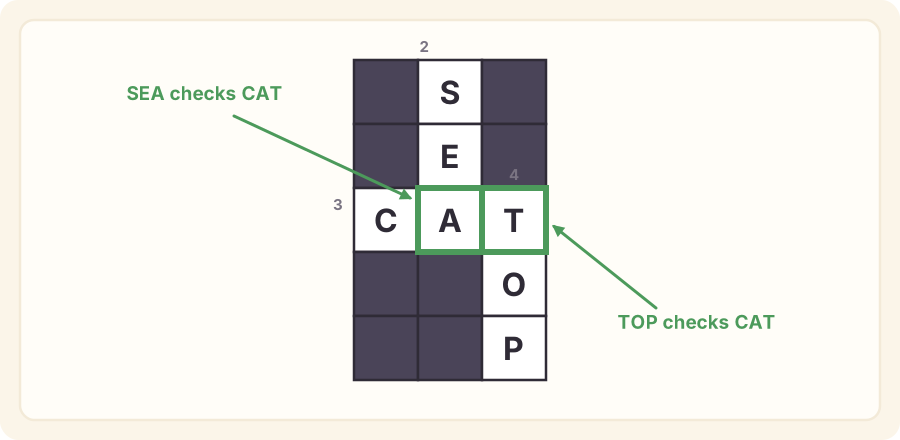
The American philosopher Susan Haack compared reasons to a crossword in a book in 1993. An answer in a crossword is good when its clue points to it and it fits the answers around it.
Think about how you know your friend Ben's birthday is in June. You remember the party in the park, in summer. You remember that it came just after the end of the school year. You have his card on your wall, signed "June". None of these is a foundation. They all hang together, and that is why you are sure.
This answer is called coherentism, from "coherent", which means fitting together without clashing.
A ship you rebuild at sea
The Austrian philosopher Otto Neurath had another picture for it. We are like sailors who have to rebuild their ship in the middle of the sea. They can never take the whole ship into a dry dock and start again from the bottom. They change one plank at a time, standing on all the others while they do it.

That is how we change our beliefs too. When a new belief doesn't fit, we don't throw everything away. We change the belief that fits worst, and keep standing on the rest.
Can a story fit and be false?
Here is the hard question for this answer. A good novel fits together perfectly. Every chapter agrees with every other. A well-planned lie can fit together too. So fitting together can't be all there is - a story must also be connected to the world.
Most philosophers today mix the two answers. Your senses give you some beliefs that don't need other beliefs first, as in the house picture. And everything, the senses included, is checked by how well it fits with the rest, as in the crossword. Haack's crossword already does both: the clues come from outside, the crossing answers from inside.
Try it at home
- Pick something you are sure of about a friend - where they live, their favourite food.
- Write down every belief that supports it. Do they form a line, or a web?
- Now imagine one of them turned out to be false. Which other beliefs would you have to change?
Words to know
- fitting together - beliefs agreeing with and explaining each other without clashing
- coherentism - the view that beliefs are held up by fitting together, not by a foundation
Big idea
Another answer to the chain of reasons is that beliefs hold each other up, like the answers in a crossword. Fitting together matters - but a story can fit and still be false, so it must also connect to the world.