Same Shape, Different Size
When you zoom in on a photo on a phone, the picture gets bigger, but faces still look right. If you pull a photo wider without making it taller, faces look fat and strange. What is the difference between the two?
Every length times the same number
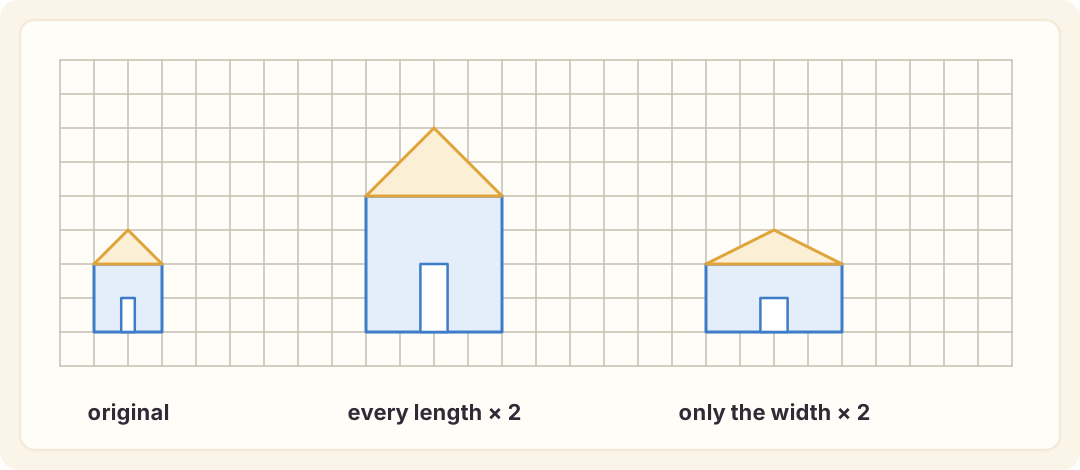
Zooming in multiplies every length in the picture by the same number. Draw a little house 2 squares wide and 3 squares tall on squared paper. Double every length: 4 squares wide and 6 tall, with the roof twice as wide and twice as tall too. The new house has the same shape, only bigger.
Two shapes like this are called similar: every length in one is the same number of times the matching length in the other. Their angles are exactly the same: a right angle stays a right angle, and the roof keeps its slope.
Now make the house only wider: 4 squares wide, but still 3 tall. Widths were doubled, heights were not. The angles of the roof change, and the house looks squashed. It is not similar to the first one.
Drawing to scale
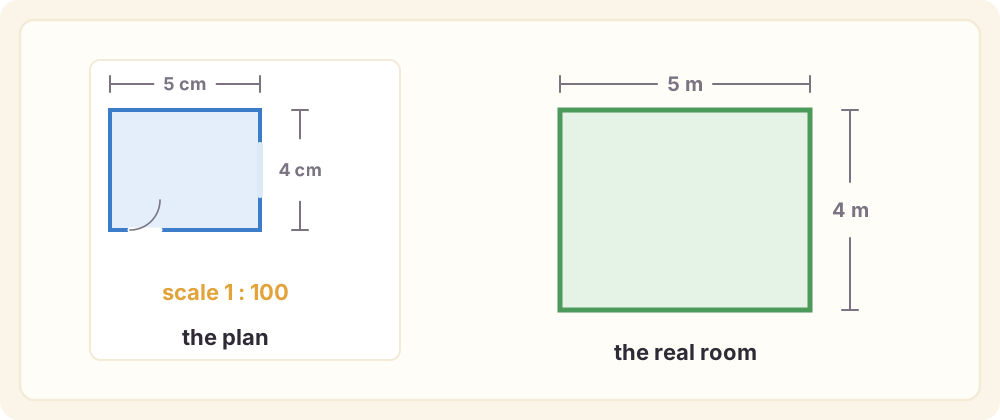
A map, a plan of a house or a model car is a shape similar to the real thing, only smaller. The scale says how many times smaller. A plan with a scale of 1 to 100 means 1 cm on the paper stands for 100 cm, which is 1 m, in the real house. A room 5 cm long and 4 cm wide on the plan is 5 m long and 4 m wide in real life. A drawing made like this is called a scale drawing.
Twice as long is not twice as big
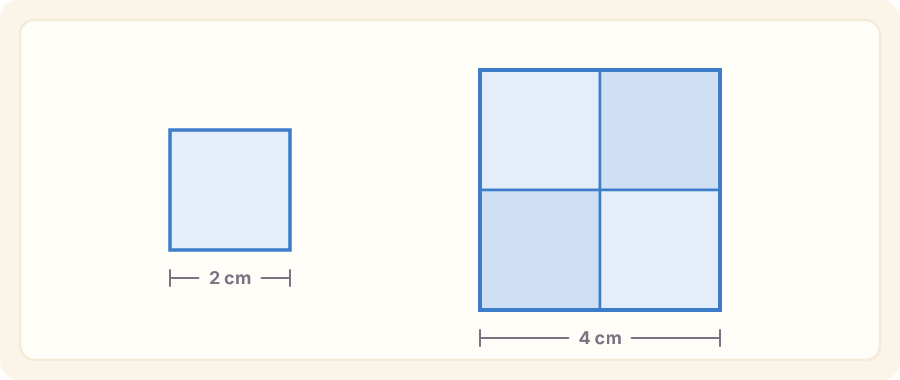
If you double every length of a square, how much more paper does it cover? Draw it and count. A square 2 cm on each side becomes one 4 cm on each side, and four of the small squares fit inside the big one. Doubling every length makes the area four times as big, because it doubles the length and the width: 2 × 2 = 4.
Try it at home
- Draw a shape on squared paper. Draw it again with every length doubled.
- On a plan with a scale of 1 to 100, a table is 2 cm long. How long is the real table?
- Is every square similar to every other square? Is every rectangle similar to every other rectangle?
Answers: 2. 200 cm, which is 2 m. 3. Every square, yes: all their angles are right angles and their sides are always equal. Not every rectangle: a long thin one is not similar to one that is nearly square.
Words to know
- similar - the same shape, but maybe a different size: every length multiplied by the same number, every angle the same
- scale - how many times smaller (or bigger) a drawing is than the real thing, like 1 to 100
- scale drawing - a drawing similar to the real thing, made to a scale
Big idea
Similar shapes have the same shape and maybe different sizes. Every length is multiplied by the same number and every angle stays the same. That is how maps, plans and models work.