Solid Shapes
Look along a kitchen shelf: a box of cereal, a tin of beans, an orange, a dice, an ice cream cone. You can hold each one and turn it round, which you can't do with a drawing. What are these shapes called, and how can we tell them apart?
Flat shapes and solid shapes
The shapes in the Shapes with Straight Sides lesson were flat: a square drawn on paper has a length and a width, and nothing more.
A dice is different. It has a length, a width and a height. It takes up space. A shape like this is called a solid shape. Many solid shapes are flat shapes joined together: a dice is six squares joined at their sides.
The family of solids
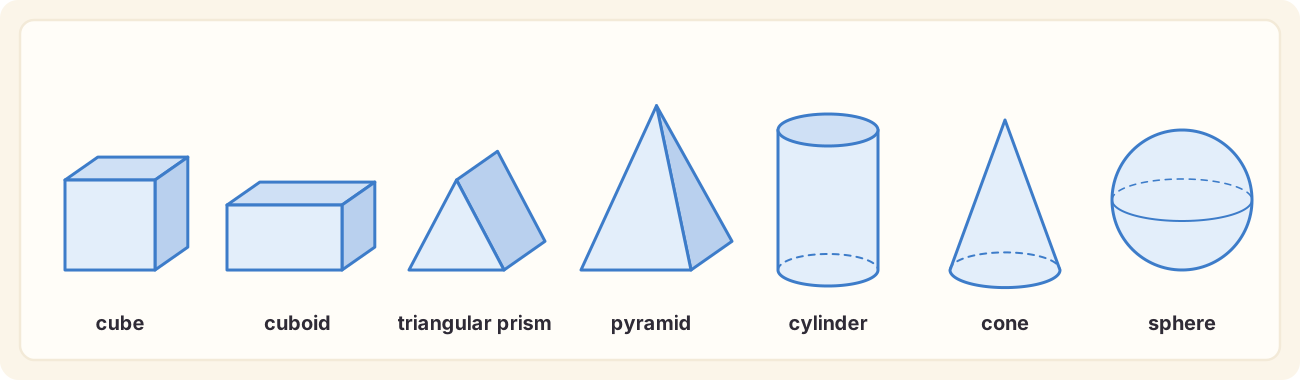
These seven solid shapes have their own names:
- A cube has six square faces, all the same size: a dice, a sugar lump.
- A cuboid has six rectangle faces: a cereal box, a brick, a book.
- A prism has the same shape all the way through, like a chocolate bar in a triangle box (a triangular prism). A cuboid is a prism too.
- A pyramid has a flat bottom and triangles that meet at a point at the top, like the pyramids of Giza in Egypt.
- A cylinder has two flat circles at its ends and a curved side: a tin can, a candle.
- A cone has one flat circle and a curved side that comes to a point: an ice cream cone, a party hat.
- A sphere is perfectly round, the same from every side: a ball, a marble.
Faces, edges and vertices
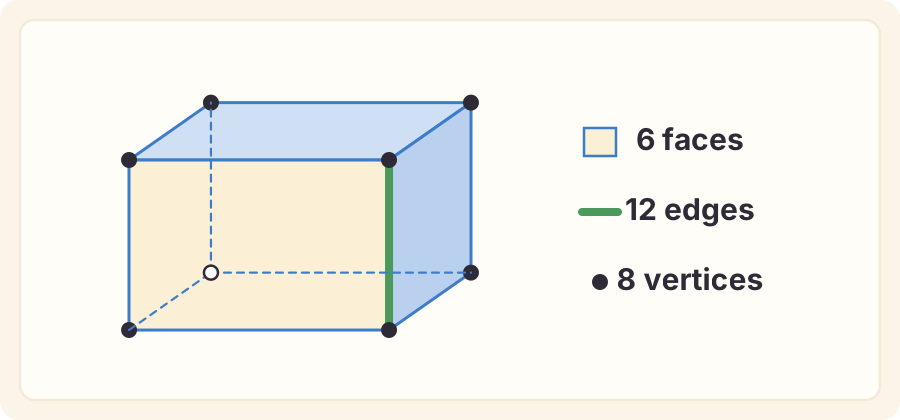
A box has three kinds of parts:
- A face is one of its flat surfaces. A box has 6 faces: top, bottom, front, back and two sides.
- An edge is where two faces meet, a line you can run your finger along. A box has 12 edges: 4 round the top, 4 round the bottom and 4 going up the corners.
- A vertex is a corner where edges meet, a point. A box has 8 vertices: 4 at the top and 4 at the bottom.
Counting is easier with a rule: count the top, then the bottom, then what joins them. A square-based pyramid has 5 faces (the square bottom and 4 triangles), 8 edges (4 round the bottom and 4 going up to the point) and 5 vertices (4 at the bottom and the point at the top).
Some solids have a curved surface. A cylinder can roll because its side is curved, and a sphere is one curved surface with no edges or vertices at all.
Try it at home
- Find a box. Count its faces, edges and vertices, marking each with a pencil so you don't count it twice.
- Find something shaped like a cylinder and something shaped like a cone. Which one can roll in a straight line?
- How many faces, edges and vertices does a cube have?
Answers: 1. 6 faces, 12 edges, 8 vertices. 2. The cylinder rolls straight; a cone rolls round in a circle about its point. 3. The same as any box: 6, 12 and 8.
Words to know
- solid shape - a shape that has length, width and height, and takes up space
- face - a flat surface of a solid
- edge - a line where two faces meet
- vertex (plural vertices) - a corner of a solid, where edges meet
Big idea
Solid shapes take up space. Most of them are built from flat faces that meet at edges and vertices, and counting those three tells shapes apart: a box has 6 faces, 12 edges and 8 vertices.