Parallel and Perpendicular
A train runs on two steel rails. Wherever you stand along the line, in Mumbai or in Madrid, the gap between the rails is the same. If the rails came closer together, even a little, the wheels would slip off. What do we call two lines that keep the same distance for ever?
Parallel lines
Two straight lines are parallel when they always stay the same distance apart. However far you follow them, they never get closer, never get further apart, and never meet.
Look along a long, straight railway from a station platform or a bridge: the rails seem to come together far away. They don't. Far-off things look smaller, so the gap looks smaller too. Seen from above, the gap is the same all the way.
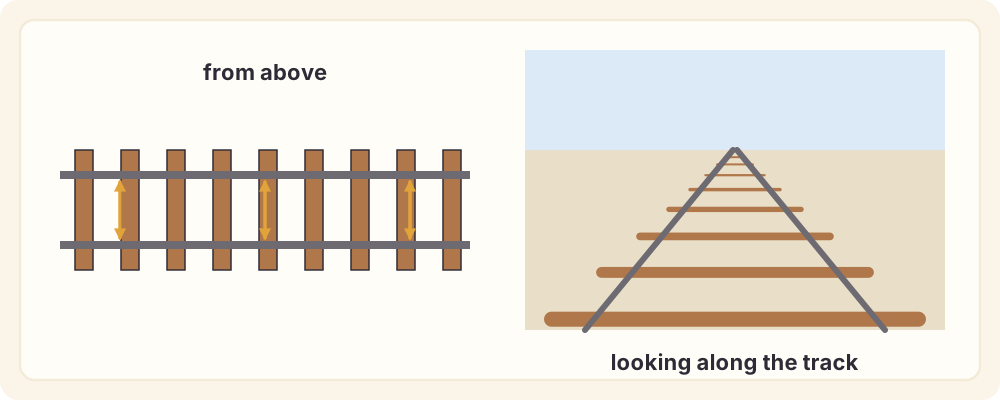
In a drawing, we show that two lines are parallel by putting the same small arrowhead on each of them.
Perpendicular lines
Two lines are perpendicular when they cross, or meet, at a right angle. The two edges at the corner of a page are perpendicular. So are the two strokes of a plus sign, and a flagpole standing straight up from flat ground.
In a drawing, a perpendicular corner is marked with a small square, the sign of a right angle.
Parallel, perpendicular, or neither
Most pairs of lines are neither. The two blades of open scissors cross, but not at a right angle, so they are not perpendicular. And since they cross, they are not parallel either: parallel lines never meet at all.
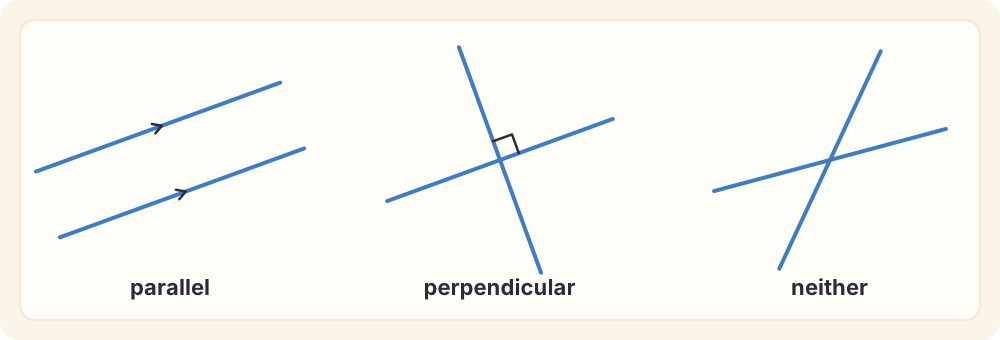
Here is a useful link between the two. Draw a line, and then two lines that are both perpendicular to it, like the rungs of a ladder standing on one of its sides. The two rungs are parallel to each other. The rungs of a ladder, the lines on writing paper and the shelves of a bookcase are all made this way.
Find them in a room
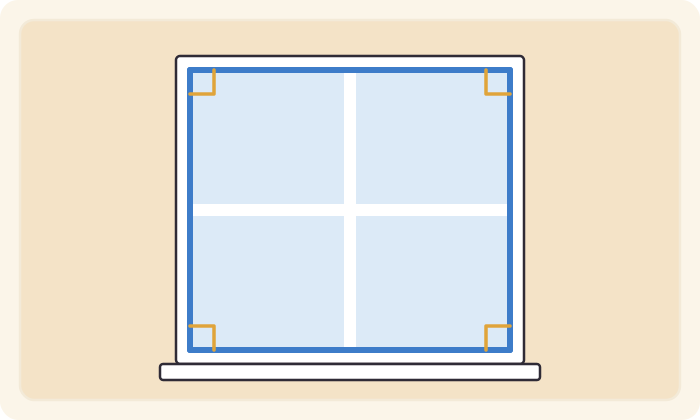
Look at a window. Its top and bottom edges are parallel; so are its two sides. Each side is perpendicular to the top and to the bottom, so the window has four right angles at its corners.
Try it at home
- Find three pairs of parallel lines in your room.
- Find three pairs of perpendicular lines. Check each corner with a right-angle tester, a scrap of paper folded twice.
- Open a pair of scissors. When are the blades perpendicular?
Answers: 1. For example: the two long edges of a table, the lines on a page, the top and bottom of a door. 2. For example: a table's edges at a corner, a door's side and its top, a tile's edges. 3. Only when they cross at exactly a right angle.
Words to know
- parallel - always the same distance apart; parallel lines never meet
- perpendicular - meeting or crossing at a right angle
Big idea
Parallel lines keep the same distance and never meet; perpendicular lines meet at a right angle. Two lines that are both perpendicular to a third line are parallel to each other.