Pi: Once Round the Circle
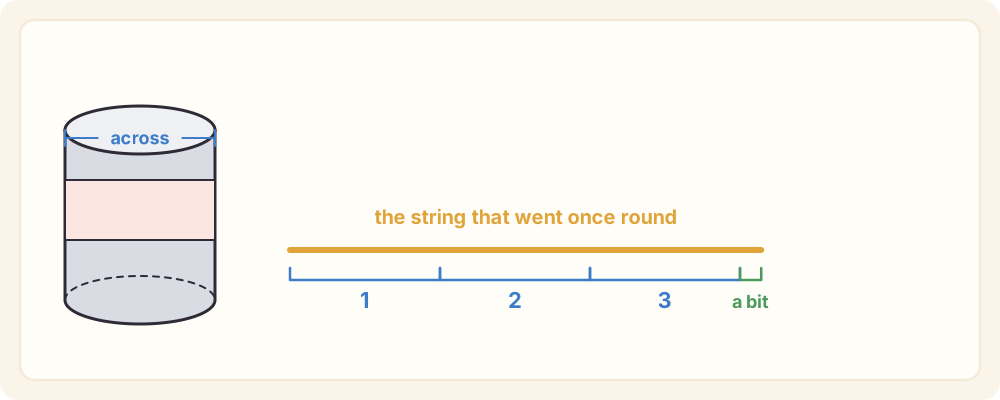
Take a tin can and a piece of string. Wrap the string once round the can, mark where it meets, then lay it straight next to the can's top. How many times does the width of the can fit along the string? Try it with a plate, a cup and a bicycle wheel. The answer is a surprise: it is always the same.
Round and across
Here is what you might measure with a tape measure. The way round is the circumference, and the way across is the diameter:
| thing | across (diameter) | round (circumference) | round ÷ across |
|---|---|---|---|
| a tin can | 7.5 cm | about 23.6 cm | about 3.1 |
| a dinner plate | 25 cm | about 78.5 cm | about 3.1 |
| a bicycle wheel | 66 cm | about 207 cm | about 3.1 |
Small or big, the way round is always a little more than 3 times the way across. Your measurements will be a bit off (string stretches, a tape slips), but every careful measurement lands close to the same number.
Why more than 3?
Draw a circle, and inside it a hexagon (a polygon with six sides) whose corners all touch the circle. The hexagon is made of six triangles with all sides equal, so each side of the hexagon is exactly one radius long. Six radii are three diameters, so the hexagon's way round is exactly 3 diameters.
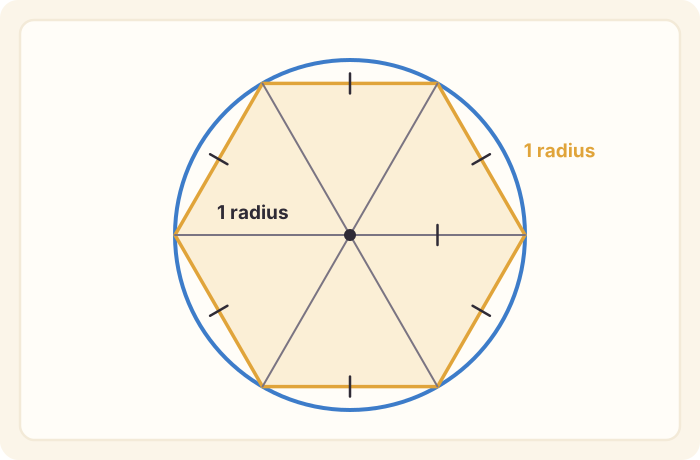
The circle bulges out past every side of the hexagon, so the circle is a little longer: a little more than 3 diameters. About 2,200 years ago, Archimedes, in Syracuse on the island of Sicily, used polygons with 96 sides to squeeze the number between 3.140 and 3.143.
The number called pi
This number, the way round divided by the way across, is the same for every circle. It is called pi and written with the Greek letter π. It is about 3.14. So:
- circumference = π × diameter
- or, since the diameter is two radii, circumference = 2 × π × radius
A wheel 66 cm across moves the bicycle about 3.14 × 66 = about 207 cm, just over 2 metres, every time it turns once.
The digits of π never end and never fall into a repeating pattern: 3.14159265358979... Like the diagonal of a square in A Length No Fraction Can Name, π is an irrational number: no fraction is exactly equal to it. For most jobs 3.14 is close enough. Computers have worked out more than a hundred million million digits, just for the challenge.
Try it at home
- Measure round and across three round things in your home with a string and a ruler. Divide round by across each time.
- A round pond is 10 m across. About how long is the path round it?
- A coin is 2 cm across. Roughly how far does it roll in one turn?
Answers: 1. Each answer should be close to 3.1. 2. About 3.14 × 10 = 31.4 m. 3. About 3.14 × 2 = 6.28 cm, a little over 6 cm.
Words to know
- pi, π - the number you get by dividing any circle's circumference by its diameter; about 3.14
Big idea
Every circle's way round is π times its way across, and π is about 3.14. π is the same for a coin and for the Earth's equator, and its digits go on for ever without repeating.